
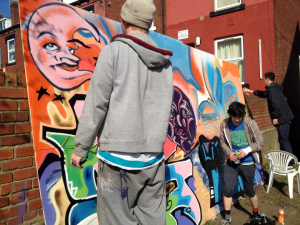
Youth worker and Baptist minister Simon Hall is involved with the Revive community and Left Bank Leeds. He explains why it's very difficult to know where one ends and the other begins.
Revive has been a bit of everything in the past. It was a youth congregation 20 years ago but, obviously, the people have got older and Revive eventually became a church plant rather than a congregation within a larger church.
We moved into Hyde Park, the 'boho', bedsit land area of Leeds because we knew the people we wanted to reach and where they lived. Revive has had its ups and downs, with many mistakes being made along the way, but in many ways we can now see Left Bank as a perfect fulfilment of Revive's original vision.
 Revive saw young, single, people with alternative lifestyles and felt that these people weren't going to connect with traditional churches at all. We wanted to put church in their way and make God more accessible. Well, we haven't seen revival since then but we have seen a few people become Christians and others explore faith more deeply.
In more recent times, members of Revive helped to found a project called Left Bank Leeds, an arts and events venue based in the amazing surroundings of the former St Margaret of Antioch church in Hyde Park.
The building hadn't been in weekly use for some years, although occasional services had taken place there. From the outside, it's not the most attractive of places but inside it's huge; a mock gothic cathedral with a real 'wow' factor. We had funding from the Heritage Lottery Fund and other funders for major repair work which began in July 2008 and finished in February 2011.
The idea was that it would be a centre for arts and culture, for new thought and new ideas, friendly and full of life – which is why we called it Left Bank, after the artistic district of Paris known as the Rive Gauche.
 Half of the people who got behind it were from Revive and the other half from another local church. Left Bank is kind of undergirded by these people, most of whom are still either staff or trustees. There is also a wider community of Christians who ensure that the explicitly Christian part of the vision is maintained – known as the Left Bank God Group, they are involved in the day-to-day God 'stuff' and bits of programming that have a clear faith emphasis. There are about 20 people in the Left Bank God Group and most of them are part of Revive.
The other side of it is that we have got a wider group of people who have been drawn into the community through volunteering, about 200 of them. That's where conversations about faith occur naturally rather than us trying to manufacture opportunities. In the old days, I guess you'd call it an attractional model but it's the building and project which are bringing people together, rather than a service. We don't have to work hard at building community, it's all around us.
A great example of Left Bank programming would be Amazing Graze, our street food and culture festival. We worked in partnership with street food traders and buskers to create a unique weekend event – the vision came in part from the bad experiences of a member of Revive who is a professional busker; we wanted to celebrate the diversity of life on the street and celebrate 'the commons'. In the autumn we'll be working together on a massive Narnia community project – as pioneered by Liverpool's In Another Place. It will involve about 300-400 people, including professional sound engineers, lighting designers and producers wanting to lend a hand. Isn't this what church is supposed to be like with so many people using their gifts – a lot of them Christians, a lot of them not?
 For the next six months, we will all be getting involved in the Narnia project but it's difficult to know where the boundaries are. Revive doesn't meet in Left Bank, it's too big! I live with my family in two terraced houses which we knocked into one and I think we have had about 50 people meeting in there at times. We've also got one or two other places that we go to and we have met in church buildings in the past but that just didn't work for us.
Revive was definitely a young people's and then young adults' church. We have been really blessed in that quite a few of those people are still involved but it's quite hard keeping a church of that type going. Every now and then we'd say, 'Shall we just give it up?' and have a meeting to talk about it – but we kept on going because it's definitely like a family; I can only think of one or two people who have really left.
We are still only about 40 adults and 20 kids even when we are all together but we also have a much bigger group of people from all over the world who, in some way, feel they are part of it.
 We still do the thing that churches do and meet on a Sunday but we also have a strong focus on vocation and small groups meeting around a common purpose. We have:
- book Group which is involved in organising open debates and lectures;
- 'blokes' Group. Someone in the church bought some woodland and is trying to set up a programme to take kids from the city to learn bushcraft skills (this is sort of shared with another church);
- women's Group, a prayer group exclusively for women in the church;
- group for people who are musicians or really into music;
- group for those who want to get involved in Forest Church;
- the Left Bank God Group;
- a very informal leadership group made up of anyone who wants to discuss what we should do next.
The small groups work as a sort of free market. They start and, if they gather people, they carry on. There is no central idea or strategy along the lines of, 'Oh we must have a small group based on…'
When Revive started we had some priming money. Over three years, we were given money from the Baptist Union and individuals were able to make up the rest.
I have never worked more than half time for Revive and, technically, I only work a day a week for them. We also have an organised, admin-type, person who does half a day a week. I would have thought our annual budget is in the region of about £10,000 a year. Thankfully, we have a few people involved who earn good money and they also support it financially.
 Left Bank Leeds is a quintessential social enterprise. There is a charity that owns the building, with responsibility for the faith and heritage side of it. On top of that, we set up a Community Interest Company – which is the new legal vehicle for social enterprises – and that deals with the community and the arts ventures. We also have a commercial arm, renting the space out for gigs, parties, conferences and – in the summer – lots of weddings!
In terms of the future at LeftBankLeeds, there is a long list of needs to improve its facilities. Long term plans at the moment include:
- development of a café bar at the front of the building. People are certainly attracted to the space but, at the moment, it's too big for them to feel able to stop. We want to ensure that there is community there every day;
- continuing to curate a gathered space for all the creatives in the city; we want to be the catalyst to make things happen
For God Group, we are working on two things that people could pray for:
- permanent exhibits that draw people towards God. There are already plans in the pipeline to have the Chartres labyrinth as part of our new floor;
- commissioning other arts that would just give people pause – not as invasions of space but that the space would allow them to consider what life is all about.
We have reached an amazing new stage with Revive. While we have always wanted to reach out the truth is we have always been like a hospital for people with heart conditions – people who have been hurt by church, people who have asked too many questions of their churches and come unstuck – but now they are finding 'real' church again. This has always been the main way that the community has grown and sustained itself.
 At the moment we feel less like a hospice and more like a hospital, where people are actually getting well! We have been quite well known in the past for writing quite melancholy songs, but at the moment we are having to write songs of faith, hope and love because as a community we are finding out feet and want to be more positive.
Left Bank has a chequered history. It is a long time since it was full, if it ever was. Changing demographics in the area – first Irish Catholics, then Pakistani Muslims – mean that there was never a large congregation. And it means that the building doesn't have a place in the heart of the community, even though it is the largest building by some way. Most people who visit Left Bank have never been in it when it was a church, which has turned out to be a great help to us as people don't immediately associate it with religion. This new phase in the life of the building is fulfilling the vision of the original church in new ways, as well as the vision of Revive.
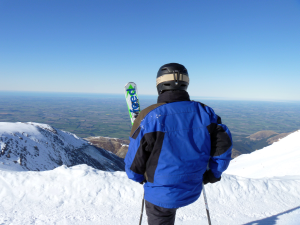
 It started because people come to Methven from all around the world to work in the ski/snowboard industry. Some might be Mt Hutt staff, like instructors, or they may work in the hospitality and catering industry. They need to hear about Jesus! The church very much saw a need in its surrounding area and began a fresh expression to engage with that need.
 The format each week is:
 There was a break of nearly a year between ministers and, during that time, feed. was lay-run – with visiting speakers each week. The church 'really 'took ownership' of feed. and there is still a lot of lay involvement, particularly in getting everything ready, technical stuff (audio visual), cooking, washing up and packing everything away. It's pretty labour intensive, particularly the cooking, as we average about 30-40 people each week but we have had over 60 people at times.
 I am also a chaplain for Mt Hutt and this is a ministry which very much complements 'feed.' in that I am part of the employment support for employees and guests. This means I actively build relationships with the staff, some of whom also come along to 'feed'. Many of them are also 'locals' so the chaplaincy is a community role which allows me to build connections with people in the immediate area.
 We want to reach those not normally reached by traditional churches because 'traditional church' is unattractive to this segment of the community – hence the subtitle under 'feed' is 'Church done differently'.
 Feed. really is a church in its own right. We also run a more traditional morning church in Methven, but it doesn't mean that the people who come in the evening are any different from those who come in the morning; they both get the same spiritual food (my sermons are the same, although adapted to suit the audience). We don't expect people to 'graduate' to traditional church, they are already are 'in church'.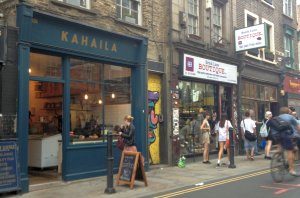
 I could never have imagined what has happened since then and I am in awe of all that God has been doing since the café got off the ground. We have had a very good response from local people and businesses and we are generating four times as much business than we originally anticipated! That is particularly good because we are a charity, so any profit that is made goes into supporting local community projects and other causes.
 Home Mission awarded us a grant in 2011 and others believed in it too, with friends in the Anglican church and many individuals giving cash backing. Kahaila opened its doors to the public in June last year and things have gone so well that the trustees of the project agreed they would not need any Home Mission Support after the end of 2012.
 It took a huge amount of faith on many people's part to get this off the ground – to get the money and to get the building. Then, once it had been transformed into a café, the challenge was, 'How can we make sure it makes money? It's a business and, if the business fails, the mission fails
 At this stage in the life of Kahaila, we are constantly experimenting as to how we build community and relationship through intellectual, creative and social events. A monthly 'bring and share' supper club involves us inviting regular customers to come and have a meal together. The regular programme of activities includes things like origami, a book club and live music and poetry. Much of it develops because someone enjoys doing a particular art or craft, for example, and they ask if they could do it in the café. We just say, 'Do it and see what happens'.
  Kahaila is a 'crossing place' between Christians and non-Christians and, as a model, it demonstrates that the faith community (church) is at the centre of the café and all its activities. As a result, I feel like I have more significant conversations with people in one week than I had in one year working in a church building. What encourages me is that these conversations just happen by being available in the café. There have been so many examples of this, including a Muslim man from a neighbouring shop who came in and asked us to pray for him. So, in the middle of the café, we prayed God's blessing on him in the name of Jesus.
 Another fantastic thing that we see happening is the effect on those working with us at Kahaila. We have a core team of about 20 and I believe that all of us are called to leadership in one form or another. Encouragement of young leaders is particularly important to me and we have seen many of them go much deeper in their discipleship; in their early 20s they are developing ministries to prostitutes in the area, to ex-offenders, to those in desperate need. My role involves looking at how I can release people into the calling that God has placed on them. They then go on to inspire others to do the same.
 I don't see us as being 'radical' in any way I think we're just doing what Christians have always been called to do – which is to go. When the Spirit comes in power it sends us out. So we probably just need to get out of our churches a bit more and start meeting the people where they're at – rather than expecting them to come in to where we are.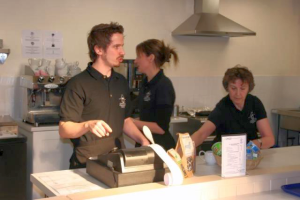
 At the heart of my role lies a conviction that being a welcome, accepting, incarnational Christian presence in the community is key to contemporary ministry. So I spend a great deal of time simply hanging out in the coffee shop, sometimes working behind the counter, sometimes tapping away on my laptop, and often just meeting friends old and new.
 Marriage and Parenting Courses. We have run a number of these courses in the Coffee Shop.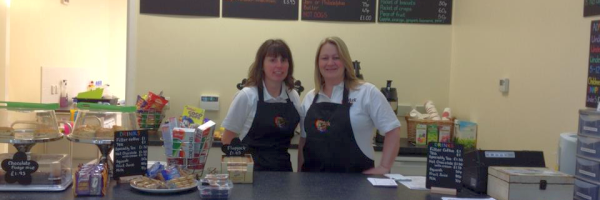
 The Ark opened its doors this month and we aim to help children and adults to talk about God and learn more of Bible stories by providing a safe space in which to explore matters of faith. We look to serve the local communities of Crawcrook and surrounding villages – as well as the wider Gateshead area.
 The playframe has been tailor made for The Ark because we managed to secure the rights to using drawings by popular illustrator and author Mick Inkpen. He's well-known for books like Kipper the Dog and Wibbly Pig but he has also produced many books based on the stories that Jesus told.
 Our church centre manager, in a full-time role, oversees the day-to-day running of the centre and takes the bookings for it but is also very much part of the vision. Janette is like a mission partner because she has to work with our partner organisations as well as supervise two part-time café supervisors. Volunteers help us to run the café and keep a watch on the play centre.
 Of course we have to cover our costs as well but we are working with the council in an effort to access money to subsidise places for the disabled-only sessions. Our business plan shows that the birthday parties are what pay for the building and the café. The idea is that we cover costs so we can be as flexible as we can.

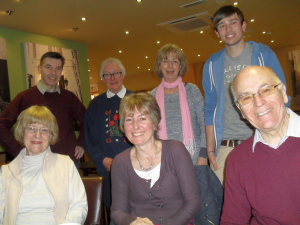
 The cafechurch is now seen as the next move in these ongoing relationships with individuals – and the wider community.
 Keith Miller, another of the planning group, adds,
 A coordinator provides prayer backing, both in the development of prayer partners in each of the link churches involved and on site. A 'dress rehearsal' for young people from local churches was held last week in order to give the planning group an idea of timings and practicalities.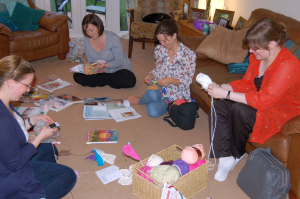
 I have been here for just over 20 months and, in that time, my priority has simply been to get to know as many people as possible. I started by having regular curry nights at my house and, from that, people would suggest different things we might do. This led to 'Stitch and Yarn' which involves people coming together for crochet, knitting or some sort of stitch craft; a cup of tea and a lot of chat. We've also had quizzes, running sessions, picnics and even a 'bake-off' around the kitchens of Roundhouse Park. We are trying to offer as diverse a range of activities as we can but we are still in quite an exploratory phase.
 The café would not only provide a physical focus for activities but, from the very start, be a spiritual hub. For us it's very important that Christian contemplative prayer and prayer stations of some sort would be 'built into' the rhythm of all activities there to give people the chance to explore Christian spirituality in a very familiar setting. It would be part and parcel of what's available and should beg the questions, 'What does it mean to live well? What would that mean to a community of people exploring faith together, meeting in a café space or school?'
 As a giving, supporting, encouraging new community of faith is formed at Roundhouse; that will be 'proper church' too.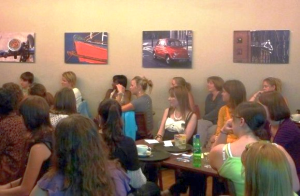
 At first we thought it might be a stepping stone for people moving on to church but we quickly realised that the sort of church our community now called LINK would be prepared to go to didn't really exist. For a handful of people I'd say that LINK is their only contact with Christians and they consider it as a place where you can discuss all sorts of things; however they probably wouldn't describe it as church.
 We are right in town next to the new University Campus Suffolk. We now have pioneer minister Tim Yau working with us, the only ordained person on the team, and we're hoping he will be able to get to know people at the university and develop contacts.
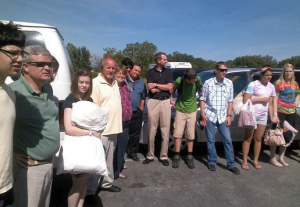
 But Greg is now helping the Graceland congregation to see things differently, going outside the walls of their building to the people not reached by any church.
 This 'one-off' event has become a weekly gathering. Every Friday afternoon, a small group of people, some of whom first met at the original event, get together for church. They meet on Friday, because they (like 30% of people in the US) work on Sundays.