
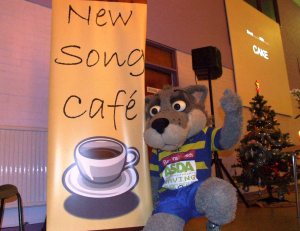
New Song Café has been running at Bold Street Methodist Church, Warrington, for three years. Jackie Bellfield traces its story as a fresh expression of church.
It's amazing to think back to how it all got started and what our intentions were with it. The whole point was for it to be a stepping stone to some sort of gathering in a local Costa.
We did not anticipate that people would come in the numbers they did and we still welcome new people every month to the Bold Street Mission's church hall but we're not in Costa… yet! We're currently up to 125 and we'd struggle to fit more people in at the moment. About 30% of regular attenders now see New Song Café as their church and that number is increasing all the time. It's because New Song Café is offering them vibrant Christianity while creating community, building relationship and providing opportunity to explore issues of faith in a friendly, non-threatening environment.
New Song Café meets on the 4th Sunday of the month from 7pm to 9pm. In saying that, it never starts on time… we have local preachers who come along and point at their watches because people are still chatting to each other and having coffee at 7pm. They say they're ready to start but we tell them that we have already started because the chatting and the coffee and the being together is all part and parcel of it. That's what community is.
In a way, we are a bit unusual as a fresh expression in that the whole thing for us is about focusing on worship as the heart of what we do. Many fresh expressions discern that introducing worship may be later down the line for them in their development because so many people have so little experience of what it means to worship. For us, in our context, it is different.
When people arrive they'll get a coffee or tea and select from what is normally a mountain of cake on offer! They'll have a chat, I'll welcome them in – particularly anyone new, we may have a short video clip or something but then a worship band will lead us in singing 12 songs during the evening. We'll have a giggle and I'll tell a few stories and have a joke with people as we go on because it's important to celebrate people's presence.
 We recently welcomed a special guest – Wolfie, the mascot for the Warrington Wolves rugby league team. People queued up to get a photo taken with him. Everyone really enjoyed that – except for fans of the club's local rivals, the Widnes Vikings!
Our band comprises drums, trumpet, keyboard and guitar. They really get things going and it's fantastic to see all the ages taking part – our oldest regular is 89 and the youngest participant was six days old. We've now got every age in between. There's also a great denominational mix among those with current and previous church links – mind you, some of those links have been very fragile; some have mums or dads who go to church but they have been fringe members themselves. New Song Café has helped them to get engaged on their own terms because of its very open environment.
We'll sing six songs, including two new songs every month, and then we'll have a break of about 25 minutes before singing a further six. In the past three years we have learned over 300 songs. If people are not accustomed to singing in public with others around them, they can be a little puzzled at the start of it all – but that's OK, we'll just give people time and space to get used to what's happening. After just one song, I can guarantee that the feet will start tapping and there maybe tears or they will be singing. People are really responding to the worship and those not linked to traditional congregations or fellowships now see New Song Café as their church.
We need to consider what we do next with New Song Café because we are at the critical stage of thinking about how we move it forward. One thing that is going to happen is that we will grow the New Song network to include a New Song Breakfast to again offer a very different style of church – though still in the context of worship. There will also be New Song Pub Church.
Some of those who come along have been disenfranchised or hurt by traditional church but they are seeing New Song Café as their future. In feedback from them they say they know they can also bring their non-Christian friends along with them because they know it's going to be consistently good and it helps them to start having godly conversations along the way.
There's no doubt that New Song Café is becoming a very loving and caring church. A key decision as things unfold is whether to create New Song Church as a separate entity or continue to operate under the authority of Bold Street Methodist. At the moment we decided to continue with the latter. This has been great and has really enabled us to see mixed economy in action; the established church has been really fired up because they see New Song Café developing. As a result they see the future of Bold Street – now part of Sankey Valley Methodist Circuit – as being more secure because of what we are doing. It really is mixed economy in action.
 I love the traditional, I love the inherited but that alone is not going to be sustainable in its present form for the next 50 years. What will carry Bold Street through is the network of church communities developing. New Song has grown beyond what we ever imagined. Thinking back to the original idea for it all, we might well end up going into Costa and we have an invitation to do so but the next thing is Pub Church in a local bar on a Sunday night.
There are still so many questions of course. How do we grow this? How do we nurture it bearing in mind that some of the people feel disenfranchised with institutional church? How can we adapt our denominational system so that we can be more flexible in structure when things are developing? Could worship leaders, for instance, be licensed to a circuit rather than to a church? At the moment there are quite a lot of challenges around these things and it can be quite frustrating at times.
Sankey Valley Circuit has brought together the former Warrington, Widnes, St Helens and Prescot, and Ashton and Makerfield circuits. Its purpose is to release us for mission and it's wonderful that New Song Café certainly does tell others about Jesus. However, we know that New Song Café is not for everybody and that will also be true when we start up the Pub Church but we're happy with that because we are simply looking to create opportunities for godly relationships.
We have also set up discipleship evenings and between 18 and 25 people now come to that. Thirty five people also came on an away day to explore more about faith. People are being transformed by singing worship to God and the tears of freedom and liberation are phenomenal.
New Song Breakfast is just about to start from 9am to 10.15am at Latchford Methodist Church followed by a traditional Communion service. There will be half hour of bacon butties and then there will be a couple of video clips to prompt a discussion time. The same theme will be used for the New Song Breakfast and the Communion that follows.
Looking ahead, we have been discussing our strategy for future development and 20 people have made a commitment to the New Song Network. We are now exploring the future and are developing a variety of roles in leadership. To be honest, I'm just trying to keep up with it all. We've just given out a New Song calendar detailing what we hope to achieve in 2012. It says, 'Keep calm and pray on!'
 In February we launched a Monday church just for them. United Media Church uses film clips and computer games to teach the gospel message fortnightly on Monday evenings. These meetings, which include a short prayer time and all-important food, take place in an informal 'café church' environment. A variety of films are used and the same format has encouraged some to return to Sunday church as well.
 e now regularly attract up to 16 young people from the ages of 9 to 13, most of whom have been brought along by someone else in the group. That's very good news in that most of those children have not previously had a link with any sort of church at all but the challenge is that we outgrew our original room at Kingswood; it was simply too small for what we were doing.
 They are exploring their faith and the world around them in new ways and it includes things like supporting a youth project and families in Kenya, and sponsoring a child. They have raised quite a bit of money for their charity projects, a sleepover in the church raised more than £600. This is a way of being 'church' that our young people asked for. They also give into a collection every week because the adults do that in the main church and it's important to be reminded that we are part of something much bigger.
 We have always seen this as a fresh expression of church and not a church youth group and we need to keep that focus on being a different way of doing church. Otherwise it could easily become a youth club where you just come along and have a bit of a laugh.
 The church building itself is on the way to a school so many parents walk past St Paul's during the week. Many mums and dads also drop their children off at our church nursery and, for quite a long time, we had seen people standing outside the church in the cold and the rain while on the school and nursery 'run'.
 When people walk in they can go and get a tea or coffee, pick up something to eat from bacon rolls and croissants to waffles and homemade cake and take a look at the Sunday papers. Everything is set up around small tables, there's music in the background and it's all very informal. For the first 15 minutes, we just let them come in and 'be' and I then welcome them from the front – but it takes a while for people to settle down!
 I then explain that people can explore the theme in more detail in various ways. We have various 'stations' set up around the church to help people to do this. A small team got the whole idea of the different stations up and running but they have now grown their own teams to develop the work.
 That all happens for about a quarter of an hour and at the end of that time we then gather everyone together again. Children who have made something show it on our big video screen and we have a final song and then a prayer. It runs from 10.30am for an hour though lots of people do hang around to chat. The response has been huge and it's teaching us a lot about church and being church because it really does attract people who wouldn't come along to the other services.
 For some people in our main congregation it has been a bit of a challenge but they can see the difference it is making. Thinking about the popularity of this form of service with families made me wonder about our context. We are in a commuter belt and many parents work really hard during the week and don't get to see their children very much because they're travelling. If they came to a standard service they would be split up again after 40 minutes when the children go off to their own activities but to have church where the family can all be together within a loving worshipful environment is a different model that seems to fit more comfortably with them.
 None of what we have done is rocket science; most churches have run holiday clubs where they have creative activities and we have done that sort of thing too. It's just putting some of these things together and creating an environment where you are willing to take risks. It's also about being prepared to have 'holy disorder' while keeping that dignity of worship somewhere in the midst of it because there is an element of control that is right and godly.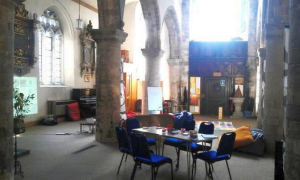
 We were clear from the start that we were not looking for any sort of transfer growth from other youth work in the city or even to reach non-Christian youth with existing church connections. The missional focus was, and is, unchurched youth – though ultimately we are also looking to include people of all ages.
 Two years ago we began renting an office at the back of Mary Arches church in the city centre to use as a café base. That's where we also have a worship service three Sundays a month now. We had decided that we would only start doing worship when we saw someone come to faith; now we have got two people who have been baptised and two further people also become Christians. Our worship time must be the world's most casual and informal because our aim is always to reach young people that don't do church. It's a 60-minute service, half of which involves eating toasted sandwiches! After that we have a video clip, some songs, an activity, prayer and response.
 Our mission statement is 'Unlimited Church – young people encountering the God they've never met and living the difference' but ultimately we need to be church of all ages if we are to be genuinely church rather than some sort of monochrome Christian group. The young people need older people in their lives if we are into discipleship and not just conversion.
 Soon we hope to have the freedom of being a Bishop's Mission Order with the continued aim of converting the young people to Christian culture, not church culture. Lots of churches say they want a youth church but what they really mean is a youth congregation. The BMO evolved when our new converts wanted to be baptised. I asked the Bishop, 'How does that work ecclesiastically?' He suggested becoming a BMO which was wonderful – other churches in the area had initially been rather suspicious of our motives; many were also fearful that we would whisk their young people away. They didn't know if we'd parachute in and then disappear without trace as some sort of parachurch organisation or an outreach. The BMO changes that because it establishes the formal structures needed for right leadership and accountability.
 Up until now I have been serving as half time team vicar in five parishes as well as spearheading Unlimited. However, from the middle of December I will be going full time in this pioneering role. My prayer is that Unlimited becomes a viable church of people of all ages which exists to reach and disciple youth who've never really had anything to do with church before.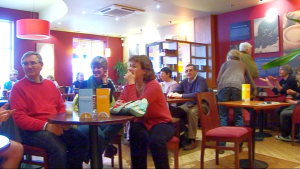
 It was a great success as it developed. People came and the events were of a good quality but then it became clear that many of those visitors were Christians fed up with their traditional churches. They wanted a community that seemed less structured and distant from the established church, even though The Lounge was born out of – and accountable to – a 'traditional' church.
 It was really exciting doing Alpha at Costa as various people would wander in alongside a core who attended most sessions. It was particularly pleasing to have some older teenagers attend. An important step we took was to have a very small tight team and to say to the rest of the Church not to come unless the person they invited would only come if they did. As a reasonable sized church for our area we can easily fill Costa with Christians so we had to be very clear about this!
 At the end of this month, on Sunday 28 August at 5pm we are having our first open 'The Lounge' which will include jazz music, DVD, short testimony and lots of relationship building. It is too early to call this a missional community and a couple from the Church is considering the possibility of taking on the leadership of The Lounge or whatever emerges. We also hope that some of those who were on the edge of Alpha@Costa might come along. We might even consider another Alpha course if that is what is required! These are exciting days. 'The Lounge' might become a pilot missional community but once again we are seeking to listen rather than impose.
 One friend, Rachel, and I met whilst we were at the checkout in the local supermarket one day. She wanted to pray about something and, out of that meeting, came an idea for a monthly breakfast at which people from all denominations would come to pray if they wanted. That group formed the basis 11 years later for Thirst. As we began to pray for the school, other people started coming to faith and getting healed and seeing answers to prayer in their families. We realised this was bigger than us and much bigger than anything we had anticipated up to that point.
 My husband's Ridley friends kept asking me why I was not at Ridley training for ministry as well! I'd reply that there was no chance that I had been called to be a vicar. They used to encourage me to think about it, so much so, that I wondered if there was something that I should not be ignoring about ordination! There certainly was. I have just completed training as a mixed mode pioneer at Ridley, and I'm just about to be ordained with 50% of my time as OPM of Café Church from the Diocese of Ely and 50% spent at the local parish of St Philip's. Somehow God has combined my relationships, family life and calling to a place where he has already been at work. Like Moses, I felt that God asked me to take what was in my hand and use it in a wider setting.
 I went through a phase of being concerned about the views that some people inside the traditional church have of people outside of the church family. The question was asked of us, 'Why don't some of these (unchurched) people come to church?' My response was to wonder why on earth they would! The church is an alien environment for many nowadays. We ask, even expect people to come and sit on a pew and sing songs, followed by a talk or lecture (as they view it). Both of these activities are unusual for many who have never been to church before. I wonder, what on earth possesses us in church to think that others outside of the church might want to do that? It is the Church that is alien in our culture, we are the unusual one, the minority.
 We didn't begin straight away because I was too apprehensive of starting something that did not last once it became official. So, we prayed about it for about a year before we started meeting in the school lounge in November 2006. We served good coffee, food, fruit and juice. Everybody invited friends and we had about 30 people there at our first gathering.
 We do now also have prayer time for those who are interested to pray. After a few months we started to offer one session a week where we have a meditation or devotion of some kind, during this time there is also a five minute talk and discussion on a biblical theme, followed by a spiritual exercise or activity of some type. Because of our relationship and growth together this is natural to people now.
 We wanted people to feel comfortable around Eucharist so I told people, not to worry about it, but that if they wanted to participate they should do whatever seemed comfortable for them. I invited a visiting chaplain to lead and she explained the meaning of each part and action of the service and this helped people to understand the Eucharist. It is always a great time and we and we look forward to it and it's part of our regular worshipping life at Thirst.
 We don't know how Thirst will develop; we don't know what's around the corner. We are wondering about our next step but we know that we need to be obedient to God and follow his leading. Two of the leaders lead an art group and some come to this group who do not feel comfortable in our Friday morning get-togethers. My vision from the start has been for a larger number of small groups, rather than one large group, although of course we are all connected through our relationship networks.
 Belfast's Titanic Quarter is at the heart of the city's regeneration. A few years ago the area was largely deserted, but a large-scale redevelopment programme is transforming it into a 21st century 'urban village'. Chris Bennett is chaplain of The Dock.
 It requires a kind of reordering of your expectations in a new way. It's a process. I was coming in with some expectations which were pretty standard parish-based ideas and it's been fun having that knocked out of me.
 The idea of yet another expression of church in a place where division and sectarianism has caused such problems in the past can be seen as not overly helpful. There are very few working models of how Christians all share a ministry other than chaplaincy – why should it not work in the Titanic Quarter? The variety of needs here is too great to ever be encompassed by one minister or even one denomination. Chaplaincy is helping us to work out shared working in denominations. It's a key that unlocks unity rather than describing my absolute mission statement.
 Clearly the Titanic Quarter, when complete, will be big enough to merit its own local church. But the opportunity runs even deeper than the chance to plant another church along existing models. A brand-new community, in a brand-new part of the city, offers an opportunity to re-envision church for a new cultural context.
 I would see our expression of church as our weekly Dock Walk where we chat about a passage of Scripture as we're on the move, or as we stop, pray, or listen to meditations or music. We use
  As part of our future plans, I also hope to get a boat – that has been the concept right from the start. Quite a few people ask us why, particularly with all of the Titanic associations here, but it feels like we are at the stage where we have done all we can do in coffee shops and a boat would give us an operational base. That means people could physically find us rather than having to rely on a website and a phone number for information.
 As for being associated with the name of the Titanic, we're all accustomed to queries as to whether it's bad taste to commemorate that link at all. In fact the view in Northern Ireland is that it was all right when it left here; it was later on when disaster struck. But for many years there was a real level of shame about it – I actually think there is something of God about the way that everything is tying together in Northern Ireland at the moment. Somehow, the Titanic, from being a thing we never much talked about, is being re-born because it pre-dates the Troubles. For all that it was quite clearly a tragedy on its maiden voyage, the very fact that it sank has stamped its name on history. Many other ships suffered tragedies but the scale of the Titanic's amazing construction makes it unique and people now feel it's right to remember the incredible expertise that went into it. That's why there was such interest surrounding the recent 100-year anniversary of the Titanic setting sail.
 The talk in the corridors of political power is all about Shared Future and Community Cohesion – redefining the existing communities and asking them to change but here we have the opportunity to create a new community that looks very different from our sectarian past.
 Revd James Blandford-Baker, vicar of St Andrew's, Histon, describes how the church's vision to be at the heart of the village community led to the development of Essence.
 We began Essence three years ago in an attempt to offer mothers a space to explore their spirituality alongside the Christian narrative. We had lots of contacts through our children's work but they had remained just that, contacts without relationship. Having looked at a number of courses (such as START and Alpha) it quickly became apparent that we would need to invent something of our own that would connect with people. The driving issues as we put Essence together were the attitude of consumerism, the importance of story and the desire for spirituality.
 When Essence was launched, we prayed for five people to show up on the first Wednesday and 10 arrived. The format worked from the outset; people talked naturally and honestly, sharing their stories and engaging fully with the Christian story. By week three people were exchanging mobile phone numbers; community was forming. Not long afterwards people began to look after each other when they were in need. It is quite normal for a new mother to have meals for the family delivered each evening for a fortnight.
  Of course this approach raises questions about some big issues, including Baptism and Communion. We haven't resolved those issues but are happy to be continuing on this journey while we continue to consider them.
 Essential to the success of Essence has been the team made up of clergy, our lay pastor for people with young families, our children's worker and other lay people who have taken on certain roles. The crèche team give of their time generously; they have a real heart for the mothers as well as the children. They too feel involved in the spiritual journeys of those who come with many conversations about what God has been doing as the mothers pick up their children after the quiet time. The topics for the sessions each week are a mix of ideas from the team and suggestions from those who attend. Unlike on an Alpha course, there is no sense of the need to get through a defined 'spiritual programme'; we go with the flow and find that there are plenty of opportunities to explore all the most important Christian themes and ideas.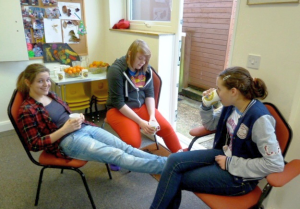
 The research was carried out by groups from within the schools themselves while Christian Research did all the analysis. It mirrored our first research results and also told us that what they meant by 'activities' was really a good place just to chill out and relax, somewhere they could go to play with their PlayStations and Wii. As health and fitness was such a big theme, we got in touch with
  The spiritual dimension is there in all we do because of our desire for God to be at the heart of it all, involved in every aspect of it – and for the glory to go to Him. It is also there because of who we are and the values we apply. They shape and form us into the community we are and what we hope to be. We see these as being Worship, Pray, Create, Learn, Enjoy Abundant Life, Transform, Influence, Give, Celebrate, and Be inclusive.