
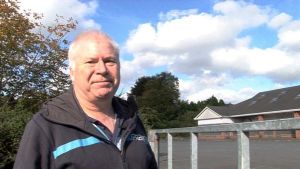
 Boring Wells is a network of fresh expressions of church in and around Belfast. Each has a very different flavour but all share the same vision and core values. Adrian McCartney explains more.
Genesis 26 tells the story of Isaac who pursued the vision passed to him by his father, Abraham of re-opening old wells and digging new wells, sources of life and prosperity for anyone who chose to live close to them.
The collective vision of Boring Wells is to continue the legacy of faith in the Church of Ireland, to re-open old wells in old places of faith and to open new wells where there are signs that a new community could be expressed. The hope is to bring life and the presence of Christ to local communities who may have difficulty connecting with church.
Our ideas of what the church is like are fairly well culturally shaped and even when we apply scripture to them we tend to default back to something like it has always been. Wells is no different mostly. We are trying to be the family of God. If there is any difference it is that we want to be shaped by the mission and by those whom we engage with rather than predetermining the result.
We originally thought that we were to reopen old wells but then we found that we were re-digging wells where the church had gone a bit dead. Since then the main emphasis has been to try and open up new wells.
I am a Church of Ireland minister but I came out of parish ministry in 2003 when the Bishop of Down and Dromore gave me permission to plant a church in a commuter village on the outskirts of Belfast. We quickly discovered that trying to do that among unchurched people just didn't work in that area.
 I had taken a year to recruit a group of people. Initially there were 35 of us who started meeting in a pub in Moneyrea. We organised a Sunday service but not one unchurched person ever came to it! We threw everything at that service; we had projectors and sound and lovely coffee and nice things to eat. We also had lots of visitors from other parishes, saying, 'O we'd love to do this' though there was always the underlying thought, 'This just looks like we are moving the existing church around.'
Then we read the Mission-shaped Church report and we began to consider how we do church and it became something that wasn't quite what the bishop or any of us had expected. Questions like 'when are you going to build the buildings?' became irrelevant. We had to say that we weren't going to be doing it that way any longer. Defining ourselves in a way that can be accommodated within a diocese when we cross parochial boundaries, and even diocesan boundaries, has been an ongoing challenge both for us and the diocesan head office.
Our main problem was, and is, that people find it difficult to recognise anything except the parish. We don't have the equivalent of a Bishop's Mission Order in the Church of Ireland so most people see us as something between a parish and a mission agency. The way we have moved forward is to become a company limited by guarantee with a charitable basis. We have a board of directors and have to submit our audited accounts to the Charity Commission. This allows us to have charity number but it doesn't give us any status within the Church of Ireland even though we would very much like to be part of the diocese. Representation at Synod and financial support are ongoing discussions.
Five wells, our attempts at creating mission shaped communities, go to make up the Boring Wells network. We found that people had a sense of call in different sorts of areas – not geographical as such but among certain groups of people. The wells each decide how they express church individually but we have a general sense of how the whole family of Wells expresses their love of God together. The wells are called Tinys, Resound, Shankill, Elk and Networks.
 Within a year of us starting, we set up Tinys. It all happened when we were running that service in the pub; one night we simply came across a crowd of teenagers drinking on the windowsills of a row of shops. In time, we rented one of the retail units as a coffee shop for young people; there was no way those youngsters would or could transfer to the Networks church – then known as Moneyrea Wells. We needed to let them do something to express their experience of Christ where they were in their own way. That was quite a learning curve for the first group of people who had thought that what they were originally offering was a fresh expression of church only to discover that something very different was happening with the people who actually lived in the place.
We released some people to go and make Tinys their spiritual home. The original group of people now call themselves Networks. They have a non-local sense of connecting primarily with their natural contacts in work and through friendships. Members of Networks are now praying about the possibility of gathering somewhere closer to the city.
The bishop gave me an opportunity to work in two inner city parishes part-time. These small congregations are very elderly but we have found that the Networks group (about 30 of them) have been very supportive of those congregations who have actually come to like them.
Resound was originally a small outreach in an interface community comprising two working class estates on opposite side of a main road in Dunmurry on the outskirts of Belfast. There are two large secondary schools, one Catholic and one Protestant, and some community facilities that have been made available to Resound for youth activities. In the summer we have a fortnight of non-stop activities; the first week is aimed at primary school children – this year we had 400 children and young people every day with 73 leaders. In the second week we had over 100 teens daily. The regular Resound meetings, comprising a Sunday night session and drop-in stuff during the week, are organised by the late teens/early 20s.
 The Shankill well is all about people serving in the area, a place at the heart of sectarian paramilitarianism. The Summer Madness festival started Streetreach to offer an opportunity of service to the community. Every summer for five years we used to take teams of people to do street cleaning and gardening in different parts of the city. Growing out of that was a group of people who had a strong sense of call to go and serve in Shankill itself. One couple have moved to live there.
Shankill well has a meal together every Monday evening. They are trying to be very simple in what they do, developing friendships from around the area and trying to incarnate the gospel in natural ways.
Elk well meets in my local pub in Dundonald, not far from Stormont. Our team get together on Thursdays to join the weekly quiz night. Friendships have grown and relationships have developed in a away that has allowed for many opportunities to share in prayer and care for this growing group of people.
All of our network team leaders are pioneer types and so are now really struggling with what to do when communities do start to grow. Launching out in mission has an excitement about it. Discipleship and pastoral care are the balance. The challenge for this autumn is come up with a better support system for those who make up the mission teams and the new family members who are becoming part of us. We presently organise a monthly gathering for worship and teaching supported by resources for small groups. None of this is easy and everything always feels quite fragile. As St Paul said, 'I am certain that He who began this good work in you will bring it to completion…' I pray that the Lord will help us to keep going.
 St Augustine's Church pioneered the
  Once in contact with the Centre, individuals can connect with the Christian community through our many expressions of worship, spiritual practice and community life: Ambient Wonder (alternative worship community), weekly Christian Meditation group, learning events, Sunday morning services, small groups meeting in people's homes and local community projects.
 The problem is that churches today are finding it difficult to find a niche within contemporary society. What we see as part of the solution is that many such churches fit naturally into some part of the contemplative tradition and there is a hunger in contemporary society for 'spirituality' or the cultivation of a sensitive and rewarding relationship with eternal truth and love. These churches could institute local Christian Meditation Centres to teach the contemplative tradition, and so appeal to those in search of spirituality. In support of that vision, a book is about to be published which includes all the contents of the Developing Consciousness course.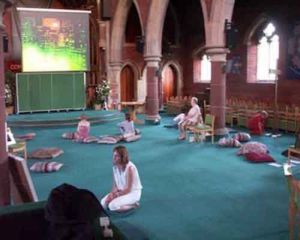
 Three of the highlights of the past year have been:
 Jon and Jo Soper tell us the story of Exeter Network Church, in the Church of England Diocese of Exeter. This network church is soon to make history as one of the first fresh expressions of church to become a Church of England Bishop's Mission Order. Jon and Jo explain all.
 Many networks are social networks where you bring friends – salsa, surfing, poker; some are social action networks, such as the team which visits Dartmoor prison once a month; some are age related (children, teenagers, young adults); some are orientated towards discipling Christians, and a few are geographic, such as 'God and Chips', who showed Alpha DVDs in a chip shop during opening hours.
 At our last event we held a 'big giveaway' (instead of selling) at the car boot sale, which gave rise to interesting conversations, as well as having a team of people praying for people in the high street, cafes, and another team going to the prison. Some in ENC use 'Edge Sunday' to do their own personal blurred edge activity, like inviting their neighbour round for lunch which they have been meaning to do for months.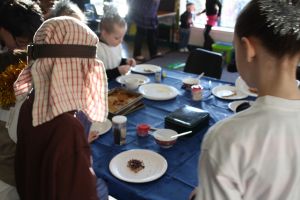
 We had a trial run at Wilmcote House on four successive Sundays earlier in the year. As a result of that, one family – who live in Wilmcote House – decided to join us. At Christmas we had the Wilmcote House Nativity. All ages were welcome and children had the chance to dress as an angel or shepherd to hear the Christmas story, enjoy a free breakfast and take part in some craft sessions.
 A fresh expression of church that is 'fuelled by coffee'… Matt Ward, a chaplain at the University of Leeds, takes us behind the scenes at Emmanuel Café Church.
 Café Church operates in 10-week bursts during term-time. Obviously, as we operate in a university environment, we always miss the major festivals. That's a bit of a challenge for a church community… but there are still ways to celebrate 'together', even when we're not in the same place at the same time.
 Every year has seen quite a sense of growth in the life of the church, and in the lives of those who have come and found faith or confidence in their faith. My hope for the future is that Café Church continues to be shaped in a way that serves the needs of the students who come in and reaches out to students who don't. If it looks the same in 12 months as it does now, it won't be doing that.

 B1 continues to be a community that seeks to reach out to the unchurched and dechurched within the city centre of Birmingham. Significant developments over the last few years have included the Breathe project and a 'recasting' of our vision and values.