
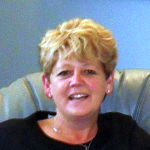
 Hope Cirencester opened The Upper Room in 2008 with the aim of reaching out to people who had never been to church to show them that Jesus loved them in a way they could understand and relate to. Leader Kim Hartshorne tells how a cup of tea and chat can lead to a world of opportunities.
We provide a welcome and a place of acceptance. We felt that society has become quite fast moving and many people are isolated, not heard or noticed by anyone, especially those who are vulnerable. We felt Jesus would want to welcome them and so we became his hands and feet for that. We try to demonstrate Jesus' love for people – that they are each unique, valuable, precious and made in God's image.
Listen to Karen Hartshorne discuss The Upper Room with Karen Carter.Read the transcript
We run a drop in space called The Upper Room above a shop in the Market Place, Cirencester. This is open on Monday and Friday mornings and that's when we listen and welcome everyone with a cuppa. We run meditation classes, eat out together and support local people and charities. Many people who find their way to us have never had any background in church and so we gently offer to pray if they have a problem, explaining that Jesus does care about the small things of daily life. We try and chat in a relaxed way about what the Bible says, but always offering space for disagreement or conversation. We are helping people start their faith journey and travel alongside them as it develops.
 We have seen some amazing answers to prayers small and large. It is noticeable in the past year however that we have seen our visitors suffering greater pressures than anything we've seen before in the areas of finance, family issues and mental health problems.
As a registered charity, Hope Cirencester's aims are to show the love of Jesus and alleviate need and distress in Cirencester and elsewhere. It all started when a group of us we were praying for our town and we were really hoping to take church out onto the streets and just get involved in a missional 'day to day' sort of way with our community. We were praying for a building on one of Cirencester's estates but we didn't find one so we kept on prayer walking and calling out to God, 'Where do you want us to do this?'
Eventually an estate agent contacted us to say they had a set of three rooms right in the market place so we asked him for the keys and brought a team of about 12 people here, including some church leaders from other churches in the town. We prayed in the building for the morning and very much sensed the presence of God here so we felt that this was the place to be.
The Upper Room is accessible to those who wouldn't necessarily do traditional church because they feel it wouldn't be for people like them, saying it's only for people who are clean and neat and have nice clothes and drive big cars or whatever. A lot of our visitors are homeless or people with addictions, severe depression or mental illnesses, those who have perhaps suffered abuse in the past, people who just find it very difficult to access things that they just consider to be for the well-educated. Perhaps church is too 'intellectual' for them and they need to 'see' the Gospel demonstrated practically in order to grasp it.
 So they come in for a tea or coffee and to talk to us about what's going on in their lives. We offer to pray with them, signpost them to other agencies, and go with them where they need to go or advocate for them if they need us to. Social justice is really connected to the gospel and so when Jesus comes to someone, you would expect to see changes in every area of their life – and that's why we just try and look at where Jesus really would begin to work in their life and we follow on from that. For example we have supported mums learning to read for the first time, sent someone away on holiday for a break, we supply starter boxes to people moving into a refuge and fill up flasks of coffee for homeless people in the town.
The Message translation that says, 'The Word became flesh and moved into the neighbourhood', is talking about Jesus transforming whole neighbourhoods when he comes. So we work really collaboratively with all the other churches, charities, Citizens Advice, local council – everybody that will have a connection with us in order to go and try to build bridges for the sake of the Kingdom.
I'm inclined to say The Upper Room is like a mini branch of social services combined with a prayer room and a coffee shop; just like the church in the Victorian era built schools and eradicated slavery, and Anglo-Catholic revival 'slum priests' ministered to the poorest people. Instead of a binary way of thinking that is 'either/or', for us, it's 'all/and'. That to me is a sacramental view of life – everything belongs to God and so we are 'being' church in everything we do.
 We don't have a Sunday expression at the moment but it seems that the Spirit is leading us to consider that and we're really praying and brainstorming and just waiting on God to see what will bubble up. I'm sure something is coming, we don't know what it's going to look like yet, our team is still waiting – but God has gone ahead of us and has a plan.
Our people seem to want things that lead to belonging, they want to be together with each other and be together with us so people will say things like, 'Why don't we go out for a curry?', 'Why don't we invite some people in?' or perhaps we'll have a birthday party for someone. On Easter Sunday we gather at my home for a BBQ to celebrate our belonging – to Jesus and to one another. We're open to all of that because belonging is a big deal in today's society; belonging is such a huge part of faith to me and if we can help people to belong and to feel safe, to join in community and in family together we'll have already done so much of the journey towards the gospel, towards Christ.
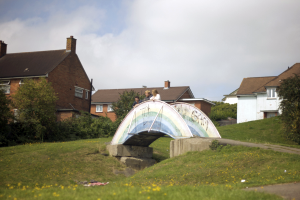
 The Lab was initiated by the Bishop of Monmouth five years ago in order to develop a church community of students and young adults in Newport who would otherwise not have contact with a traditional parish church. It involved trying to be church in a different way. At first we used to meet in a pub but now our gathering takes place on Sunday evenings in the hall of St Paul's City Centre Church in Newport City Centre. We also have a weekly community meal in which people take it in turns to cook and serve each other.
 For instance, the parents of younger children in the area asked us if we could run some sort of summer holiday club. We did, and lots of families came along to join in. As a result we've had a lot more contact with the mums and dads.
 One of the challenges we have encountered is people being interested in spirituality and faith – but as individuals not as part of a group. We think that perhaps this is the direction youth culture is going, as we seem to be meeting lots of young people whose reliance is not on a particular friendship group.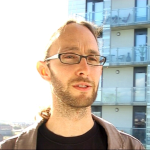
 A docklands regeneration project in Glasgow is now home to hundreds of people – and The Glasgow Harbour initiative known as authentic (?). Church of Scotland minister Alex Smeed, one of the authentic (?) leaders, explains how churches in the area set it up in response to a call for new ways of 'doing' church.
 The audit firstly focused on qualitative data which included us intentionally spending time in the area itself to try and ascertain who the residents were, what kind of culture they came from, what hours they kept and where they worked.
 Some of our team moved into a flat in the harbour to have a place on site where people could be invited for a meal and generally practice hospitality. We continue to explore ways in which they can gather people together, including the launch of our authentic (?) curry house as a 'pop-up restaurant' and the development of a greater internet presence in order to promote online community.
 As authentic (?) we're also looking at things like having a regular running community. We would also love to offer free, organic, fairly traded beautiful coffees to people as they leave for work in the morning. All these sorts of ideas are things that we are pursuing, we believe in a God who blesses and so we want to pursue that, we want to embody that in everything we do.
 We are doing all of this hand in hand with other Christians in this area so that we can be as effective as possible, living out the unity of that body. Part of our vision is to see people reconnected with God, seeing that relationship restored and so we're going to be intentional about the way that we invite people to experience God, to live a life that is transformed by a relationship with him. It's about having the integrity to talk about that, to invite people into a place where they can explore in a contextually relevant way what it means to follow Jesus in this area.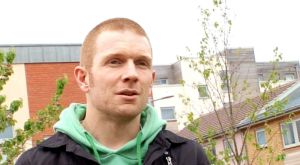
 It used to be an industrial heartland but the Dartford Bridge area became ripe for redevelopment and housing schemes began to spring up on Thames Gateway sites previously dominated by factories and business. The Beacon came into being when the local Methodist Church appointed Bart Woodhouse as lay leader of a new church plant team.
 As more and more people began to move on site, I was very keen to start a Residents' Association. We put letters through people's doors and organised an informal meeting in one of the new buildings; about 40 or 50 people come along to it.
 We then stumbled on the national Big Lunch initiative which encourages communities to get together for food and activities. We had a very popular tug of war, a bouncy castle and a barbecue. We also got local people to bring along some home-made food that expressed something of them and their background – a kind of signature dish. As a result of that we had goat curry and many other wonderful things! About 60 or 70 people come which, from the small community that we are at the moment, was quite a big proportion of the people here.
 We had quite a small group of people with us when we started and now there is about nine and 10 on a core team. They all have a real sense of call to be doing this kind of work but we are learning again what it means to be community and what it means to be church together. We've also got quite a large and growing fringe group and we are using things like the Y Course and other things to encourage that fringe to maybe explore the Christian faith and then hopefully transition into the cell life of the church.
 We meet on a Tuesday evening in cell groups – or Beacon groups – and then on one Sunday in the month we all have a big meal together, maybe with some sort of interactive prayer time. The Dartford Bridge Learning and Community Campus has been built on site and we have a room there which is just the right size for us. We also launched a celebration service at the new school on the Bridge Development in January.
 There are a number of challenges that I think we face in trying to shape a full and healthy Christian community here. One of them is that I'm a lay person in the Methodist Church and so I'm not able to preside at the Eucharist meal. I think there needs to be a real integrity about these new communities we're forming in being able to celebrate that meal – and all that it means – together.
 I wasn't sure if it was just me or if the other women felt the same so the first thing we did was have Women Who Lunch and Pray and I asked a small group to come together early last year for lunch to talk about some of the women we cared about and think about the type of leisure activities we could invite them to.
 People seemed to go for the whole thing immediately. The venue we use is licensed and I think we set the tone by inviting them to bring whatever they wanted to drink. There are always ethical issues around these questions of course and we don't go so far as to provide the drink but we felt it important that they could bring in a bottle of wine if they wanted to. So far we haven't had any problems with this, people seem to respect what we're doing and only drink in moderation. If it was causing any sort of distress, we would obviously think again.
 Bollywood Nights featuring Bollywood style dancing was another one that made the programme. It featured the testimony of a young woman, a Muslim convert to Christianity, who told us some of the complications that decision had brought about in her life. People were really moved when they realised the personal cost of being a Christian; that was the event when people started saying it was 'their'church. There had always been relationship stuff going on but that event was certainly a turning point.
 A core group of seven of us is involved in the planning; there is a big denominational spread as we operate across a joint benefice. There are lots of us who are very conscious of the very worldly things around which we are weaving Christian themes in our events. Divine Divas doesn't seem to be a clear bridge to bringing people into church because, for some of them, Sunday church is not appropriate or convenient for them or they don't really relate to it. At the moment Divine Divas seems to be developing a community in its own right but it's very much at early stages.
 Some of the more mature members of my traditional congregation are now coming along to Divine Divas and thoroughly enjoying it. People have been very supportive and they're just genuinely pleased to see people involved with church in its wider sense.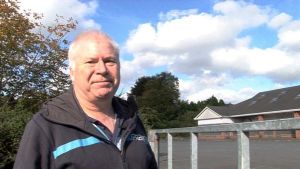
 Boring Wells is a network of fresh expressions of church in and around Belfast. Each has a very different flavour but all share the same vision and core values. Adrian McCartney explains more.
 I had taken a year to recruit a group of people. Initially there were 35 of us who started meeting in a pub in Moneyrea. We organised a Sunday service but not one unchurched person ever came to it! We threw everything at that service; we had projectors and sound and lovely coffee and nice things to eat. We also had lots of visitors from other parishes, saying, 'O we'd love to do this' though there was always the underlying thought, 'This just looks like we are moving the existing church around.'
 Within a year of us starting, we set up Tinys. It all happened when we were running that service in the pub; one night we simply came across a crowd of teenagers drinking on the windowsills of a row of shops. In time, we rented one of the retail units as a coffee shop for young people; there was no way those youngsters would or could transfer to the Networks church – then known as Moneyrea Wells. We needed to let them do something to express their experience of Christ where they were in their own way. That was quite a learning curve for the first group of people who had thought that what they were originally offering was a fresh expression of church only to discover that something very different was happening with the people who actually lived in the place.
 The Shankill well is all about people serving in the area, a place at the heart of sectarian paramilitarianism. The Summer Madness festival started Streetreach to offer an opportunity of service to the community. Every summer for five years we used to take teams of people to do street cleaning and gardening in different parts of the city. Growing out of that was a group of people who had a strong sense of call to go and serve in Shankill itself. One couple have moved to live there.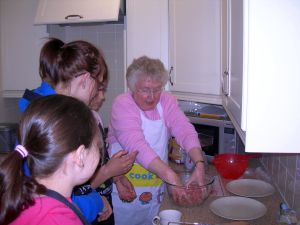


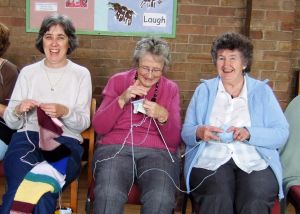
 A fresh expression of church for knitting fans in Ellesmere Port has inspired several similar groups to pick up the needles and wool. One of the organisers Mrs Chris Crowder tells how the original vision has blossomed.
 It wasn't long before we had so many members we had to move to the hall and now our members meet every Tuesday afternoon in term time from 1.30pm–3pm. Over the past two years, have posted off more than a quarter of a tonne of knitted jumpers, hats, scarves and blankets to people in need at home and abroad. These have included the homeless, lonely, ill and bereaved of Chester and Ellesmere Port. We have also sent goods to South Africa, Haiti, Kosovo, Nepal, Kenya, Bulgaria and Eastern Europe, as well as having the pleasure of being able to knit for children by name at an orphanage in Swaziland.
 Knit and Natter isn't just a knitting club making clothes for charity – it is a fresh expression of church which works on many different levels, giving people a purpose in life and sending God's love around the world. There is no doubt at all that many of our members see Knit and Natter as their church, they recognise the fact that we are meeting together in community and God is there.
 Knit and Natter has inspired people to start similar groups in Northolt, Bromborough, Lymm, Kettering, Little Neston, Heswall and Chester. The latter is an Anglican group that is going to approach the Methodists to see if it can be run jointly – again strengthening bonds between churches. We have even been Club of the Month in Simply Knitting magazine!
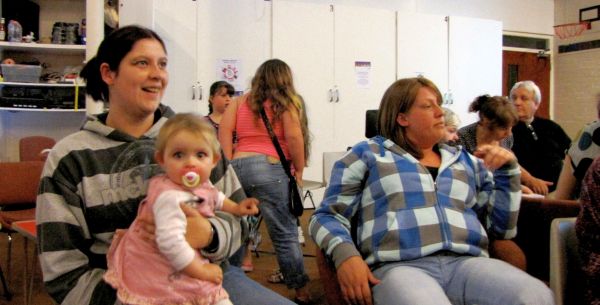

 Growing leaders and helping people to achieve their potential was something that underpinned everything. Elaine Lindridge was our leader at that time and she helped us through a major transition in 2008 when many members of the Mind the Gap – who were also involved in their own local churches and doing too much as a result – were released to go back to those fellowships.
 A worship leader will start up at about 5.30pm and we'll go through to 6.30-7. There are no set rules as to what happens but generally there is a speaker or people sharing what has been happening for about 10minutes. At other times we'll use the NOOMA DVDs by Rob Bell to prompt discussion; on other occasions we use songs and projected words.
 Those who have committed to cell have grown a great deal in confidence and are prepared to do more and more things. One example is when a homeless lady came into Mind the Gap having been to the main church in the morning where she had been given a crisis number to ring if she wanted to find a bed for the night. Instead she came to us, shared our food, and sat through a service after which one of our members said she would help to find this lady a bed. People are doing things like that through the growth in fellowship. It's key because it's about not trying to do things on an inappropriate scale, doing things that are right for our normal figures of 18-22 people rather than something more suitable for a church of 80-100.
 We are also looking forward to our first Mens' Breakfast in July when our speaker will be a man was a local gangster before becoming a Christian and a church leader. The idea is very much to try and engage with men in their 20s and 30s.