
Charis Robertson is the Acting Director of Hot Chocolate Trust in Dundee. She tells how the city centre youth work organisation is seeing the signs of a developing church community.
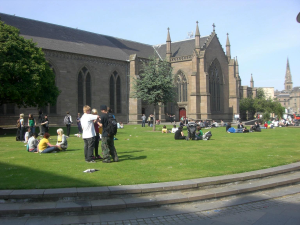
Hot Chocolate started in 2001 in the heart of Dundee. There is a shopping mall built around The Steeple Church in the city centre and, in front of the church, is a grassy area which became a meeting place for young people from the 'alternative' culture (ie. those dressed in black with piercings and tattoos and skateboards and thrash metal music etc).
At that time, there was a young woman on placement as a part-time youth worker with The Steeple who was looking outside the church, saying,
There is a community inside the walls of the church and there is a community outside the walls.
 She went out with a small group of volunteers and they had no agenda other than to go and meet young people on that grassy area. Within a few months, there were quite a few significant relationships developing. We are called Hot Chocolate simply because that's what the volunteers took out with them and the young people themselves started calling the encounters, Hot Chocolate. The name just stuck.
Then we started to ask the young people, 'If you had a bit of space in the church building, what would you do with it?' The answer was that they wanted some rehearsal space, a place they could just crash out and be themselves, and so we ended up with some thrash metal bands come to rehearse in the sanctuary of the church!
Since the outset, it has been the young people who have made the decisions about how, when and what happens. These roots remain totally foundational to who we are and the way we operate today.
It all grew very organically and was very relationally-based. We became an independent charity in 2004 and we now have six paid staff (two of whom are full time) and around 35 youth work volunteers each year. We work with about 300 young people in the course of a year and do lots of things, including group work and one-to-one sessions but we don't preach at them or do anything that would be seen as typically 'churchy' in any way. Instead we get alongside to support them and are always asking the question, 'What do you want to do?' We've got good facilities, including a sports room, kitchen and chill-out room so we have the space to accommodate lots of different types of activities.
Many of the young people are from difficult family contexts and some have been in and out of young offender institutes. The young people we encounter hear from so many sources that they are bad, stupid, worthless, and will amount to nothing. Giving as much of the responsibility and ownership of Hot Chocolate to the young people as possible has resulted in a deep commitment and respect for both the place and the relationships around it. Creating a space that is truly owned by the young people has been vital to this. They most commonly describe it as their 'home', where they can make their own cup of tea, hang their art on the wall, and find a place of belonging. Hot Chocolate is not here to do things for young people or to provide a service for young people, but instead to grow a community with young people. That actually makes all the difference.

We've found too that language can also play a huge part in unhelpful power dynamics, and Hot Chocolate works hard to be thoughtful about this. For example: we are not a service. We do not have clients, customers or service users. We are a community, and the young people are young people. We do not have staff and volunteers, we have team. We do not try to fix the young people but walk alongside them, open to learning as much from them as they might from us.
Our approach is not that of a typical church based youth work organisation. We don't do God slots, but we share our lives, and those of the team who have faith share our faith when the time is right. A lot of the young folk are interested in spirituality and it is not difficult to get spiritual conversations at all.
As time has gone on, some of the young folk have found faith. That has often coincided with them coming onto team and experiencing a more explicitly Christian part of the community. As the former young people find that sense of belonging amongst the team, it opens up all sorts of questions. One young person started coming when he was 13 or 14, became a Christian along the way and is now one of our key volunteers. Not all of the team are Christians, but all are open to exploring and all feel that the Christian ethos is very important. We also often attract team members who are disillusioned with mainstream church – especially artists and social activists especially who feel they haven't found their place.

What they tend to describe as their 'church' time is when we're sitting around the dinner table together, three times a week. Before opening for any youth work session, the team has a meal together and shares some sort of devotion – and that's where they find belonging and faith. We want to develop specifically around that time, and help grow an indigenous Christian leadership. We feel uneasy about importing worship resources that are not appropriate to our context so we have started writing worship and prayers of our own. In a way, everything that has happened so far in the way of church community is completely accidental, and so tends to be quite different to intentional church planting models and approaches. (This is not a bad thing, it is just different).
Hot Chocolate has never been about getting the young people into church on a Sunday morning and it wasn't even about starting a youth project. It was simply about building relationships and seeing what might emerge, motivated by the love of God. It seems that every couple of months we stop and say, 'What are you up to now God? It's changing again!' We know we are very strong on belonging, on community and activism; we are not necessarily great at discipleship but we are learning.
Hot Chocolate experiments: not recklessly, but without anxiety of failure. There is a strong culture of reflection, vulnerability and learning together, even when we have made mistakes.
 We've learned a lot about the God of mission. It's God's mission to transform the lives of the young people and not ours. God is already at work doing this, and so our job is to get alongside him, not the other way around. This has been a liberating, challenging realisation.
In terms of challenges, when you work for a charity, finance is always going to be a challenge but we do have support from various agencies, including the Church of Scotland's Go For It Fund which aims to encourage creative ways of working which develop the life and mission of the local church and are transformative for both communities and congregations. We have had some major staffing changes in the team in the past couple of years too, but we have just appointed a new director to start in January so we are looking forward to starting the new year with a leader who is very missional-minded, someone to help us grow this amazing community together.
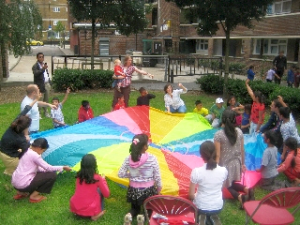
 We remain a small church that struggles in many ways with the seeming chaos of life and messiness of church but there is also a lot of joy along the way and much hope for the future. Today E1CC covers the same geographical area and includes Sunday meetings in the homes of two families from the church and Wednesdays at 6pm in the hall of St Mary's Church on Cable Street. Once a month we have celebrations which are all-age, messy church, café-style, with a meal to finish. We have active children's and youth groups too, who bring us much joy and often speak nuggets of truth to us 'grown-ups'! You will rarely hear a sermon here but we hope, pray and trust that people will hear plenty of what God is saying.
 What are we about? E1 Community Church have five key distinctives. We are a Jesus-centred church; worshipping and following Jesus together in our daily lives. We are a church at the edge, seeking to be a church of people who have too little rather than have too much and of those who often feel marginalized by society and sometimes by the church. We are made up of people who live in the local neighbourhood and our worship, discipleship and decision-making aim to be relevant to the area in which we live. We aim to be multi-voiced in order to discover together what God might be saying to us. We believe passionately in being people of peace and we try to work at this both within church and within our community.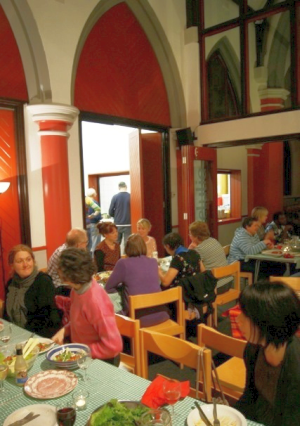
 I'm sure that many people will have read Ralph Winter's and George Lings' papers on sodal and modal expressions of church. The sodal and modal framework creates space to innovate within the existing structures and also highlight that innovation has always been part of the character of the church of God.
 The Rhythms of Grace have been developed by the community of St Chad in Lichfield Diocese. We found them and liked them and so we've adopted them! We think that they encourage us to live as believers in the real world, not in some kind of holy huddle. The term, Rhythms of Grace, is taken from Eugene Peterson's translation of Matthew 11:28, 'Walk with me and work with me – watch how I do it. Learn the unforced rhythms of grace'.
 For us, mission and prayer go hand-in-hand. All we want to do is follow the example of Jesus in his life, death and resurrection; demonstrating and reflecting God's love. It's our aim to enable and encourage people to do this where they live and work.
 What is 'Come & Go' worship?
 Where did the Come & Go idea come from?
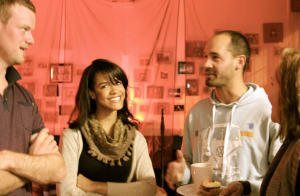
 I'd say that the wider church tends to be very good with children's work and young teens but seems to be haemorrhaging people in the young adults age range. We now have a regular core group of about 20 but we can have up to 60 coming along for music nights, mostly 'post'-students in their late 20s and early 30s from the Mumbles area.
 The name, 'Canopy', first came about because we thought of it in connection with the Rainforest as a place of refuge. We meet on Sunday evenings at the community Red Café – run by Linden Church – but we developed four very different approaches to our Sunday gatherings, saying that all these styles of Sunday come 'Under the Canopy'. They are:
 I have done a theology course and it was when I was looking at the Early Church that I realised the importance of eating together as a community. So we introduced Sustenance, a meal on the third Sunday of the month. Around 15 people come along to that; we do some slow food and spend a lot of time being in relationship with each other.
 Our seafront base at the Red Café is great because the building has been run as a community project by Linden Church Trust since 2001 so lots of people – young people in particular – use it for all sorts of activities. Partnership is very important in that Linden Church is strongly linked in with churches around Swansea. I also meet up with others involved in youth work and we support each other, which is vital. The work is demanding and we all need to be reminded we're not in it on our own'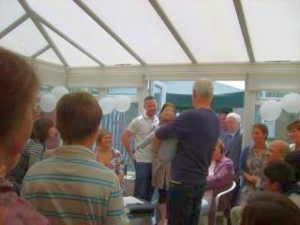
 The small congregation developed through friendship and community involvement. In the beginning we encouraged each other to take an active part in the local community in various ways, such as becoming a school governor, joining the local PTA or attending the local residents' association meetings. If there was a local quiz night, they would enter a team. This helped us to make friends and to get to know and love the community of which we were a part.
 Together, 12 years later, we continue to grow in faith and make friends as we meet twice a month. We will firstly get together once a month on a Saturday for food or to take part in an activity together and we frequently share bread and wine. Then the adults also meet for supper at another time during the month at someone's home to share in a discussion about life and faith and important matters of the day.
 Wood Green Mennonite Church, London, is piloting a 'walking' fresh expression this year. Phil Wood, a member of Wood Green, explains how the monthly church is a mixture of walking, talking, prayer, liturgy and meditation.
 When I first talked of this, responses were mixed. No matter how practised I become at explaining the notion of a congregation where church occurs in the walking there are still people who don't 'get it'. That isn't surprising. Walking Church was never intended to be in competition with worship inside a traditional church building – some still think it is a gimmick but I believe they are wrong.


 We're learning something about evangelism in the values driving this particular fresh expression. One of our walkers likes us because we don't 'proselytise', instead we 'reflect'. Are we too peaceable to share faith? I hope not – but our message isn't 'become like us and you will be saved'. We are a 'peace church'. Yes, words are important, but mostly peace is in the pace. It's easier to listen at three miles per hour.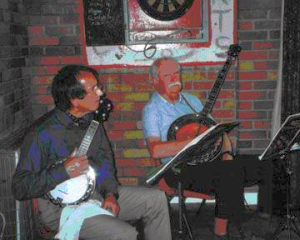
 It was about five years ago when two or three of us, quite independently, thought that a church luncheon club would be a good idea. Our minister, Jeff Reynolds, was enthusiastic. Some of us youngsters (we're all over sixty) who were to become the cooks attended the local college to gain qualifications in food safety; and we were ready to start.
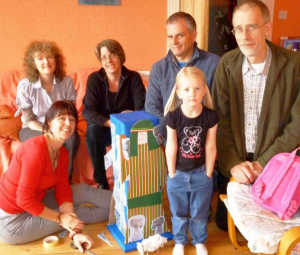
 When Andy and Ali moved to Dorset, the Café became a social enterprise with a board of management and a project manager running it day by day. My wife Katy and I moved here two years ago. I have been in ministry for 27 years and, at 59, I am probably one of the oldest 'pioneer ministers' in CofE history!
 Mine is a five year appointment and we knew it was vital to get those strong building blocks of community in place right from the start. As a result we moved a lot of events away from Vicars Café and hosted them in our own home. We are fortunate in having a large dining room, kitchen and living room so we began to meet together as a group around meals. Food and drink became the staple of what we were doing and when people eat together, somehow there is a little heaven in the ordinary.
 A real turning point came when GraceSpace came up with the idea of having a different meal theme for each Sunday in the month. On the first Sunday we have Breakfast when people turn up at 10am to help us cook breakfast together; we will then organise a spiritual thought or reflection at some stage while we're eating. The whole thing can run for about three hours as people often want to stick around and discuss things.
 The fourth Sunday is based around supper time at about 6pm. It is called Ikon; this is more reflective and allows people to share what comes out of that time together. Typically they will have bread, soup, pate and cheese at that one.
 This illness has prompted the devolving, training, encouraging and mentoring of new people into leadership. For this fresh expression to develop we want to create another network of community, a second GraceSpace. For that, we need leaders, though we have also taken a long, hard look at our purpose in all of this. It can't just be to build community. How do we look outside and make a difference?
 In February we launched a Monday church just for them. United Media Church uses film clips and computer games to teach the gospel message fortnightly on Monday evenings. These meetings, which include a short prayer time and all-important food, take place in an informal 'café church' environment. A variety of films are used and the same format has encouraged some to return to Sunday church as well.
 e now regularly attract up to 16 young people from the ages of 9 to 13, most of whom have been brought along by someone else in the group. That's very good news in that most of those children have not previously had a link with any sort of church at all but the challenge is that we outgrew our original room at Kingswood; it was simply too small for what we were doing.
 They are exploring their faith and the world around them in new ways and it includes things like supporting a youth project and families in Kenya, and sponsoring a child. They have raised quite a bit of money for their charity projects, a sleepover in the church raised more than £600. This is a way of being 'church' that our young people asked for. They also give into a collection every week because the adults do that in the main church and it's important to be reminded that we are part of something much bigger.
 We have always seen this as a fresh expression of church and not a church youth group and we need to keep that focus on being a different way of doing church. Otherwise it could easily become a youth club where you just come along and have a bit of a laugh.