
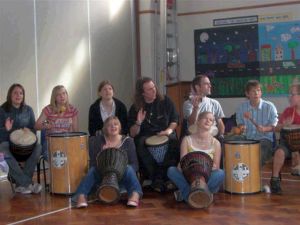
The parish church of Truro, St Paul's, closed in November 2007 but the parish of St Paul continues to exist and worship is now based at Archbishop Benson CofE School. Parish priest, Father Christopher, describes how it is also home to… Holy Commotion!
On alternate Wednesdays during term time, we get together in the school hall – a licensed place of worship – for a short, informal act of worship with songs, a prayer, a reading and lots of fun. Everyone is welcome and we always tells people that if they don't fancy formal Sunday church but want to explore the Christian faith in a familiar and 'safe' environment, Holy Commotion! could be just the thing.
Emphasis is on informality and the involvement of children. As a result we have a regular kids club with activities designed specifically for them. For those wanting to explore their own spirituality or beliefs, or specific aspects of the Christian faith, we run an Emmaus course.
 Sometimes we have theme evenings at Holy Commotion when we get involved in other activities as part of our act of worship. Truro Methodist Church's Speaking in Drums group has visited us a couple of times.
As well as our regular Wednesday evening gatherings we also have social events for adults and/or children. It has come a long way since it first got off the ground a few years ago. I arrived here in 2003 and noticed that Christingle services always brought in so many people who would never otherwise come to one of our services. In 2006 the church was absolutely heaving with people; it was so packed we were putting visitors in the choir stalls and there was still standing room only at the back.
Afterwards I thought, 'This is incredible, where do all these people come from and where do they all go? Why are they happy to come to Christmas services but not at any other time?'
The answer, of course, was because they knew nothing 'strange' was going to happen. Even allowing for the fact that St Paul's is fairly strong Anglo Catholic – and people may not be familiar with that tradition – there was obviously a very different 'feel' about those Christingle services. People felt comfortable in coming to them.
In digging a little deeper about the whys and wherefores of it all we came to some serious conclusions about things we tend to take for granted in church circles:
- The day: Sundays are not good days to get to a service for many people;
- The place: Church buildings can be quite intimidating;
- The time: 10am is useless if you're taking your children to play football or some other sport; or arranging to transport them from one place to another if they're going to see a parent who no longer lives in the same home as they do;
- The formality of it all: Radical reassessment was needed because this thing called 'church' does not attract people in the same way these days. I have found that people of all ages, and whatever family or age bracket they happen to be in, are not averse to religion and spirituality but they don't like the way it is contextualised in institutional church.
 So we decided to launch Holy Commotion! in the school hall. We now have a very committed bunch of people and the way we break it down generally is that I do the 'bits' that requires someone with a dog collar and they do the 'commotion'. It's very informal and, to my mind, combines the best of both worlds to establish some kind of early church model.
There was quite a milestone recently when we had our first ever baptism which means that people are now seeing that school hall as a holy, sacred place. They may not necessarily see themselves as Christians but they are interested in finding out about that thing called religion.
We worship, we pray, we sing, I talk to the children but the 'shape' of it is never quite the same! We also have a Eucharist from time to time. Holy Commotion! is all delivered on PowerPoint so people don't get mounds of books given to them; there is nothing scary about it. I find that if we take the scariness away, people really do open up.
We have children up to the age of 14 but don't seem to attract the older teenagers. In saying that, it has been successful beyond my wildest dreams in drawing people into the Christian family.
One of its wider effects can be seen in the number of baptisms having increased phenomenally across the benefice – most of whom are people who have come through Holy Commotion! and then fed back into other churches. It has also had an impact on my other congregations, we have introduced a fourth Sunday family service because the 9am Mass attracted one kind of clientele but it wasn't right for people with families. Now, after the Mass, the 9am crowd sit down for breakfast with the congregation arriving for the 10.30am service.
There have been some rumbles of 'It's all very nice but when are they going to come to proper church?' Well, Holy Commotion! is church and the fact is that these people simply will not come to what many think of as a church service. If they didn't go to Holy Commotion! they wouldn't go to church anywhere else – Wednesday has become the new Sunday for us.
I'm a high churchman and I was very much stepping out of my comfort zone when we first started – now I find it all hugely encouraging. The wonderful thing is that the people who come are here because they want to be here, not because they feel they should be here for whatever reason. Perhaps more importantly they tend not to come with any baggage, politics or prejudices associated with church life.
 Holy Commotion! is quite intensive in terms of energy and resources – and of course I have the life of the wider parish to look after as well but thankfully, because this is 21st century, I can communicate with the Holy Commotion! people extensively via email, text or Facebook.
There's no doubt that we really need to be doing this, we need to be doing both fresh expression of church and traditional church. It's the only way forward. When we started I was quite keen that whatever was to be presented had to have some kind of liturgical structure. That wasn't so much based on a deep theological reasoning, more that it was a complete experiment so I just stuck to what I knew and put together a service that was sort of familiar in structure. This included a welcome, gathering prayer, hymn or song and a reading from Scripture – I wanted it to be recognisable as church rather than just a social gathering.
People didn't find it off-putting. Instead they took to it all immediately because we forget how unusual it all is – they have not heard the Bible read so it's great to see their reaction to something like the Parable of the Good Samaritan. Also to have teaching is unusual because they don't know about Jesus. To me, that's what it's all about, a fulfilling life with a spiritual dimension. On the whole they are truly intrigued by it all because they see it as something incredibly relevant to today.
It could have such a different story on the first evening… we got to about 6.25pm and there were only three of us there. I was just about to say, 'Oh well it was worth a try but that's that' and then suddenly everyone came in through the door and there were about 36 people in the room. Our age range is from newborn to a lady in her 80s, the number fluctuates – for our harvest social there were more than 70 but I would say we have a core of 50.
Perhaps a testing time next year will be when I take a six-week sabbatical in March. I've tried to do my very best to get the message across that Holy Commotion! isn't me, it's them. My own personal resources are limited and one of the struggles is to try and think of new things to do, coming up with the ideas is tricky.
We need to resource it with people from either Holy Commotion! itself or other local churches. There are sufficient numbers of them to do that and the shape and form of it can continue in my absence because they now have a template to work from but they can develop it in different ways.
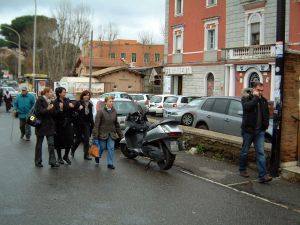
 Mary Styles, an ordinand with the CofE Diocese in Europe, is a Reader at All Saints Church, Rome. For the past nine years she has led Footsteps, a fresh expression of church meeting in two areas of the city.
 Footsteps started because I was aware of the gap between these sort of discussions and the opportunity or space to follow them up. Since that time, some of those who have been part of Footsteps are churchgoers who have lapsed, others have been involved in church life for quite a while and there are also those who are not interested at all in attending a traditional church.
 Footsteps now meets in both a northern and a southern suburb, Casal Palocco and La Storta, for informal worship in English and runs weekly Bible study groups and occasional Alpha courses open to all. We meet in people's homes, as families and individuals, to serve and reach out to our neighbours. Our mission is 'knowing and growing in Jesus, following in His footsteps and putting His love into action.'
 Dealing with ex-pats means there are large fluctuations in numbers because our community is particularly mobile; quite a lot are highly skilled professionals and they may be with us for anything from six months to two years before they fly off again. We generally tend to attract families with children; there aren't too many people of grandparent age.
 We try to keep the actual worship to an hour but there is always a time of fellowship afterwards with coffee and pastries. I have had lots of support from the local Baptist pastor and Methodist minister and my parish priest at All Saints has been very supportive too – though there has been the inevitable tension from some people in the community who say that we should bringing regulars from Footsteps into All Saints. On the positive side of things, we have got vicars and ministers who want to help us lead interdenominational worship because we are not linked to any one tradition. The only link is through me – who happens to be an Anglican Reader.
 I have been trying to prepare people for a handover in leadership but, due to the transient nature of the congregation, everybody I have trained as possible new leaders has left. As a result I am now trying to forge links with churches with a good organisational structure in order to help make the big decisions about the way we are going.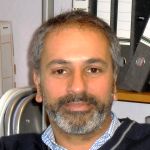
 Christian Selvaratnam, ordained pioneer minister at St Michael le Belfrey, York, oversees G2. He traces its development since it was first featured on
  A major change was moving the venue of our meetings. We're no longer in our original venue at the gym because we outgrew that and had to find somewhere bigger so we now meet in a community centre. Moving from the gym was a big formative thing for us. There was a great positive association and we made a lot of it – fitness for the soul and that kind of thing – and connecting with people at leisure. A few years on though, we’ve got our maturity, we've got our base and so I think we accommodated that move fairly well. In that first year it might have been really hard to move because G2 was all about being in the gym; now we're a community with a name and an activity so the place where we meet perhaps is not so critical.
 In terms of people coming to faith and their discipleship, our thinking has developed over the years. What we know we have done really well is to connect with people on the fringe, people who have got a bit of church in their background – perhaps they went as a child or years ago – and a lot of those people find the church building an off-putting threshold to cross. As a result we have got a lot of stories of people who have really seen their faith come alive, some have come back to faith and they've connected with us while others have returned to faith and then connected back to their local church.
 On Sundays, in many ways, we're trying to balance both those that are coming in with the core of people for whom this is their sustaining faith experience week by week so we need to be faithful to that. We also need to be thinking about what are we teaching from the Scripture. We have Communion once a month now and that's really important to us, and to many people who come. We need to have worship that’s not only accessible to somebody who walks in off the street but is actually meaningful to somebody who already is a committed follower of Jesus.
 We originally had one team whose work consisted of all the practicalities and all the blue sky thinking too. We now have two – the core team have got the overview of everything while there's also a larger group called the leadership team and everyone on that team has one, and only one, responsibility. They have quite a focused role. So far we've got about 14 people in that team and probably another seven to eight posts to fill as we find the right people.
 At the moment it's early days for cluster groups, we've got two of them operating with a third just developing. The cluster is the outside profile and then they also meet as cells so there’s a community and discipleship focus behind that. One of the clusters is specifically for students; that's going really well and focuses very naturally on York University campus which is very near to where we meet.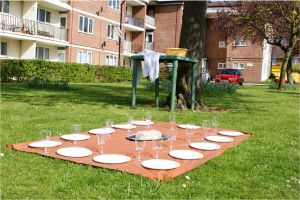
 There are lots of facilities on the base and they also have a padre but people are encouraged to worship outside the camp at churches in the town, there is no provision for church worship on the base itself. This can be quite difficult for people to access in an unknown place so I see part of my role as being that of a welcomer. I speak several languages, including French, German and Italian so I'm hoping that I can make myself understood when the time is right! The influx of people comes from all over the place, including Italy, Poland, Portugal, Turkey and Spain. The whole world appears to be on my doorstep.
 Alongside them we do get some younger families but we haven't got as many in the middle age group. I am curate at St John the Evangelist (Churchdown and Innsworth) but there wasn't a church presence actually on the estate which meant that people could feel a bit isolated from the rest of the parish – part of a Local Ecumenical Partnership which supports the Pioneer Minister work.
 During Holy Week I put up installations on the green spaces in the community. It was quite funny getting permission; I went into the police station and said, 'Can I have some police incident tape? I would like to create a scene of arrest.' They agreed but said they thought it would be vandalised. I was putting it up when a car full of young lads came to a screeching halt alongside me. They asked if there had been a crime, I said no but it was meant to remind people of a man who was wrongly arrested for what he did for us. 'Can we help?' they said. I asked them to make sure it stayed safe. I don't know what they did – or didn't – do but it never got vandalised.
 What I suppose is lacking at the moment is people emerging from the community to be leaders but it's early days yet. When people want things 'done' – like baptism or a wedding – they actually still tend to look for a tower or spire but for those who are unchurched, a church building and a normal church service is too much. I'm not in the business of forcing people to come into traditional church.
 The Ruth Project, part of the North West Durham Methodist Circuit, has been building community on an estate in South Stanley. Grace Cauldwell became its first project worker in September 2006. She explains how patience is a virtue when it comes to relationship building:
 I settled in straight away and spent the first 12-18months just getting to know the area, joining in with what was already happening and becoming known in the community centres. My dog Jasper, a black and white labrador pointer cross, was absolutely key at the start of it all because I'd go out for a walk with him and many people would stop to say hello.
 After a while, more relationship building, and various other failed 'events' we started something called Friday Fun Factory. At first we got 10 kids, then it was seven, then two, then six. At one point near Christmas we had just one child. When the New Year started, we republicised it – through all the local schools, shops and school assemblies and the children started to come. We visit all the families every week with a fun sheet to tell them what the children were doing as part of the Fun Factory (and with the hope of a prize on it's return!)– and that has been a really good way to get to know people.
 Since January 2010 we have had six to 12 parents and their friends coming along and they have been getting really involved in what has been going on. It has become a sort of family church with none of the hang-ups they see as being part of traditional church. We worship (without hymns or singing mostly!), have a silly Bible story with a life application, and enjoy a great time together with arty crafty stuff and a lot of games. In the last two or three months the children have started asking to pray. Praying is something we really believe in, but getting them to say prayers out loud in a circle seems very religious- however this has come directly from the children – they do it comfortably and it's something they asked to do! Spirituality in a lot of families has just started to blossom, with people meeting Jesus in very real ways.
 My post was originally for five years with promises of continuation funding for 10 but funding is sadly no longer available and I leave this summer. It's incredibly difficult; what's here at the moment is not self-sustaining and it's going to be at the very least another five years before it is. I am hoping we can try and keep something going because a lot of what I do is simply about being here, having a physical presence.
 It's the people I will miss; people like Joe, his wife and daughter. Joe is clearly a man of God but doesn't quite know how to put that into words because he would say a Christian is boring, wears a suit and is rude to people. Raising indigenous leadership is difficult but Joe now volunteers for everything we do. He started coming to us to make our refreshments; he now looks after our registration and acts as 'security man'. Getting him to have the confidence to do that was difficult enough without asking him to take on leadership. You can't expect to raise up a confident and humble leader in a short period of time.
 Many people I've come across here do not read often, sometimes they can only read with great difficulty so it's about making discipleship that's right for them. So many resources are too text based, and often speak into a middle class situation, and so providing suitable and relevant teaching and discipleship is not an easy task.
 Church Army New Zealand runs a successful bus ministry called Canterbury Kids Coach. Captain Louise Weller tells how a new Christian community, X-Site, has developed to work alongside the mobile ministry to reach families in Rowley, a needy suburb of Christchurch.
 The X-Site weekly sessions are from 3pm-5pm every Friday and follow a similar pattern each week. Leaders and other adults from the community arrive from 2.15pm and we stop to pray at 2.45pm. The children arrive from the nearby local school and are given a drink and games to play and we sit around and chat.
 Refreshments are provided and meals arranged at the end of each term. We carry out visits and follow-up work to help meet material needs and address neglect, truancy and abuse. This is much more than just a bus; it is bringing Church to the people.
 Three team leaders are members of the local Anglican Church and two are from the nearest Baptist Church; teenagers help as junior leaders. Although we are a Church Army initiative, we also have the support and encouragement of our local parish and some families have now started attending services on Sunday.
 We want to see lives transformed and communities grow. I didn't have an opportunity as a child to hear about Jesus, so I had to struggle alone during my tough teenage years. Consequently I desperately want others to have opportunities to hear about, experience and grow in the love of Jesus, and be equipped to reach their full potential.
 I prayed with a member of a local Baptist Church about the direction in which we were meant to go. A third person came along from Christians Together in Capel and she had a vision that we should set up Messy Church so we decided to pool our resources and put our energies into that.
 At our first meeting we catered for 40, buying two hotdogs for each person expected so we got 80. Then somebody reminded me that we might have vegetarians there so we got veggie versions as well. Thankfully we did, with a crowd of 65 on the day!
 Creation was the theme. We had a table game and word searches, and told a story with drama involving the children. It was so packed and so noisy, we had to stand on chairs to be heard and seen.
 As we knew that not everybody would be there on Easter Sunday we included the celebration of the Resurrection as part of that Good Friday service. There was a wonderful sense of having gone through Holy Week and to Easter with our Messy Church newcomers. We had linked things together for them in the previous Messy Church sessions by following the accounts of Creation, Noah and God’s promise, and then God’s Promise showing itself in the death and resurrection of Christ. A rainbow poster we made on our second session carried the theme through.
 The ARK is a place where children and their families can learn about Jesus and explore their faith. Established in 2007 in Newmains, The ARK has since grown significantly and is aiming to make a real difference to the people of the area. Shona Stirling explains more.
 We went on to introduce flags because some of our boys who hate singing really love flags. We are not getting it 100% right all the time by any means but we do talk about worship as a response to Jesus, and emphasise that worship can be done in a variety of ways. We say that if we want to respond by singing quietly, that’s fine, but there are all sorts of other expressions too. Some of our boys breakdance and some choose to just sit quietly or to use sign language instead of singing.
 Six years ago, Lucy Moore spoke to several of us at St Wilfrid's about the idea for a place where those on the fringes of church life would be happy to come without it being threatening in any way. It was a kind of pulling together of people who may come to the church building for a toddler group, for instance, but who had never actually looked at something God-centred as part of their life.
 The wonderful thing is that my daughter Kathryn also comes to Messy Church with granddaughter Molly, aged three; and one-year-old grandson Joshua. That means four generations of 'girls' from our family (and Josh!) all get together to take part in the sessions and enjoy the food afterwards.
 I don't take notice of any criticism that says "it's not real church" Our vicar, Paul Moore, is wonderful in that he says we are very blessed here to have three churches, St Wilfrid's, Westbrook, and Messy Church. This is a special place, for my family and for many others because it speaks of God and shows the love of God in action. To me, that's got to be church.
 Kathryn is a teacher so she gets to the session as soon as she can after the end of the school day. Her husband Pete, who is diocesan youth adviser, also gets along when he can. It's a huge joy to be sharing something like this with not only my Christian family but also my mum, daughter, and grand-children. My special prayer? That Molly will know the Lord, and know that He is with her through life. I also want it to be her decision to follow Him, not just because four generations of her family happen to come together in the same place at the same time.