

 Café Sundae, based at Timperley Methodist Church, opened in May 2006. Will Sudworth gives an update on the place that describes itself as 'church like you’ve never seen it before'
We're a bit like the Muppets…
Café Sundae wasn't planned at all. We hadn't heard of Fresh Expressions, but we simply felt we weren’t engaging with our teenagers. Yet now we have been running for over three-and-a-half years, have at least six churches in the UK using our material, and been responsible for leading alternative worship at a national youth event.
We started off with what was basically a youth group meeting every Sunday night but the members would never come to family services or any other service, it just didn't work.
 We listened to the teenagers and they were pretty frank about it all, 'Sunday morning is a bad time, we're doing sports and anyway, church is dull.' So we transformed all-age worship into café multimedia worship on Sunday evenings. We thought we'd nailed it. In truth we had a half-hearted shot at changing it as a compromise but it didn’t come anywhere near hitting the spot.
It was time to do something radical so we brought together a team with multimedia and many other skills, and decided to do it properly on the second Sunday of the month from 6.30pm for about an hour-and-a-half. We cleared the church and all the chairs, put up a lighting rig, introduced café style tables, and got the young people involved. The teenagers came up with the name Café Sundae, and we were on our way.
Our vision included some key components. They were:
- Asking people what topics are relevant to their lives and then exploring what God has got to say about that topic;
- No communal singing;
 Going out on the streets to interview and film people about the topic. We then edit the voxpops together and show the results on screen. As well as speaking to members of the public, we have also created our own presenters, like Jeremy 'Vile' and Miss Polly Titian, to help explore a particular subject;
- Introducing role-play and tabletop games to help us really consider an issue;
- Involving teenagers in setting up the event and helping us to run it;
- Giving opportunities to respond to the message of that week;
- Carrying on the conversation afterwards in a blog.
We immediately welcomed people our church had not reached before. Numbers started at around 90, dropped to about 30 and ended 2009 at about the 70-80 mark, which is roughly the same size of our traditional church congregation. Today about half of the Café Sundae regulars are teenagers, with a good mix of male and female; and about 50% are adults aged 18-40. We make it clear that some of the issues covered are not suitable for younger children so our members need to be of secondary school age and older.
During the first summer we hosted a service for Churches Together. The feedback included the comment 'sacrilege' and the phrase 'I didn't feel as if I'd been to church'. We took the phrase as a compliment, even though it wasn't intended that way. When you're trying to make church for people who don't like church, could you get a better recommendation?
As to sustainability, we've seen our original minister move on, our team change, and new minister Revd Andrew Bradley getting to grips with it. Andrew runs a youth club on a Sunday afternoon and he brings them straight on to Café Sundae. Other youth clubs from churches of various denominations around and about have done the same.
MAYC asked us to lead Café Sundae at its Breakout event for young people. It may just have been the offer of free chocolate but we were packed to overflowing. We'll be back there this year with a full weekend of activities.
 We also believe in sharing what we've done and learned so we package up our material and give it away for free on our resources website. We don't have a magic formula, and our ideas may not work everywhere. All we've really done is shape church around what our teenagers respond to. Why does it appeal to adults as well as younger people? We think it's because it's a bit like the Muppets in that it works on two levels so that everyone can enjoy it.
Even though we're still meeting in a church building it doesn't feel like church and it certainly doesn't look like what you'd find in your average service. We use multi-media green screen technology, which means that we have a video camera and a blue screen behind our teenage actors – they act out a scene and we can put any image behind them. It's much easier than getting a whole youth club to practice for weeks and hope they get it right when performing the thing!
Discipleship is an area we're looking at very closely as time goes on. Our plan is to follow the model of the cell churches – namely to have a big event once a month before members go their separate ways with the adults going to house groups and youngsters in youth groups.
Our first group of teenagers has now gone off to university; our big challenge over the next five years is to draw them back in after their studies to become part of the Café Sundae leadership. To be fair, some of the young people are already doing that; one is on the computer, another runs the lighting desk, and several of them go out on the streets to do interviewing, acting, and videoing.
 Some people ask, 'Is it a fresh expression of church if it's still in the church building and doesn't meet all the fresh expressions criteria?', 'Should it be heavier on the Bible content?'
At the moment, we plan to stay in the church. We transform the interior, and our teenagers – and adults – are very happy to come into that building. As a result they change the atmosphere and it is very much a fresh expression of church, but we keep on grappling with all these things, and all we can hope is that we will continue to listen and explore these questions and others for many years to come.
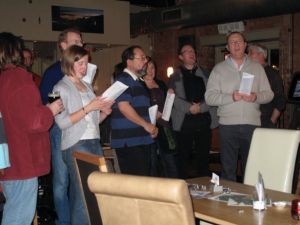
 It all happened very quickly. I started in post at the end of May 2009, discussions took place over the summer to sort out the BMO, and it was signed in December at a Beer&Carols event. We certainly reaped the benefits of the hard work that other BMOs had done before us in Exeter and Thanet.
 In the middle of the BMO area is The Quay, a canal side pub which was itself part of a regeneration project a few years ago. It is now the base for Presence's midweek meetings, and some of those at Presence have become regulars at the pub’s open mic session on Thursday nights.
 The regeneration of great swathes of the city means that new communities have become cut off from parish churches because the landscape has shifted, but by starting a fresh expression alongside those churches, we can redefine a pastoral boundary. It has just worked brilliantly in that it's possible to run a straight mixed economy which lets the existing parishes do what they do while we look at how we use these places in new and creative ways.
 This is a minimum 10 year project, and part of the challenge is that the landscape will continue to change dramatically during that time. Large brownfield sites in our area are set aside for new developments but are yet to be built on, so we need to be flexible in our approach and planning.
 We also very much hope to be involved at The Quay on St Patrick's Day. There are lots of possibilities but we might look at having a religious 'bit' followed by Open Communion using Naan bread – reflecting the type of area we're in. We want to reclaim these celebrations for God, and show that we're a church of festival and fun.
 A fresh expression of church that is 'fuelled by coffee'… Matt Ward, a chaplain at the University of Leeds, takes us behind the scenes at Emmanuel Café Church.
 Café Church operates in 10-week bursts during term-time. Obviously, as we operate in a university environment, we always miss the major festivals. That's a bit of a challenge for a church community… but there are still ways to celebrate 'together', even when we're not in the same place at the same time.
 Every year has seen quite a sense of growth in the life of the church, and in the lives of those who have come and found faith or confidence in their faith. My hope for the future is that Café Church continues to be shaped in a way that serves the needs of the students who come in and reaches out to students who don't. If it looks the same in 12 months as it does now, it won't be doing that.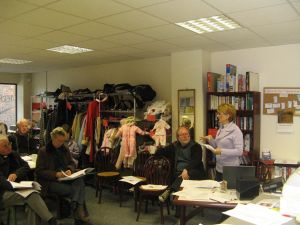
 It was initially conceived out of unmet needs of a 'mission audit' completed by a local Methodist Church. To complete this, we went out into the estate to ask questions about what people thought the needs were. The most significant finding of the survey, was that local people thought the church was irrelevant and had nothing to contribute. One of the greatest needs that people did identify was the need for a drop-in for older people to be able to come to meet people and socialise in safety, and also a place for younger people. At that time the estate was known for being a rough place with problems with drugs and anti-social behaviour. This coincided with an offer from the owner of the butcher's shop to the Methodist church, to use it for something to help the community. I was asked if I would assist in the exploration of potential solutions to the meeting of these needs and sought other agencies to see if there were any opportunities for partnerships to be able to take on the shop for mission and ministry. So the vision for a community café gradually emerged.
 I was one of the founding members of the initiative, as I was involved with it in the early days of my training for Methodist ministry. I quickly discerned that God was asking me to stay with the Terminus Initiative, which at the time was completely against the usual expectation of Methodist itinerant ministry. So I kept this discernment to myself (not even telling my husband) waiting for it to be confirmed by someone else to test it. Within a few weeks, our Superintendent Minister at the time, Ian Bell, asked me if I would consider staying on and co-ordinating the Initiative, but that there would be no money for a stipend. As I had retired early on a pension from the National Health Service, I decided I could cope, and committed to it.
 The Terminus Initiative is now in its eighth year. The café is open three days a week, targeting different groups in need, and the premises are used by other community groups when the café is closed. The Terminus Initiative, with its other projects, has supported asylum seekers, refugees, drug users, people with alcohol addictions, people with mental health needs, young people, and older people. In fact there are many social activities going on all the time including discussions/Bible studies, and prayer underpins it all.
 In the many partnerships we have, we focus on the spiritual needs of those who come into the Terminus building. We hope that the work of the Initiative has challenged people's perception of the church as 'irrelevant', replacing negative stereotypes with a greater respect for Christianity and the Church. We have seen many people seeking to explore the Christian faith coming out of the community and loving service they have experienced at the Terminus. Many of these people have gone on to discipleship groups of the partner churches, as we seek to be a committed local 'mixed economy' of church finding unity of purpose in mission.
 Ted's story