
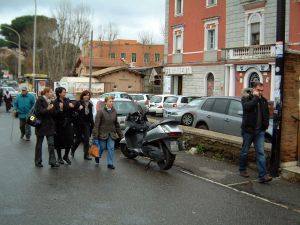
 Mary Styles, an ordinand with the CofE Diocese in Europe, is a Reader at All Saints Church, Rome. For the past nine years she has led Footsteps, a fresh expression of church meeting in two areas of the city.
Rome is the base for three United Nations agency headquarters and many international companies so there is a large English-speaking community here. Hospitality, friendship and fellowship are the basis of our ministry and, as a cosmopolitan group, understanding and celebrating other ways and cultures are hugely important.
When I first arrived in Italy I really noticed the difference in people's openness to talk about things other than the weather! In England it had been very difficult to talk about spiritual matters and no-one really wanted to engage with that. However, when people are away from their home 'territory' they are far more willing to discuss all sorts of matters.
 Footsteps started because I was aware of the gap between these sort of discussions and the opportunity or space to follow them up. Since that time, some of those who have been part of Footsteps are churchgoers who have lapsed, others have been involved in church life for quite a while and there are also those who are not interested at all in attending a traditional church.
Whilst there is a good choice of established churches in the city centre, it became clear that there was no opportunity for worship in English in the suburbs and beyond (from where it can take one to two hours to reach the heart of Rome). It was also notable that many who expressed an interest in learning more about the Christian faith or coming together to worship were either not interested in – or disillusioned with – inherited church.
 Footsteps now meets in both a northern and a southern suburb, Casal Palocco and La Storta, for informal worship in English and runs weekly Bible study groups and occasional Alpha courses open to all. We meet in people's homes, as families and individuals, to serve and reach out to our neighbours. Our mission is 'knowing and growing in Jesus, following in His footsteps and putting His love into action.'
We are all English speakers but that doesn't mean we are all British. Instead we have got people from every continent and denomination and as a result we have been very enriched by our Orthodox and Catholic members.
 Dealing with ex-pats means there are large fluctuations in numbers because our community is particularly mobile; quite a lot are highly skilled professionals and they may be with us for anything from six months to two years before they fly off again. We generally tend to attract families with children; there aren't too many people of grandparent age.
We have what would broadly be recognised as a Liturgy of the Word where we sing songs, read the Bible and talk about what relevance the Bible has for us. We may also have a forum or discussion with different people leading it. People have come along through word of mouth 'advertising', in the past there have been very good mother evangelists at the school gate but we don't have many of those people at the moment so we are having to rethink how we get the message out. There is no big strategic plan; we do what we do depending on who is around at the time.
 We try to keep the actual worship to an hour but there is always a time of fellowship afterwards with coffee and pastries. I have had lots of support from the local Baptist pastor and Methodist minister and my parish priest at All Saints has been very supportive too – though there has been the inevitable tension from some people in the community who say that we should bringing regulars from Footsteps into All Saints. On the positive side of things, we have got vicars and ministers who want to help us lead interdenominational worship because we are not linked to any one tradition. The only link is through me – who happens to be an Anglican Reader.
If I could go back and start it all over again I'd say it would have been better if we had put a proper authority structure in place; otherwise there's a danger of Footsteps becoming 'Mary Styles Incorporated' and I'd never want that.
 I have been trying to prepare people for a handover in leadership but, due to the transient nature of the congregation, everybody I have trained as possible new leaders has left. As a result I am now trying to forge links with churches with a good organisational structure in order to help make the big decisions about the way we are going.
I have a leadership team and every now and we do gather as a group to try to discern prayerfully what we should be doing. The big challenge is for me eventually to leave Footsteps as something that is sustainable, something that continues with a life and energy and purpose.
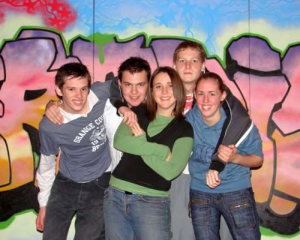
 These are the voices of two teenagers, members of re:generation youth church in Romford, Essex, a church that provides a spiritual home to around 50 young people aged 13 to 21, both churched and unchurched, and with a wide range of cultural styles. At re:generation, young people from diverse backgrounds get along very well.
 A welcome team rota, 'Be a Blessing', involves all the members in this ministry. A shortage of adult helpers when Jamie and his wife, Ruth, were setting up the youth church bred a necessity which has proved a blessing in itself. The young people had to get involved in practical ways such as administration, setting up and clearing away, leading small groups.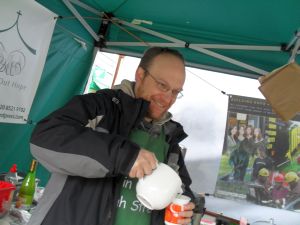
 St Luke's-in-the-High-Street focuses around the weekly Walthamstow Farmers Market in north-east London. It is one of 40 Christian churches based in Walthamstow but team vicar, Revd Tony Cant, says it is a unique form of missional experiment in the diocese of Chelmsford.
 St Luke’s-in-the-High-Street is part of The Parish of Walthamstow Team, which also includes St Gabriel's, St Mary's and St Stephen's. The churches all work differently, complementing each other in working for the common good and helping to shape the future for this area.
 As part of their discipleship in building their own faith, St Luke's meets at one of their members' homes on Wednesday evenings for reflection, prayer, Bible study, worship and Holy Communion. And the last Wednesday of the month is given over to enjoying a meal together.
 Tony says that some weeks St Luke's members find themselves simply huddled in the stall, looking out at the driving rain, and wondering just quite what it is that they are doing. Yet on other occasions have had hugely significant conversations with stall holders or customers about life, the universe and everything. Both extremes are expressions of love; both dependent on a willingness to be present; and (much more importantly), both resourced by the true source of all love that they have been grafted onto.
 Richard Moy, ordained pioneer minister explains how church is forming amongst those who have never been involved before, through Wolverhampton Pioneer Ministries.
 A small team of three gathered to pray every week in a local church and then gradually others joined in. After a year they began to gather in a café location in the centre of town and now a pool of about 50 people meets regularly for Sunday evening worship. On any one occasion 30 or so will gather together. Church 18-30 has been born.
 Early on Richard decided that one size would not fit all. Based on differing learning styles, this fresh expression of church offers deliberately varied learning and worship opportunities. There's a gathering for 'reflectors' which has a real sense of the 'spiritual'. Another event is aimed at 'theorists' and encourages those who attend to think why they believe what they believe. A third gathering has a contemporary worship style and a fourth is based on food and sharing communion together.
 And Richard believes what he is doing really is church. They operate as church – with regular worship, gathering around word and sacrament. People have been baptised as a result of joining Church 18-30 and mission is very much at the heart of things. If you see a couple of people sitting on a sofa in the middle of Wolverhampton, it is likely to be members of the church sharing their faith or offering to pray for passers by. And in a network church, 'some bits of the church will only last for a season and some bits will last forever', says Richard and that's OK.