
 Night Shift at Hereford Baptist Church runs on Saturday evenings from 12 midnight to about 3am – and was featured on expressions: the dvd – 1. One of its organisers, Mair Granthier, explains how things have changed – and some remained the same – since Night Shift started over nine years ago.
The church's front entrance is opened up so that those in local pubs and clubs can finish their evening with a hot cuppa or coffee and a chat. We have met hundreds of young people, and some not so young, over the years.
A small team of volunteers are on duty each Saturday night to provide a welcome for anyone who comes through the door. Since Night Shift was featured on expressions: the dvd – 1, the process remains the same and what we offer remains the same but there is a significant drop in the numbers of those coming in. This is due to several things: the licensing hours have changed so people filter out of the venues at different times and the local fast food outlets now have to shut by 1.30am so you no longer have huge queues of people waiting for their fish and chip supper.
 However, the fact that fewer people are coming in does offer greater opportunity for us to speak to them. Looking back on those early days it was more like crowd control! Week by week, we continue to feel that there is a reason why we are still around. The clubbers now expect us to be there – though it's not just clubbers we serve. We also have the homeless call in on us and people who would be seen as the misfits of society; they view Night Shift as their 'night out' or at least a place – maybe the only place – where they can feel welcome.
Another thing we've noticed more recently is the increasing call on team members' time, which unfortunately limits their availability. The needs of the people we serve don't change so the availability of sufficient staff is really important to us. We always try to have at least three or four on duty at any one time and there's probably about 10 people involved altogether.
We offer hot drinks, toilet facilities, and a safe warm place to sit, wait for a taxi, eat a burger or rest their feet. We've also had people who get thrown out of clubs; they come in to Night Shift and text their friends to tell them that they are 'at the church'.
 Some of them we see very regularly, in fact we know most of our visitors by name, but a lot of those we used to see don't tend to go out drinking any more but will occasionally drop in and say hello. We have built up a lot of friendships over the years and it's great to see how people are getting on. We've also had parents and grandparents of young people say to us how good it is to know that there is somebody trustworthy there to help their kids or grandkids if they get into trouble on a Saturday night out.
We have come to accept that Night Shift really is church to quite a few people, and even if they only come in for 20 minutes or half an hour they know who we are and why we do it and who we do it for. There was great joy at Christmas when we gave out carol sheets to them and we all sang favourite carols; they really enjoyed that! We pray that Night Shift will be part of people's faith journey; it may be that someone else does the harvesting, but that's fine.
We have a small prayer team of predominantly older people who support our work. We write a prayer request report for every Night Shift that they use to identify prayer needs; the report is also useful because it means that we have a record of who comes in.
 Our greatest desire at the moment is to recruit more volunteers – even if it's just to do one stint every couple of months. Our team members are all getting older and so we would like to encourage others to be part of the welcoming team. They could come along to 'taste and see' what it's like; if they do they could well become hooked on it – just like us! We recognise that very elderly people or those with young families couldn't help us in this way but it would be good to see some new volunteer faces.
The people we meet at Night Shift wouldn't normally consider going through a church door and it's a privilege for us to be there for them. We believe that the church more and more has to be prepared to reach out to where people are, rather than expect them to come to what we call church and 'fit in'.
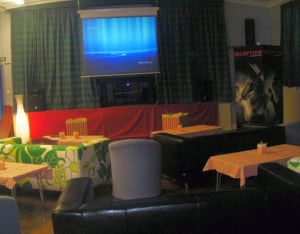
 We run the film evening once a month on a Thursday night but it is more than an event because we are seeking to build a Christian community. It is taking place in the church building at the moment as we have got two fantastic projector screens in our main church area and we make the most of that – but we also try to make it as informal as possible. We also have two other halls in the church and they are also kitted out with DVD projectors so we can use those spaces if we want a more intimate setting. Cinema going is about the whole experience, not just the film itself, so popcorn and sweets are available and we have had ice creams and hot dogs in the past. About 20 to 25 people come along on average and we have an equivalent Reel Church for children which is also very popular.


 However, after the first few sessions it became clear that we were not reaching the people we were aiming for. Another church in Pontypridd had started an all-singing, all-dancing café service, complete with live bands, at the same time as us and that attracted the students. We couldn't compete with that. After a few months we were at the stage of thinking Café Church was an interesting experiment that hadn't worked and we would let it die a natural death.
 I also run
  1st Sunday has developed in a very different way to the Porth Café Church in that it has drawn in people who had left traditional church, whereas in Porth we have appealed across ages and across theologies within traditional churches. Our main problem in Trefforest comes with leadership because inviting people to share leadership responsibilities for something they see as part of the traditional church – which they feel very disillusioned about – makes it very difficult. One of those who comes along is an active lay preacher. She has very much enjoyed attending 1st Sunday@5 and not having to lead. I have respected that but we will have to look at people who are willing to find a way of continuing it as my term in the church is likely to end in about a year's time.
 The vision for Tulloch NET came into being in 2004, three years before its official launch – and charitable status. Its Community Development Officer, Revd Richard Higginbottom, outlines Tulloch NET's development and future plans in north west Perth.
 Our ethos is to have an innovative, creative and fluid relational approach to social and spiritual needs in Tulloch, listening always to God and engaging in a sustainable way with the community, especially the disadvantaged. Tulloch is classed as an Area Based Initiative; this is a local authority designated area for re-generation and help with deprivation. We do this through social action, prayer, liaison, visiting, listening, occasional events/Sunday activities, projects and hospitality. On our promotional material we say that Tulloch NET is a Christian network offering practical help and spiritual support to the people of Tulloch.
 Starting with attempts at addressing perceived local needs through parenting seminars and partnerships with the local primary school and Council, we formed a team of volunteers and a small inter-denominational reference group. Some initial funding came from personal supporters and from the Church of Scotland, Baptist Union of Scotland and the Scottish Episcopal Church.
 Since 2007, we've also organised 'spiritual events' such as a Christmas carol service, a Songs of Praise and Christian stalls at school celebrations. These have had limited effect but our big breakthrough in 2011 has been to secure – in partnership with other Christian agencies – former shop premises as an incarnational base in Tulloch which we're developing as a community drop-in for local needy folk, including addicts. We opened in May and have since attracted an average of 20 visitors per week; a part-time Welcomer has now been appointed there. We have maintained regular local prayer-walking throughout our project history and a prayer box for specific prayer requests is kept in our Hub.
 Our core virtues remain Relationship, PRAYER, Creativity, Humility, Commitment, Bridging the Secular/Sacred Divide, Restoration, and of course… Jesus. Creativity under God is not based on strategies, but depends on moves of God. Our project is all about Jesus and Kingdom: it involves patience and God's timing.
 Mary Styles, an ordinand with the CofE Diocese in Europe, is a Reader at All Saints Church, Rome. For the past nine years she has led Footsteps, a fresh expression of church meeting in two areas of the city.
 Footsteps started because I was aware of the gap between these sort of discussions and the opportunity or space to follow them up. Since that time, some of those who have been part of Footsteps are churchgoers who have lapsed, others have been involved in church life for quite a while and there are also those who are not interested at all in attending a traditional church.
 Footsteps now meets in both a northern and a southern suburb, Casal Palocco and La Storta, for informal worship in English and runs weekly Bible study groups and occasional Alpha courses open to all. We meet in people's homes, as families and individuals, to serve and reach out to our neighbours. Our mission is 'knowing and growing in Jesus, following in His footsteps and putting His love into action.'
 Dealing with ex-pats means there are large fluctuations in numbers because our community is particularly mobile; quite a lot are highly skilled professionals and they may be with us for anything from six months to two years before they fly off again. We generally tend to attract families with children; there aren't too many people of grandparent age.
 We try to keep the actual worship to an hour but there is always a time of fellowship afterwards with coffee and pastries. I have had lots of support from the local Baptist pastor and Methodist minister and my parish priest at All Saints has been very supportive too – though there has been the inevitable tension from some people in the community who say that we should bringing regulars from Footsteps into All Saints. On the positive side of things, we have got vicars and ministers who want to help us lead interdenominational worship because we are not linked to any one tradition. The only link is through me – who happens to be an Anglican Reader.
 I have been trying to prepare people for a handover in leadership but, due to the transient nature of the congregation, everybody I have trained as possible new leaders has left. As a result I am now trying to forge links with churches with a good organisational structure in order to help make the big decisions about the way we are going.
 I now have an Anglican team of about ten people, including Church Army officer Shena Woolridge. Church Army gave us full funding for five years and Shena works full time on spirituality and the arts. The entire Deanery is represented in the make up of the team, we have got 27 Anglican churches here for instance but five of those churches may be in one benefice so one person will represent that group.
 We also have a mix of lay and ordained as well as some people who have recently come to faith. Whatever their Christian story so far I look for people who don't speak church 'language' all the time – it's very easy to slip in to that but it ends up meaning nothing to the people you're trying to reach. It's interesting that people who don't know anything about church tend to respond to friendship and support but the de-churched people we meet along the way look for some form of accountability so they know if we are 'safe' or not.
 Healing on the beach for example is a bit controversial among the churches but most people on the streets – faced with things like regular Mind Body Spirit Fairs – are saying, 'It's about time Christians were doing something like this'. The media around here call me 'the vicar without a church' and I'm fine with that. I don't face too much opposition as such – mainly because I'm ordained and the vicars see me as being in the same boat and also that I came into this job because I truly felt that God was telling me to do it; to be a church without walls.
 Part of our role is to try to encourage churches to shape a team and take over building community when they feel equipped to do so. At Christmas last year, St Mary's, Cloughton, staged a live nativity on Town Farm in the village. It was the first time the church had ever been involved in anything like that. It has since moved the local post office inside the church to ensure that the community doesn't lose that vital service. They also have a fresh expression café church called Café Refresh which meets in the village hall.
 Sacred Space on the beach is very popular with people lighting a candle to give thanks or commemorate something or remember someone. In the pilot project last year 150 candles were lit on South Bay, Scarborough. We are not there to Bible bash or collect money. As a result people stopped and said, 'We don't go to church but can we join in?'
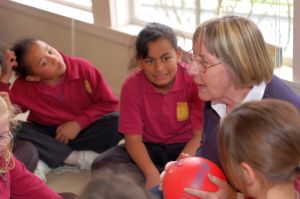
 Church Army New Zealand runs a successful bus ministry called Canterbury Kids Coach. Captain Louise Weller tells how a new Christian community, X-Site, has developed to work alongside the mobile ministry to reach families in Rowley, a needy suburb of Christchurch.
 The X-Site weekly sessions are from 3pm-5pm every Friday and follow a similar pattern each week. Leaders and other adults from the community arrive from 2.15pm and we stop to pray at 2.45pm. The children arrive from the nearby local school and are given a drink and games to play and we sit around and chat.
 Refreshments are provided and meals arranged at the end of each term. We carry out visits and follow-up work to help meet material needs and address neglect, truancy and abuse. This is much more than just a bus; it is bringing Church to the people.
 Three team leaders are members of the local Anglican Church and two are from the nearest Baptist Church; teenagers help as junior leaders. Although we are a Church Army initiative, we also have the support and encouragement of our local parish and some families have now started attending services on Sunday.
 We want to see lives transformed and communities grow. I didn't have an opportunity as a child to hear about Jesus, so I had to struggle alone during my tough teenage years. Consequently I desperately want others to have opportunities to hear about, experience and grow in the love of Jesus, and be equipped to reach their full potential.
 The Kairos Centre has opened its doors as a building for the community in Grange Park, Northampton. It's a dream come true for project chairman Charlie Nobbs and the start of another chapter in the story of Grange Park Church. Anglican minister Charlie tells the tale.
 As an Anglican and Baptist Church Local Ecumenical Partnership we meet together on Sunday mornings in Grange Park Community Centre in a nearby part of the village but the Kairos building, in a parade of shops opposite a doctors' surgery, is the base for our church office and coffee shop.
 The larger meeting room can take about 60 people and there is also a quiet room; a place where people can have 'kairos' or just find some peace from the hectic pace of life. The lounge area also has a coffee shop currently open four mornings a week as well as a small meeting room and the church office. These rooms can also be used for affordable conference/meeting facilities.
 I gathered a few people together but the Baptists had beaten us to it! They felt that God had called them to plant a cell church at Grange Park and we had a similar sense of calling to what God was doing so we joined forces and started to gather a team.
 Kidzone has continued and grown as an annual event and we usually get 400 to 500 children over three days in the last week of the summer holidays. As our aim is to be good news in the community, Kidzone is something that has worked very well in letting people know there is a church, that it is good to have it and begin to build relationships.
 The good news is that the Health Visitors believe Talking Point has significantly improved the mental health of struggling mums as it is a network which picks up different people. We now have various Talking Point groups in and around Grange Park. We use cell principles and organise a social night for the parents without their kids; it welds them together as a cohesive group.
 That in turn has developed because several mums said they wanted to find out more; their children were asking questions they didn't know the answer to and the parents also thought of the Bible stories as being a 'good thing' to teach the little ones.
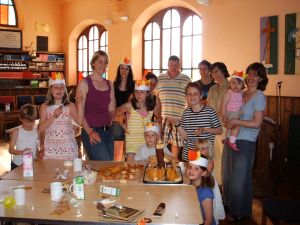
 I prayed with a member of a local Baptist Church about the direction in which we were meant to go. A third person came along from Christians Together in Capel and she had a vision that we should set up Messy Church so we decided to pool our resources and put our energies into that.
 At our first meeting we catered for 40, buying two hotdogs for each person expected so we got 80. Then somebody reminded me that we might have vegetarians there so we got veggie versions as well. Thankfully we did, with a crowd of 65 on the day!
 Creation was the theme. We had a table game and word searches, and told a story with drama involving the children. It was so packed and so noisy, we had to stand on chairs to be heard and seen.
 As we knew that not everybody would be there on Easter Sunday we included the celebration of the Resurrection as part of that Good Friday service. There was a wonderful sense of having gone through Holy Week and to Easter with our Messy Church newcomers. We had linked things together for them in the previous Messy Church sessions by following the accounts of Creation, Noah and God’s promise, and then God’s Promise showing itself in the death and resurrection of Christ. A rainbow poster we made on our second session carried the theme through.
 Pioneering Baptist minister, Simon Goddard, explains how RE:NEW grew in rural Cambridgeshire.
 So in September 2006, 'Sunday Club' was launched with personal invitations for each of the sixty or so children that had been to the holiday club, and adverts in the village magazines and through the schools. It was advertised as a 'holiday club on a Sunday' and this meant that there would be video, games, craft, action songs, a creative prayer activity, and a very short talky bit focussed around a memory verse. A number of families from the holiday club joined us at the first event and although a few didn't return, many continued to come each fourth Sunday.
 This development, however, was not how the members of Lode Chapel had initially envisioned 'Sunday Club' progressing. The fellowship’s hope was that 'Sunday Club' would provide a way for the main Chapel congregation to grow, but although one family had come to a few services, they had not stayed. Families were still coming month by month to the school event, but Chapel services were so different from 'Sunday Club' that it seemed such movement was unlikely. To me, rather than being engaged in an outreach activity, it seemed that we were now involved in planting a new congregation. Although it was difficult for the Chapel members to understand, I felt that my commitment to this new initiative was critical.
 There have been some challenges as we've slowly realised that the two styles of event connect with two different groups of people. Whilst the Swaffham Bulbeck event was accessible for the 'un-churched', many of those coming to the 'Kids Club' could be described as 'de-churched' – having some previous, but not current, connection with church. But as we've clarified the vision there have been some exciting times too as a growing number of people at Lode Chapel have grown in commitment and enthusiasm to this mission activity. Many members have a more active role in the 'Kids Club' which is now accompanied by a 'RE:NEW Café' where parents chat over a coffee and watch a Nooma DVD. Jonathan and Emma, whose particular calling is to work with the 'un-churched', are now taking a leading role in organising social events and 'community blessing' activities.