
Emma Major is Licensed Lay Minister at St Nicolas, Earley. She tells how three friends from local Berkshire churches started Oakwood.
I became a Licensed Lay Minister (our local equivalent of a Reader) four years ago and, right from the start, have been pioneering. I'm not what you might call a 'standard' Licensed Lay Minister (LLM)!
I have been at St Nicolas for 11 years and I had my calling while I was there; they supported me brilliantly through my training which was in the evening and at weekends though the Oxford Ministry Course. I was previously a civil engineer, running Government workshops, but I have always been interested in pioneering.

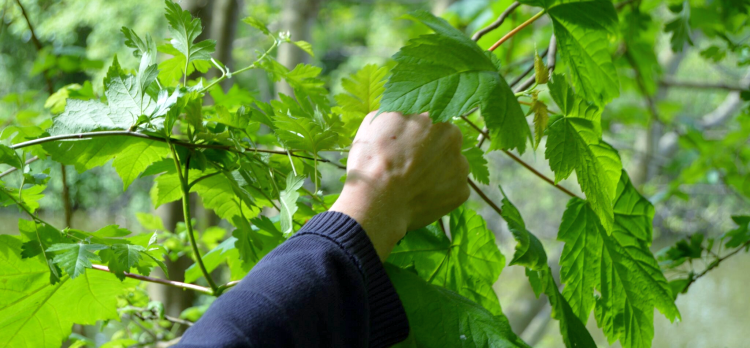
Oakwood Forest Church all started when three of us were talking at a joint churches' event about how close many of us feel to God when we're in the countryside; how he feels less removed from our prayers and he seems more alive in our hearts.
The general thought was, 'If we could worship outside, that would be amazing'.
In the summer of 2013 we were in the Maiden Erlegh Nature Reserve when this seed of an idea grew a shoot of a plan. The reserve is a lovely green space, which includes eight medieval oaks, in the middle of a 1970s urban area.
We decided that we could meet together in the reserve to worship God differently; meeting people where they are already finding the source of their belonging. That became Oakwood Forest Church (OFC) and, over the last 18 months, we have met every month to walk, explore and pray together at the reserve. We have grown in number to 30 adults and 20 children who attend at least four times a year.

It's important to say that, while we love the creation all around us, we are not worshipping it – we are worshipping God as the creator. We are very Christ-centred in our programming at Forest Church; always coming back to Scripture and prayer. We generally pick up a Bible passage that relates to the season and take it in turns to plan our time together. It's particularly encouraging when young people and teenagers are asking if they can lead sessions or elements of response which we describe as 'Mossy Church', a title I know others are also using.
We started out by putting details on Facebook of what we were planning to do and we got 20 people coming along. Then others started to ask us questions about Forest Church as we were walking around and some dog walkers joined in! There has been quite a mix of people coming along; we've had people who have been separated from God for so long but said, 'This is church for us, we don't want to go into a church building'. Others have wanted to go into a church building again and some have said they want to do both. All of them, whether they've had experience of church or not, don't see Oakwood as 'just' an event – they all recognise it as being far more than that.

Facebook and all the social media give us the opportunity to keep on connecting, we are 'meeting' every week in that way and, as a result, prayer for each other – and the Oakwood community – has grown out of it.
This spring, four of us who feel called to lead OFC over the next few years, got together to pray, plan and prune. We reflected on what had been going well and made changes necessary for the ongoing growth and strengthening of this fresh expression of church. We decided to reduce our meetings to five times a year, linked to Christian festivals at Christmas, Easter, Pentecost, Summer and Harvest, in order to ensure the sustainability and depth of our services. We also made the decision to hire the Rangers' Interpretation Centre at the nature reserve in order to make OFC more accessible and allow us to have a fixed base to worship and share a meal together.
Everybody loved it from the moment we started to use the centre because it felt like a home or us. Personally, I have developed a debilitating illness so I can't walk too far any more but knowing that I can stay at the centre and pray – while others are responding more physically – is broadening the accessibility of Forest Church.

Word is beginning to spread about what is going on here and we have people from other churches, schools and individuals nervous of the institutional church, asking what it's all about.
We are so blessed because we have such support. Our local Churches Together love it and The Bishop of Reading, Andrew Proud, has said that he trusts us in our planning for this while our priest at St Nicolas', Neil Warwick, tells us, 'Just go for it!' I feel so lucky to be part of this and to be alongside people as they come to faith through Oakwood Forest Church.
I'll be part of the team involved in the Thames Valley mission shaped ministry course, starting this month, and I'm looking forward to reflecting on what is happening here as part of that. During the summer, Oakwood Forest Church will be providing prayer stations at local church and community fairs. We trust God to lead us as we continue to grow and evolve.
 Wood Green Mennonite Church, London, is piloting a 'walking' fresh expression this year. Phil Wood, a member of Wood Green, explains how the monthly church is a mixture of walking, talking, prayer, liturgy and meditation.
 When I first talked of this, responses were mixed. No matter how practised I become at explaining the notion of a congregation where church occurs in the walking there are still people who don't 'get it'. That isn't surprising. Walking Church was never intended to be in competition with worship inside a traditional church building – some still think it is a gimmick but I believe they are wrong.


 We're learning something about evangelism in the values driving this particular fresh expression. One of our walkers likes us because we don't 'proselytise', instead we 'reflect'. Are we too peaceable to share faith? I hope not – but our message isn't 'become like us and you will be saved'. We are a 'peace church'. Yes, words are important, but mostly peace is in the pace. It's easier to listen at three miles per hour.
 Belfast's Titanic Quarter is at the heart of the city's regeneration. A few years ago the area was largely deserted, but a large-scale redevelopment programme is transforming it into a 21st century 'urban village'. Chris Bennett is chaplain of The Dock.
 It requires a kind of reordering of your expectations in a new way. It's a process. I was coming in with some expectations which were pretty standard parish-based ideas and it's been fun having that knocked out of me.
 The idea of yet another expression of church in a place where division and sectarianism has caused such problems in the past can be seen as not overly helpful. There are very few working models of how Christians all share a ministry other than chaplaincy – why should it not work in the Titanic Quarter? The variety of needs here is too great to ever be encompassed by one minister or even one denomination. Chaplaincy is helping us to work out shared working in denominations. It's a key that unlocks unity rather than describing my absolute mission statement.
 Clearly the Titanic Quarter, when complete, will be big enough to merit its own local church. But the opportunity runs even deeper than the chance to plant another church along existing models. A brand-new community, in a brand-new part of the city, offers an opportunity to re-envision church for a new cultural context.
 I would see our expression of church as our weekly Dock Walk where we chat about a passage of Scripture as we're on the move, or as we stop, pray, or listen to meditations or music. We use
  As part of our future plans, I also hope to get a boat – that has been the concept right from the start. Quite a few people ask us why, particularly with all of the Titanic associations here, but it feels like we are at the stage where we have done all we can do in coffee shops and a boat would give us an operational base. That means people could physically find us rather than having to rely on a website and a phone number for information.
 As for being associated with the name of the Titanic, we're all accustomed to queries as to whether it's bad taste to commemorate that link at all. In fact the view in Northern Ireland is that it was all right when it left here; it was later on when disaster struck. But for many years there was a real level of shame about it – I actually think there is something of God about the way that everything is tying together in Northern Ireland at the moment. Somehow, the Titanic, from being a thing we never much talked about, is being re-born because it pre-dates the Troubles. For all that it was quite clearly a tragedy on its maiden voyage, the very fact that it sank has stamped its name on history. Many other ships suffered tragedies but the scale of the Titanic's amazing construction makes it unique and people now feel it's right to remember the incredible expertise that went into it. That's why there was such interest surrounding the recent 100-year anniversary of the Titanic setting sail.
 The talk in the corridors of political power is all about Shared Future and Community Cohesion – redefining the existing communities and asking them to change but here we have the opportunity to create a new community that looks very different from our sectarian past.