
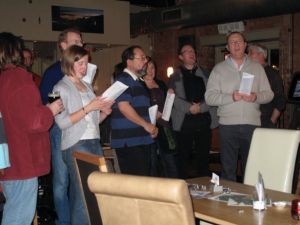
Beer and a singalong helped to launch Leicester-based Presence as a Bishop's Mission Order. City Centre Pioneer Minister and Presence leader, Revd David Cundill, looks back at a whirlwind year and outlines his hopes and plans for the future.
 It all happened very quickly. I started in post at the end of May 2009, discussions took place over the summer to sort out the BMO, and it was signed in December at a Beer&Carols event. We certainly reaped the benefits of the hard work that other BMOs had done before us in Exeter and Thanet.
Bishop Tim Stevens started the ball rolling when he gave me a brief to 'just go and plant a new church in the city centre. I give you permission to fail; you have got to take risks.'
That church was to be in an area of new apartments, waterside redevelopment, and the DeMontfort University campus. The result is Presence… a fresh approach to church. We describe it as a church for people who don't do church or go there, never did, don't anymore, don't think they fit in, doubters, sceptics, seekers and the spiritually curious.
 In the middle of the BMO area is The Quay, a canal side pub which was itself part of a regeneration project a few years ago. It is now the base for Presence's midweek meetings, and some of those at Presence have become regulars at the pub’s open mic session on Thursday nights.
My first task is to develop a 24-strong planting team to reach out to the area's diverse communities; including those based around a series of tower blocks in gated developments at Freemens Meadow, Westbridge Wharf and Leicester Square.
These new blocks are in stark contrast to the area's traditional terraced streets. Each tower block looks in on a quadrangle, and you have to get through two gates to get into the heart of it all. There are no community facilities. When you look at the ads for these apartments you'd think that we had so many stockbrokers just about to nip on their bikes to Canary Wharf – and yet the development stands at the edge of the country's biggest Hindu population, but you’d never know that from the marketing image portrayed.
 The regeneration of great swathes of the city means that new communities have become cut off from parish churches because the landscape has shifted, but by starting a fresh expression alongside those churches, we can redefine a pastoral boundary. It has just worked brilliantly in that it's possible to run a straight mixed economy which lets the existing parishes do what they do while we look at how we use these places in new and creative ways.
In other areas people may say, 'we are all in this together', but underneath the surface they are worried. In Leicester I believe it has worked – and, with God’s help will continue to work because of the unique circumstances surrounding redevelopment of this city.
 This is a minimum 10 year project, and part of the challenge is that the landscape will continue to change dramatically during that time. Large brownfield sites in our area are set aside for new developments but are yet to be built on, so we need to be flexible in our approach and planning.
But some of our plans are very firmly in the pipeline, including the launch of a film club in the Highcross area; the setting up of a Christians Against Poverty (CAP) centre and money management course; and a term time Street Pastors scheme around DeMontfort University.
 We also very much hope to be involved at The Quay on St Patrick's Day. There are lots of possibilities but we might look at having a religious 'bit' followed by Open Communion using Naan bread – reflecting the type of area we're in. We want to reclaim these celebrations for God, and show that we're a church of festival and fun.
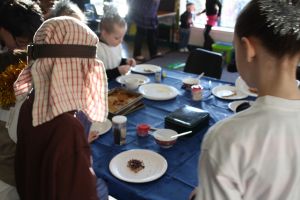
 We had a trial run at Wilmcote House on four successive Sundays earlier in the year. As a result of that, one family – who live in Wilmcote House – decided to join us. At Christmas we had the Wilmcote House Nativity. All ages were welcome and children had the chance to dress as an angel or shepherd to hear the Christmas story, enjoy a free breakfast and take part in some craft sessions.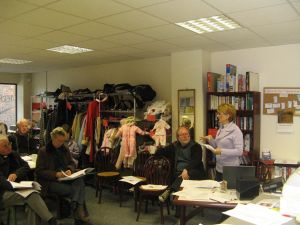
 It was initially conceived out of unmet needs of a 'mission audit' completed by a local Methodist Church. To complete this, we went out into the estate to ask questions about what people thought the needs were. The most significant finding of the survey, was that local people thought the church was irrelevant and had nothing to contribute. One of the greatest needs that people did identify was the need for a drop-in for older people to be able to come to meet people and socialise in safety, and also a place for younger people. At that time the estate was known for being a rough place with problems with drugs and anti-social behaviour. This coincided with an offer from the owner of the butcher's shop to the Methodist church, to use it for something to help the community. I was asked if I would assist in the exploration of potential solutions to the meeting of these needs and sought other agencies to see if there were any opportunities for partnerships to be able to take on the shop for mission and ministry. So the vision for a community café gradually emerged.
 I was one of the founding members of the initiative, as I was involved with it in the early days of my training for Methodist ministry. I quickly discerned that God was asking me to stay with the Terminus Initiative, which at the time was completely against the usual expectation of Methodist itinerant ministry. So I kept this discernment to myself (not even telling my husband) waiting for it to be confirmed by someone else to test it. Within a few weeks, our Superintendent Minister at the time, Ian Bell, asked me if I would consider staying on and co-ordinating the Initiative, but that there would be no money for a stipend. As I had retired early on a pension from the National Health Service, I decided I could cope, and committed to it.
 The Terminus Initiative is now in its eighth year. The café is open three days a week, targeting different groups in need, and the premises are used by other community groups when the café is closed. The Terminus Initiative, with its other projects, has supported asylum seekers, refugees, drug users, people with alcohol addictions, people with mental health needs, young people, and older people. In fact there are many social activities going on all the time including discussions/Bible studies, and prayer underpins it all.
 In the many partnerships we have, we focus on the spiritual needs of those who come into the Terminus building. We hope that the work of the Initiative has challenged people's perception of the church as 'irrelevant', replacing negative stereotypes with a greater respect for Christianity and the Church. We have seen many people seeking to explore the Christian faith coming out of the community and loving service they have experienced at the Terminus. Many of these people have gone on to discipleship groups of the partner churches, as we seek to be a committed local 'mixed economy' of church finding unity of purpose in mission.
 Ted's story


 St Paul's is an Anglican church in Willington Quay, an area of urban deprivation on the banks of the Tyne. In 2000 the church was reordered to accommodate a community project, managed by the church. Steve Dixon, Church Army Evangelist and Lay Pioneer Ministry in the Diocese of Newcastle, continues the story.
 In amongst this is St Paul's Church, which was one of nine churches in the area. As the area suffered increasingly from the trauma of post-industrialisation, all the other churches were demolished as their congregations became unsustainable. In response to the increasing social needs, St Paul's Church was reordered in 2000 to accommodate a community project, managed by the church. This was a very brave decision, as St Paul's Church itself was finding it difficult to keep going.
 The project aims to make a difference to local people facing deprivation, with groups and support for single parent families, young people, people living with long-term unemployment and older people. All these activities were centred on offering loving service, working in partnership with local government and other voluntary organisations. The project has created social cohesion for those engaged with it. We can expect 150 people to turn up for community events that we run, because there is now real ownership of it. My post was created by the Diocese to develop a fresh expression of church out of the work of the project, as part of a team ministry. Given that there is now a viable community, I was charged with exploring the need for discipleship and forms of worship. The two church wardens and I are the people on the ground. One of the first things we have done is to set up a new more inclusive and empowering management approach to the project, now called 'St Paul's Community Partnership', that involves local residents and institutions.
 We did a lot of thinking about how we can rebuild a form of church coming out of the project. Do we start with some form of discipleship course or worship gathering as a bit of a taster – to give people room to explore questions? We chose the latter, because contextually there is real resistance to training and education type approaches, as many people here had a poor experience of education. So on Pentecost Sunday 2009 we started worship services again in the church, using the CPAS 'Start course' and adapting it to meet the discipleship needs of our context.
 The Church now faces new challenges. A lot of the ex-industrial land has been bought up for new housing, for those who have money. Clearly this is not going to be the people who already live here. It seems that more affluent people living in Tyne & Wear are moving in. This raises huge issues around social cohesion, with the 'have's and the 'have not's living in different parts of our expanding village. We are currently exploring setting up some new forms of groups such as book clubs, evening classes and explorations of spirituality to engage in these 'new build' areas. We are still dreaming!