
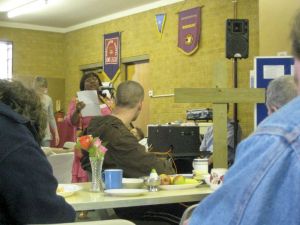
 Street Church in Northampton welcomes up to 90 vulnerable and homeless people at its weekly get-togethers. David Bird describes how Christians from various denominations work together in developing the work and ministry of this growing fresh expression of church.
Our early experience of homeless people here at St Giles involved them coming along to Alpha courses for the free food before disappearing pretty quickly. They'd also turn up on the doorstep of the vicarage and I would have a chat with them. At one point, a guy came along with a spiritual understanding of God who asked me to pray for him; at that point I knew that I had to do more than offer him a cup of tea and a sandwich.
A member of the congregation is involved with the Hope Centre, a project that serves what is quite a large homeless community in the Northampton area. When one of the community died, it was a social services funeral and none of the rest of the people who knew him from the streets had any idea when it was or what had happened.
They wanted to have some sort of memorial service and the Hope Centre volunteer asked if I would go in and do something for them. About 50 people turned up to that. It wasn't a recognisable service as such, but we played his favourite music, talked about what he was like as a person, and they lit candles to remember him.
 A lot of homeless people find Sunday the most difficult day of the week because there is nothing open specifically for them so we got together with other churches to arrange a weekly Street Church drop-in service from 1.30pm to about 3pm. It takes place at the Salvation Army Northampton Central Corps community hall, and the majority of helpers are from St Giles but there are also people from Kingdom Life New Frontiers International Church, the Salvation Army, the Roman Catholic Church, and another Anglican Church. Each takes it in turn to provide the all-important catering.
We use multi-media material from The Work of the People, an American organisation which highlights Christian issues – usually through visual images rather than words. There is very little 'preaching' as such, it's more a case of sharing testimonies and stories but a lot of it is one-to-one relational stuff. We also invite guests to come along and sing to us as performance worship. Some of the homeless have got musical gifts too so they're also getting more involved in that now.
 Every six weeks or so we offer pampering when people get their nails and hair cut. Some prostitutes also come in and we do their nails too, just to serve them and show that we care.
Street Church began in Easter 2008, and some of the people later started coming to our traditional church service in the evening as well. One man who did that now wants to be baptised. I have been quite precious about it in some ways because it feels like something that is both the work of God and a tender plant. The direction we want to take it in is to help these vulnerable people get a lot more stability in their lives, and set up mentoring for a number of individuals.
As ever, money plays a key role because the project is being run entirely by volunteers at the moment though we have recently applied for a grant for a part-time worker. It is nothing like church as many would think of church. You can't ask our regulars to give by Direct Debit for example, and that means it will never be self-supporting. Instead we see it as part of our mission to Northampton, our church supports it and other churches support it in that way.
 It is tough work but worth it because there is a huge mix of people at Street Church. Some of those are kids thrown out of their own homes by their families; they can be into drink or drugs so that can be quite difficult. There is a guy called Dancing Joe who always turns up smartly dressed though a bit 'crinkled' round the edges, and there are quite a few Eastern Europeans who have had jobs in the past but are now sleeping rough.
One of our volunteers is an ex-Army guy, and he deals with a number of men who have come out of the forces and – for one reason or another – just can't cope.
I often say that many of the homeless we deal with are no different than anyone else; it's just that their sin and their weakness are much more obvious than other people's. Those who come to faith at Street Church and begin to sort their lives out often say they no longer want to be part of the community because they are keen to move on. That's understandable but some have remained and carried on helping as volunteers and that's a very powerful message to those who come. It says, 'just because I live on the streets doesn't mean I will always live on the streets. Just because I haven't got my life sorted out now doesn't mean that it will always be that way.' It gives them hope.
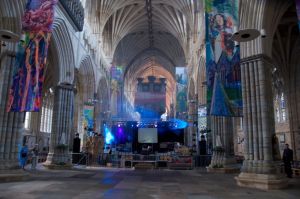
 Friday nights see us get together to explore social justice, enjoy the creative arts in poetry or music, and become involved in discussion, prayer and meditation and lots of other things.
 Wendy Sanderson, Night Club Chaplain, Church Army Evangelist, Lay Pioneer Minister and co-founder of Solace tells the story of this unusual fresh expression of church in South Wales.
 From the beginning we met a lot of people who were into clubbing who were interested in Jesus, God and faith but often, not traditional expressions of church. So we began on April Fools Day 2007 aiming at people who were searching for something. I am 32, and clubbing is part of my life, so Solace has grown out of our lives as clubbing people. On our launch night over one hundred people turned up, mostly I am sure out of curiosity, and now on Sundays we draw on approximately fifteen to twenty people a week. When the Archbishops of Canterbury and Wales came, of course numbers rocketed. We like guest speakers!!
 We engage with the de- and un-churched – in fact anyone who is interested in exploring faith. We have wanted to break down the negative stereotype that many hold concerning Christians and Church. Most of the other churches in the area are geared up to the needs of young families with children, but we are uncompromisingly focused on the many younger adults who are single. There are many, many single clubbers in their twenties and thirties who do not relate to forms of church which seem to over-focus on families. In many ways, Solace is a spiritual community, a society of friends where clubbing is an important part of our lives, and most of us are single. We are pleased that Solace has developed into a place of hope, a place of peace and safety. Some have said they value it as a place where you can be completely yourself and be accepted unconditionally and where people are non-judgmental.
 When it comes to discipleship, we specifically work on a one-to-one basis, where the themes and discussions on Sunday nights encourage people to explore or re-imagine spiritual things. We allow people to challenge each other on Sunday nights, and encourage people to dig deep with the Christian faith and the stuff of life. This is learning about the faith through proactive engagement in activity. Something like an Alpha Course or Emmaus just would not work in a clubbing context.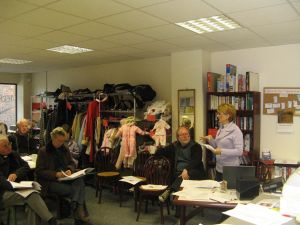
 It was initially conceived out of unmet needs of a 'mission audit' completed by a local Methodist Church. To complete this, we went out into the estate to ask questions about what people thought the needs were. The most significant finding of the survey, was that local people thought the church was irrelevant and had nothing to contribute. One of the greatest needs that people did identify was the need for a drop-in for older people to be able to come to meet people and socialise in safety, and also a place for younger people. At that time the estate was known for being a rough place with problems with drugs and anti-social behaviour. This coincided with an offer from the owner of the butcher's shop to the Methodist church, to use it for something to help the community. I was asked if I would assist in the exploration of potential solutions to the meeting of these needs and sought other agencies to see if there were any opportunities for partnerships to be able to take on the shop for mission and ministry. So the vision for a community café gradually emerged.
 I was one of the founding members of the initiative, as I was involved with it in the early days of my training for Methodist ministry. I quickly discerned that God was asking me to stay with the Terminus Initiative, which at the time was completely against the usual expectation of Methodist itinerant ministry. So I kept this discernment to myself (not even telling my husband) waiting for it to be confirmed by someone else to test it. Within a few weeks, our Superintendent Minister at the time, Ian Bell, asked me if I would consider staying on and co-ordinating the Initiative, but that there would be no money for a stipend. As I had retired early on a pension from the National Health Service, I decided I could cope, and committed to it.
 The Terminus Initiative is now in its eighth year. The café is open three days a week, targeting different groups in need, and the premises are used by other community groups when the café is closed. The Terminus Initiative, with its other projects, has supported asylum seekers, refugees, drug users, people with alcohol addictions, people with mental health needs, young people, and older people. In fact there are many social activities going on all the time including discussions/Bible studies, and prayer underpins it all.
 In the many partnerships we have, we focus on the spiritual needs of those who come into the Terminus building. We hope that the work of the Initiative has challenged people's perception of the church as 'irrelevant', replacing negative stereotypes with a greater respect for Christianity and the Church. We have seen many people seeking to explore the Christian faith coming out of the community and loving service they have experienced at the Terminus. Many of these people have gone on to discipleship groups of the partner churches, as we seek to be a committed local 'mixed economy' of church finding unity of purpose in mission.
 Ted's story