
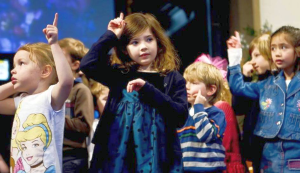
It all started when St Paul's Church, Dorking, opened up its doors to a new 'audience'. As vicar Paul Bryer explains, the result is 'Café Church – church with a twist'.
Our monthly Café Church has been running for two years and it has had an enormous impact as it reaches so many people who would not otherwise come into St Paul's.
Members of our weekly congregation make up about half of those who come along but the rest just come to Café Church. Children's attendance figures have doubled as a result; we normally have about 40 children on a Sunday but at a recent Café Church we welcomed in the region of 80 with 175 adults.
 The church building itself is on the way to a school so many parents walk past St Paul's during the week. Many mums and dads also drop their children off at our church nursery and, for quite a long time, we had seen people standing outside the church in the cold and the rain while on the school and nursery 'run'.
The thought came to us. Maybe we could give them coffee in the church instead of them having to wait outside? So we opened up the church doors, served coffee in one of our aisles and called it the Earlybird Café. People very quickly started to come in every morning.
The result was that we thought about how we could involve them a little more and invite them to our services. We also knew that if they came into church on a Sunday morning, it was possibly something they had never experienced before – we knew we needed to make it much more user-friendly. That's when we thought about making it a café based service, launched the Café Church on the first Sunday of the month and things have grown from there.
 When people walk in they can go and get a tea or coffee, pick up something to eat from bacon rolls and croissants to waffles and homemade cake and take a look at the Sunday papers. Everything is set up around small tables, there's music in the background and it's all very informal. For the first 15 minutes, we just let them come in and 'be' and I then welcome them from the front – but it takes a while for people to settle down!
I explain the theme and tell them that everyone is free to come and go when they want and join in with everything or nothing. Our worship group then lead us in one or two songs which we try to ensure are familiar to those visiting us maybe for the first time.
Each Café Church is themed to run in parallel with the general teaching in the church that week but we make it accessible for this particular congregation. We have found that the only way to gather people together to focus on one thing is to use something highly visual so we usually make the most of a really powerful video clip to illustrate the teaching points.
 I then explain that people can explore the theme in more detail in various ways. We have various 'stations' set up around the church to help people to do this. A small team got the whole idea of the different stations up and running but they have now grown their own teams to develop the work.
There are:
- creation stations – to make or create something as an act of worship in response to the main key point for that particular session;
- painting station – contributors paint an entire work of art during Café Church to have it ready by the end of the service;
- exploration station – to engage with people in greater depth. That may involve looking at some questions around the theme of the day or getting together in buzz groups;
- prayer station – to encourage various creative ways of praying such as a prayer graffiti wall and 'postcard' prayers as well as having a person available to pray with;
- giving station – highlighting different ways in which people can give, whether time, money, talents, resources or whatever.
 That all happens for about a quarter of an hour and at the end of that time we then gather everyone together again. Children who have made something show it on our big video screen and we have a final song and then a prayer. It runs from 10.30am for an hour though lots of people do hang around to chat. The response has been huge and it's teaching us a lot about church and being church because it really does attract people who wouldn't come along to the other services.
A big issue now for us is what do we do the week after a Café Church Sunday? Is it enough for these people to double our congregation on the first Sunday of the month and then disappear? If they come to one of our traditional services, they can feel like fish out of water. What about ongoing discipleship? We are dealing with all ages from little ones to teenagers as part of this and it's the kids who are bringing their parents in.
 For some people in our main congregation it has been a bit of a challenge but they can see the difference it is making. Thinking about the popularity of this form of service with families made me wonder about our context. We are in a commuter belt and many parents work really hard during the week and don't get to see their children very much because they're travelling. If they came to a standard service they would be split up again after 40 minutes when the children go off to their own activities but to have church where the family can all be together within a loving worshipful environment is a different model that seems to fit more comfortably with them.
The introduction of Café Church was a bit of a shock to some in the church but from day one it had an impact on everyone. It's incredibly rewarding how people have been touched with some finding their first expression of faith as a family together. We are always aware of trying to reach those who wouldn't be reached through traditional ways of doing things but it's not something you would undertake lightly. For instance, it was very different for all of us when Café Church fell on Easter Day but we thought, 'Well this is great because it means we can tell more people than usual about Jesus rising from the dead!' We offered an opportunity for people to receive Communion at the prayer station and there was a very warm response to that. Interestingly, they didn't wait in a 'churchy' sort of line for Communion; they just drifted up to the prayer station at different times.
 None of what we have done is rocket science; most churches have run holiday clubs where they have creative activities and we have done that sort of thing too. It's just putting some of these things together and creating an environment where you are willing to take risks. It's also about being prepared to have 'holy disorder' while keeping that dignity of worship somewhere in the midst of it because there is an element of control that is right and godly.
We are just at the point as a church of envisioning what we could look like in a couple of years time and the feeling is that we need to become a lot more like Café Church in our outlook if we are to continue to be missional.

 An old hardware shop in Walsall, had been empty for some time when churches in the parish of Aldridge took it over, changing its name to The Hothouse. Gary Daniel is the Hothouse and Redhouse Community Worker.
 Our sessions for children and young people include:
 We monitor and evaluate change in our community through relationship, conversation, evaluation and questionnaire. This is backed up by using statistical information from the Office of National Statistics. As full-time community worker here since September 2006, I am looking to develop the Hothouse as a viable community project as well as overseeing its growth and development as a fresh expression of church.
 Our overall vision is to make the Hothouse a positive place for children and their families to meet, belong and develop community. In doing this we hope they will discover the love of the Lord Jesus and we do this because, as it says in 2 Cor 5:14, 'Christ's love compels us.'
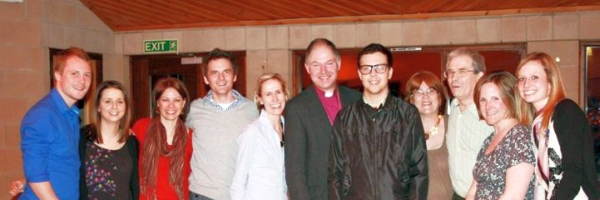

 GLO's commissioning service took place at All Saints and it was great to see it publicly welcomed by vicar Ian Parkinson; Alan Bell, Rural Dean of Stockport; Mrs Lois Haslam, lay chair of Stockport Deanery Synod – as well as a local police inspector and a community worker.
 We meet for worship on a Sunday afternoon in a local primary school but GLO Church is offering lots of different sorts of opportunities to be involved in it and build community as a result. One such opportunity is The Young Mums Way – a group for Offerton mums under 21 years old. It runs every Wednesday afternoon during term time at a local Children's Centre.
 In August we organised a Serve Week so that we could serve the community of Offerton through things like car washing, gardening, litter picking and sorting The Garage. We feel very privileged to be working alongside the police and the council; they are extremely supportive of GLO. We were invited as 'stakeholders' in Offerton to be part of a meeting with all of the interested agencies to look at the Urban Priority Area plan. I was amazed to see that all of the Plan's aims could clearly be seen as signs of God's Kingdom. It was also amazing to know that we arrived just as the local authority started to draw in the community's 'leaders' to change the face of this area and improve it as a place to live. They know that we at GLO are an extremely motivated volunteer force and that has to be a good thing! We've had the opportunity to pray and talk with council workers; I would never have expected that.
 Another very positive step forward has been the approval of our application for charitable status. We have also had planning permission granted for a coffee shop; the idea being to establish GLO Coffee as a place in the heart of Offerton for people to gather as community, train for employment, provide internet access for homework clubs and more. We're just waiting to see what's going to happen with the extremely run down precinct where the coffee shop would be. There are all sorts of discussions going on as to its future and we want to be wise as to the right thing to do next.
 Revd James Blandford-Baker, vicar of St Andrew's, Histon, describes how the church's vision to be at the heart of the village community led to the development of Essence.
 We began Essence three years ago in an attempt to offer mothers a space to explore their spirituality alongside the Christian narrative. We had lots of contacts through our children's work but they had remained just that, contacts without relationship. Having looked at a number of courses (such as START and Alpha) it quickly became apparent that we would need to invent something of our own that would connect with people. The driving issues as we put Essence together were the attitude of consumerism, the importance of story and the desire for spirituality.
 When Essence was launched, we prayed for five people to show up on the first Wednesday and 10 arrived. The format worked from the outset; people talked naturally and honestly, sharing their stories and engaging fully with the Christian story. By week three people were exchanging mobile phone numbers; community was forming. Not long afterwards people began to look after each other when they were in need. It is quite normal for a new mother to have meals for the family delivered each evening for a fortnight.
  Of course this approach raises questions about some big issues, including Baptism and Communion. We haven't resolved those issues but are happy to be continuing on this journey while we continue to consider them.
 Essential to the success of Essence has been the team made up of clergy, our lay pastor for people with young families, our children's worker and other lay people who have taken on certain roles. The crèche team give of their time generously; they have a real heart for the mothers as well as the children. They too feel involved in the spiritual journeys of those who come with many conversations about what God has been doing as the mothers pick up their children after the quiet time. The topics for the sessions each week are a mix of ideas from the team and suggestions from those who attend. Unlike on an Alpha course, there is no sense of the need to get through a defined 'spiritual programme'; we go with the flow and find that there are plenty of opportunities to explore all the most important Christian themes and ideas.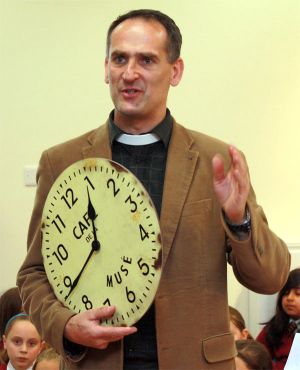
 The Kairos Centre has opened its doors as a building for the community in Grange Park, Northampton. It's a dream come true for project chairman Charlie Nobbs and the start of another chapter in the story of Grange Park Church. Anglican minister Charlie tells the tale.
 As an Anglican and Baptist Church Local Ecumenical Partnership we meet together on Sunday mornings in Grange Park Community Centre in a nearby part of the village but the Kairos building, in a parade of shops opposite a doctors' surgery, is the base for our church office and coffee shop.
 The larger meeting room can take about 60 people and there is also a quiet room; a place where people can have 'kairos' or just find some peace from the hectic pace of life. The lounge area also has a coffee shop currently open four mornings a week as well as a small meeting room and the church office. These rooms can also be used for affordable conference/meeting facilities.
 I gathered a few people together but the Baptists had beaten us to it! They felt that God had called them to plant a cell church at Grange Park and we had a similar sense of calling to what God was doing so we joined forces and started to gather a team.
 Kidzone has continued and grown as an annual event and we usually get 400 to 500 children over three days in the last week of the summer holidays. As our aim is to be good news in the community, Kidzone is something that has worked very well in letting people know there is a church, that it is good to have it and begin to build relationships.
 The good news is that the Health Visitors believe Talking Point has significantly improved the mental health of struggling mums as it is a network which picks up different people. We now have various Talking Point groups in and around Grange Park. We use cell principles and organise a social night for the parents without their kids; it welds them together as a cohesive group.
 That in turn has developed because several mums said they wanted to find out more; their children were asking questions they didn't know the answer to and the parents also thought of the Bible stories as being a 'good thing' to teach the little ones.