
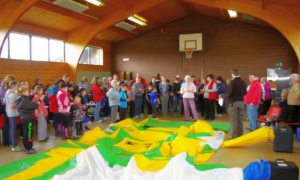
Annandale Churches Together in south west Scotland ran summer holiday clubs in a local secondary school for many years. Very few of the children involved had any relationship with existing churches. Pam Mellor and Deborah Steele explain how Fridays in Faith has helped to bridge the gap.
The holiday clubs in Annan were really, really successful. They took place in an Academy and attracted about 150 children on average but they seemed to disappear as soon as the clubs were over.
Then the questions started, 'Where do they go afterwards? Why don't they come to church?' We said, 'Maybe church is not the place for them. Maybe we should ask if there is something else we should be doing.' Amazingly it was as if everyone had the same thought.
 We had a team of 60 helpers for the holiday clubs and we all started to think about what this alternative would look like. After discussion, thought and prayer we thought about going back to the Academy on a Friday night to run something which would incorporate a lot of the key components of a holiday club – things like fun and food and games – but for all ages. The Academy costs about £150 to hire so we went to the churches and asked for their support in this.
Fridays in Faith is backed by Annandale Churches Together, an ecumenical group that includes Annan Old Parish Church, St Andrew's Parish Church linked with Brydekirk Parish Church, Annan United Reformed Church, St John's Episcopal Church, and St Columba's Catholic Church.
They were fantastic, simply saying, 'It's a great idea and we will support you!'
 Our first step as co-leaders and co-planners of Fridays in Faith was to find out whether the people themselves actually wanted us to do something. We recognised that those who were coming along to the holiday clubs were not anti-church: it was simply that church wasn't even on their radar. In saying that, there were a number of kids from church families at the holiday club as well so we could see there were great opportunities for those within our churches – as well as outside – to grow together as a community.
On the final day of a holiday club with an Olympics-type theme of Going for Gold we did a 'closing ceremony' when nearly all of the children's parents came along. At the end of the session we stood up – very nervously – and said, 'We would like to ask you all something. We recognise that you love your kids coming here and you are enthusiastic about it all. We also recognise that church isn't working for you for whatever reason. Would you be interested in joining us as we would like to offer something for the whole family? We would set up and run the whole thing but would you like to come along on the first Friday of the month?'
 The answer was clearly 'yes' with more than 140 people coming back for the first Friday night session. We read out a statement on that first night to set out what we were there for and we often remind ourselves of it to help us keep focused on the work in hand.
The statement reads:
If what we do here tonight, helps you to find faith, or helps you get to know God better, then that's what we're about.
Faith is a journey and people have helped us on our way. That is all we are trying to do – give people a little bit of help on their faith journey.
These evenings are about fellowship, fun and faith in a new and different way.
We hope that you will have a good time with your own family and with each other, that will be great.
If in time, in coming here, we all become closer to God, then that will be a wonderful blessing. Thank you all for being here and journeying with us.
Each session has a biblical theme running through it. Everything is centred on different activity tables and many of the people who helped with the holiday club became table hosts. Each table works as a team, moving from one activity to another throughout the evening. But on that first night they didn't have time to complete the activities before they had to move on to the next thing. It ran for two hours and we simply tried to cram too much in to the programme!
 So we cut back on the time to 90 minutes and allowed a breathing space in activities. Now people have the opportunity to sit and talk during supper time.
We also have a time of prayer, when people are free to join in with us or not.
In terms of planning for the sessions, we meet every week. We set a theme for the year and follow it through each month. This year we are looking at travel, with Peter's journey as the Bible thread.
We told people that we would be looking at faith as a journey and that we'd imagine it as a journey in a car. For the first session we asked, 'How do you go about buying a car?' We thought about listening to people, listening to other opinions, having a look at what was available, counting the cost of it and getting in the car and having a test drive.
 An interesting process involved stringing up a very long washing line on which we had pegged A1 sheets with various statements written on them about where you were on your faith journey. At one end of the line we had, 'I don't think there is anything' through 'I think there is something but I'm not sure what' through to things like 'I do think there is a God but I'm not involved in church' and 'I really do believe God is in my life'. There were also blank sheets of paper in between so that people could mark where they thought they were on this washing line.
What was so interesting about that was the fact that so many of our church helpers felt they could be really honest about how they actually felt on their own personal journeys of faith.
The sessions went on to include the MOT for which we looked at the Beatitudes; and Breakdown – which was our Easter session.
 We set out on this journey to do 3 months and we have just come to the end of 3 years! We recognise that there are still many questions as we go forward and many issues for us to consider, such as offering the Sacraments. We have broken bread, but recognise that this is not Communion.
All of these issues of leadership and Sacraments come up again and again. We have to stop and think, 'Are we leaders? Are we getting it right?' Sometimes we both wrestle with that a great deal.
It's also difficult when people ask us whether it is 'church' or not. The label of 'church' can be a very real stumbling block to people, we want it to be a place of God's Kingdom where people can cry, ask questions and be real. We didn't know the word 'intentionality'; we didn't know the word 'incarnational' – all we thought about was, 'These are our families. How can we connect with them? How can we make faith more relevant and more real? How can we move them on in that faith?' We're still not sure whether we're going to run Alpha because once you introduce a course like that the concern is that you're imposing something that doesn't quite fit with the context and culture of your emerging community.
 For the future, we realise that we have limits as co-leaders and some people have already stepped forward to get involved in various aspects of the work. Our funding runs until the middle of April next year and we continue to listen to God as to what he wants for Fridays in Faith. However, if our Presbytery wants to do something else, we have to be ready for that – if Fridays in Faith has served its purpose in helping the people in the churches to see what's possible by looking at things differently, then so be it.
For now, we continue to be excited at what God is doing in Annan and are blessed to be a part of it.
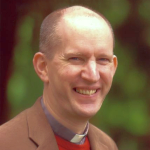
 Revd James Blandford-Baker, vicar of St Andrew's, Histon, describes how the church's vision to be at the heart of the village community led to the development of Essence.
 We began Essence three years ago in an attempt to offer mothers a space to explore their spirituality alongside the Christian narrative. We had lots of contacts through our children's work but they had remained just that, contacts without relationship. Having looked at a number of courses (such as START and Alpha) it quickly became apparent that we would need to invent something of our own that would connect with people. The driving issues as we put Essence together were the attitude of consumerism, the importance of story and the desire for spirituality.
 When Essence was launched, we prayed for five people to show up on the first Wednesday and 10 arrived. The format worked from the outset; people talked naturally and honestly, sharing their stories and engaging fully with the Christian story. By week three people were exchanging mobile phone numbers; community was forming. Not long afterwards people began to look after each other when they were in need. It is quite normal for a new mother to have meals for the family delivered each evening for a fortnight.
  Of course this approach raises questions about some big issues, including Baptism and Communion. We haven't resolved those issues but are happy to be continuing on this journey while we continue to consider them.
 Essential to the success of Essence has been the team made up of clergy, our lay pastor for people with young families, our children's worker and other lay people who have taken on certain roles. The crèche team give of their time generously; they have a real heart for the mothers as well as the children. They too feel involved in the spiritual journeys of those who come with many conversations about what God has been doing as the mothers pick up their children after the quiet time. The topics for the sessions each week are a mix of ideas from the team and suggestions from those who attend. Unlike on an Alpha course, there is no sense of the need to get through a defined 'spiritual programme'; we go with the flow and find that there are plenty of opportunities to explore all the most important Christian themes and ideas.
 The research was carried out by groups from within the schools themselves while Christian Research did all the analysis. It mirrored our first research results and also told us that what they meant by 'activities' was really a good place just to chill out and relax, somewhere they could go to play with their PlayStations and Wii. As health and fitness was such a big theme, we got in touch with
  The spiritual dimension is there in all we do because of our desire for God to be at the heart of it all, involved in every aspect of it – and for the glory to go to Him. It is also there because of who we are and the values we apply. They shape and form us into the community we are and what we hope to be. We see these as being Worship, Pray, Create, Learn, Enjoy Abundant Life, Transform, Influence, Give, Celebrate, and Be inclusive.
 St George's, Deal, faced a major challenge in 2002. Shiela Porter – who shares oversight and leadership of the church with Chris Spencer – looks back at how they dealt with that challenge and looks forward to new opportunities through the development of missional communities.
 It is about mobilising everyone to be missionary disciples and we've got a whole variety of diverse networks that are being reached through these communities. People who previously were sitting in the pews – along the lines of a 'provider client' type of model – are now doing all kinds of things that they never dreamed they would be doing. As they've gone out and taken on these new roles with new responsibilities, they’ve discovered the need to depend upon God. As a result they've grown spiritually and in their discipleship as well. This has brought about a release of 40 new missional leaders – a real treasure trove of talent.
 Another important new community to evolve has been at the Church Centre. As the centre continues to be an 'attractional model' with newcomers regularly arriving, this central community called 'Shoreline' is able to invite new people into it and give new people time to experience and understand the concept of missional communities before stepping into one that is meeting outside. Shoreline is also there to support the work of the other missional communities, being on the 'shoreline' to support them in their mission events and as they come back into the centre.

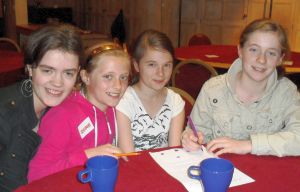
 We are committed to creating ways to worship that are culturally accessible for a wide range of people. Many find our existing worship immediately attractive, beautiful and moving. It is 'mission-shaped' worship for those people. It is growing in numbers and we aim to attract many more to it. Others though, especially those without a church background who aren't used to classical music and formality, can find it somewhat intimidating and uncomfortable. For many people today, finding their way into our worship is as foreign and threatening as going into a betting shop to place a bet would be for some traditional churchgoers.
 Parents attending the choral service can leave their children at the new 'zone' where recognised adult hosts supervise and care for them. Others come to Zone2 as a family unit.
 John Marrow is a Church Army evangelist working in Guildford. He works with local schools and runs an after school midweek fresh expression of church for families in three different locations across the diocese.
 Do people think of it as a church? I think it's a mix. Some people, when they first come, see it as a club while others decide to come along because they don't see traditional church as meeting the needs of their children. A further group would see it very much as 'their' church because a standard setting is very alien and strange to them.
 One of our previous themes was Godzworkus Circus and I was Jonno the clown. When I first did that, the kids realised that I didn't actually mind being a fool for Jesus. We want the children to know that it doesn't mean that you're boring if you go to church; we can be full of life and have fun.
 It has now got to the stage at Emmanuel where we're thinking along the lines of 'what's the next step?' I work closely with the staff team there and a major question at the moment centres on the Year 6 boys who think KidsAlive325 is now 'too young' for them.
 At Emmanuel we have already celebrated a baptism from one of our KidsAlive325 families. This was a major step forward because, years ago, that particular family had been 'turned away' from a church and they had real bitterness about the institution of church and all that it stood for.
 The development of St Mary's After School Club (SMASH) started in September 2009 when I approached two members of the church I attend, and asked them whether they would be prepared to help me re-launch an after school club I had been running a couple of years previously which I had to close down due to the pressure of my own training for ministry.
 It was during the first term of 2010 that one of the original mums involved with SMASH approached me and asked if she could have 'a chat'. We met over a period of weeks talking about her spiritual journey, and how she felt that she was wanting to find a new way of living. This led to talk of baptism, and eventually on December 11 we held a special baptism service in the newly acquired school chapel, with a gathering of a combination of church family and new friends from SMASH.
 SMASH uses a very simple formula. We meet at 3.30pm opening with a prayer and the lighting of a candle, when we remind ourselves of the words of Jesus which we say together, 'I am the light of the world. He who follows me will never walk in darkness, but will have the light of life'. We then have a game followed by a song, after which we play one more game and have one more song. After that we have a short time of Bible teaching, which usually includes some kind of interaction with the children. This then leads into a time when we do some craft, based on the theme of the teaching for the afternoon. An interactive time of prayer follows this, and we end by eating tea together. This has been a key part of the afternoon, as it is where relationships are built and deepened.
 We are very excited with what God seems to be doing in our midst. It is like having sown a mustard seed, and we are now watching it grow under our noses. Others from the main church have felt called to this ministry, and the leadership group has now grown to six members.
 Further ideas we want to develop with SMASH are a summer beach outing with young families from the local Sure Start Children's Centre, alongside the SMASH families. A couple of staff from the Children's Centre have been helping to look after children aged 0-3 during SMASH meetings as a joint working initiative. They too are very excited by this idea, as it covers both our visions of trying to reach members of our local community, and serve them in different ways.
 One of the school's developmental aims has been to increase opportunity to explore spirituality, and provide space for developing that spirituality within individuals. SMASH helps towards meeting this goal; but more than this, its very presence within the life of the school speaks louder than any words can. It exists as an open invitation to anyone who feels they want to explore faith in a non threatening environment, where they will find Christians and members of the local school community enjoying each others company and having fun together.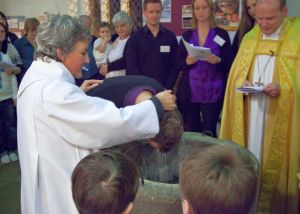
 Are people coming to faith through Messy Church? Do they really become members of the wider Church as a result? Revd Dr Jo White, Rector of All Saints’ Church, Wingerworth, tells how they responded to those questions through Messy Confirmations.
 The comments just kept on coming… 'I want to get confirmed here, even though I live two hours away – I was brought up here and my family still live here, but above all these are the people who make me feel I belong.' 'I heard my brother's getting confirmed, so I'd love to do it with him.' 'This is the time for me and God. I do really want to come, I really feel 2011 needs to be a year when I reconnect with the church and my faith, too much has come between us of late.' 'I was confirmed as a kid, but I don't remember it, I wish I could do it with you.' 'Well I'm Catholic, but this is really my church now.'
 At the rehearsal we realised that only one person knew what 'the peace' was. Things that church regulars take for granted, prayers that they know by heart, are unknown territory for most Messy Churchers and could easily divide the congregation in a service – which is exactly what we do NOT want in Messy Church.
 We chose songs that we often have at Messy Church and included some simple new ones either with a tune already known or that we’d introduced at other services in recent weeks.
 The taking of Communion was done kneeling or standing at the altar rail. We decided not to use sidespeople to indicate when to come up but to leave it open. In the event I (as the Rector) acted as maître d' in the sanctuary while the Bishop gave bread to everyone and two lay assistants gave the wine. In this way I was able to 'introduce' the Bishop to young children by name and tell him a little about those who were not taking Communion but had come up for a blessing, and just about everyone did come to the rail. His prayers of blessing were then made by name and were very specific for that person. The sight of him walking on his knees to give blessings at that rail to the many children squeezed alongside each other will stay with me for a long while.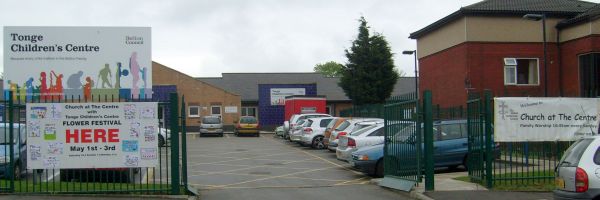

 The church responded by firstly inviting neighbouring churches (Anglican, Methodist and Roman Catholic) to create Churches Together in Tonge Moor. Then after taking advice on the potential uses and limitations of its existing building, the church also approached Bolton Metropolitan Borough Council and East Bolton Regeneration with a view to making the church's land available for the development of a Community Centre, which would include accommodation for the church.
 The Tonge Moor project involves Age Concern, Bolton Council Children's Services, other denominations, local Residents' Associations and URC NW Synod (all represented on the Project Management Group). The church has developed financial management systems for its community support work separate from its life as a worshipping fellowship. This was done to facilitate access to, and eligibility for financial support from a variety of bodies.
 In terms of community development, it takes time to build up relationships so as I'm based in the Centre, I'm able to work with the Centre's community outreach leader to organise some events jointly – it is part of their community cohesion remit and it's our reason for being. We are also building a volunteer base, involving people from church and community, which will help us to offer long-term support in this area. I’m not into offering something that comes and goes very quickly because that builds on the low expectation that many people have around here. People are accustomed to things starting up and then disappearing without trace; this contributes to the feeling that 'we don't matter'.
 A recent joint venture involved creating a mosaic on the theme of nature. Anyone who came in to the Centre via the café was invited to join in and it took us three months to complete. We had a community artist working with us and the result is wonderful – the folks who aren't used to being creative have something to be very proud of. As far as the theme of it is concerned, for those who have no faith it's nature, for those with faith it's creation. This is the best visual example so far of what we are trying to do together.
 Refresh, a fresh expression of church in the Scottish Borders, has grown out of the Church Army's Grafted project. Established in 2003 by Church Army officer Paul Little, Refresh continues to develop new ministries in the region.
 They ranged from 12/13 year-olds up to 16 and were basically pre-prison status. It was an experimental last ditch programme and things have developed a lot more since then. Many of the young people I have met along the way are now in their early 20s and those relationships bring lots of opportunities.
 Grafted (Giving Hope to those Without Hope) is known locally for its work with people struggling with drug and alcohol dependency. Using outdoor activities such as canoeing, mountain biking and mountaineering, Grafted's Window of Time project helps to develop leadership and self esteem in those with poor basic and social skills, or those with learning disabilities or emotional and behavioural difficulties.
 We have an open access policy and anyone over 18 is welcome to attend.
 Refresh Community Church in Newcastleton was the result of that period. About three quarters of the people who have come over all are non-Christians and we have grown to about 20 in number with some 60 people from the community involved in one way or another. There are also groups that meet under the banner of Refresh, all of which are missional because the people who make up the leadership are locals who have been through Alpha.
 When we meet for Refresh, there is usually discussion and some sung worship. We don't have anybody at all who is ordained – we never have had on the leadership team. Children's work didn't really take place in the community when we started Refresh but it is flourishing now.
 More recently, and as part of Refresh, Deeper was developed for 14 to 19-year-olds in the village. Deeper is a home group for teenagers, which meets each Sunday in a Church Army house we have here. The aim of the group is to disciple the young people who come along and encourage them to grow deeper in their relationship with God. The evening consists of games, a talk and discussion with food. On average 12 young people attend regularly. We see youth work as a priority so we are looking at new ways of developing youth work for 2011.