
Author: ben-clymo
Changing the Landscape 2011 – Reconnect and Poole Missional Communities
Changing the Landscape 2011 – The Beacon
Cringleford Community Project – update May14

Heather Cracknell is developing community, and a fresh expression of church, at Round House Park near Norwich. She gives an update on the work so far.
Launched in 2007, the Round House Park housing development – with planning for 1,065 homes – sits on the outskirts of Norwich at Cringleford.
In 2011, the Diocese of Norwich commissioned newly-trained Pioneer Curate Heather Cracknell to live and work in Round House Park. Heather was the first Pioneer Minister trained by the Diocese of Norwich and her remit was to go beyond the existing Christian community and create new communities: fresh expressions of church.
Heather explains,
We wanted to work out what fresh expressions of church might look like in a new housing area, because it’s clear that these new housing developments often don't relate that well to the established community or village that they are adjacent to.
Most of the people moving onto the new housing are younger, they don't have connections with the church to start with, they are not geographically moving into the parish in the same way as you would be if you were moving into a village… so that is why I was placed here.
 Being so close to the A11, the Norwich Research Park, and the Norwich and Norfolk University Hospital, Round House Park has attracted a lot of professional people, young families and a diverse ethnic mix.
There is now a new Church of England school in the centre of the development as well as a recently opened community centre, but when Heather arrived there were no community spaces. Prominent in her dog collar, Heather is open and approachable but in the early days she found it difficult to get to know people simply because they were hard to find. People spent a lot of time in their cars driving off the estate for work, school and social activities.
Heather remembers,
I have a dog and I used to walk her around to try and meet people. But that is quite hard so I just started to chat to anyone I met, inviting them to my house for curry nights on a Friday and Saturday night.
At those curry evenings Heather would encourage her guests to consider other activities that they would like to do together. From these ideas she launched as many groups as she could, including a book club, culture club, a new parents’ group and one off events including wine tasting, a bake-off and summer picnics. Heather also established, and runs, a website called Cringleford Hub which acts as a local social networking site helping people meet one another and start new groups.
She says,
Because I'm motivated by wanting to share the Good News and for the church to connect with people, the question that popped into my head really early on was: 'what does it mean to live well in Cringleford?' Part of living well is living in community, being creative together and eating together. Everything I am seeking to do is about living well and how do we go a bit deeper in life.
 Heather is keen to nurture creativity within the community. Last Christmas the Culture Club undertook a yarn bombing project, creating pompom garlands and draping them around public places to say Happy Christmas. In October, Heather put together a community art day producing attractive communal art pieces that now adorn the school walls.
It was just brilliant,
she says,
That is one of the most satisfying things I have done… literally bringing old and young, families and singles, everyone came together, we did something creative and we created all this art work from spare materials.
Heather's time is also spent within St Peter's, Cringleford, but her calling as a Pioneer Minister is to the unchurched – the growing populace who have never entered a church.
She explains her role to the congregation at St Peter's by saying,
We can be as warm and welcoming as we like but if those people come into our service they are going to have absolutely no idea what's going on. We may as well be speaking Swahili! The environment is so alien to them. So we can't sit here waiting for them.
The church's role should be to provide a place where people feel welcomed, accepted, loved and included. So this is the church serving its community by creating places for people to meet one another, and feel included and safe, and welcomed and have a part to play.
There is a hunger for connectedness with your neighbours, people do want community spirit, they don't necessarily know how to go about that, and particularly because there hasn't been any physical building in which to do that, so they have got on board really quickly when there is a catalyst. I think what the church has been and what I've been is a catalyst, a bit like the yeast – all of the ingredients were there, it just needed the catalyst to bring it to life.
 And as relationships have developed, conversations about faith and spirituality are naturally happening. Heather has run a 'Puzzling Questions' course and the Church of England's Pilgrim Course as people expressed intrigued in the Christian faith and wanted to start to explore it. In March, a fortnightly worship event was launched in the local school, which includes a meal together.
Heather says,
I've been here two-and-a-half years and we've just now got to the point where there is a core group of people who are wanting to do church – they don't really know what that looks like and they don't really know what that will be, and they've got young children. We are meeting on a Sunday afternoon, an informal environment with lots of different activities and ways to respond to God.
The Diocese of Norwich has given Heather five years to work on the Round House Park development. Her aim is to open a social enterprise community café, generating profits in order to fund sustainable community activities and events. Her main frustration has been that it has taken longer than she thought to set it up; but retains a passion to serve the community and get others involved.
She adds,
I really feel that God is at work here and all I have to try and do is join in, and join in in a way that is loving my community, loving the people that I meet and also giving people a way that they can join in too.
(This article, written by Jenny Seal, was first published on the Network Norfolk website)
A movement with a future
Do we offer a ‘plausible structure’ to others? (Kim Hartshorne)
Kim Hartshorne asks whether we offer a 'plausible structure' to others.
As a Bishop's Mission Order and small missional community, we at the Upper Room in Cirencester ponder how to appropriately and effectively do mission in our context. How do we reach people who have never heard the good news of the Gospel in a way that makes sense? How do we make sure we show and tell the Jesus story so that our actions and words work together to communicate clearly?
What we've learned over six years is that telling, proclaiming, witnessing and evangelising is just not enough – nor is inviting people into 'our church' and then expecting them to get the hang of it because it makes sense to us. This is somewhat to do with British postmodern society where experience and authenticity tend to make more sense to people than believing a list of doctrinal truths. It also makes sense in our context, where the group of people we're trying to reach have no recent history of following the Christian faith. In the main, they are marginalised people who have not had direct links with Christianity for several generations – or more.
They have no foundation to start from, given that many schools have not held Christian whole-school assemblies for years now and no-one said prayers with them at bedtime. Childhood Bible stories, cheery hymns, Sunday school treats and family Christenings have not been a part of their history. The language of faith is now foreign to many people of white, working class backgrounds.
Life in the Upper Room community is about opening up a space where people, who've lost their thread of connection to the gospel, can come. It is a space where people can be introduced to the narrative and try it on for size, question and explore, begin to find where they belong in the story, taste and see and participate in it. We offer the Upper Room as a 'plausible structure' to others, sharing the story of Jesus, who he is, what his coming, living, dying and rising is all about – and what being in the family of God feels like, eating and praying together.
The idea of 'plausibility structures' was first discussed by Peter Berger in The Social Construction of Reality (Berger & Luckmann, Penguin 1979) and explored further by Sam Richards in Mass Culture (ed. Pete Ward, BRF, 1999, pp116-130). The idea is that we all need spaces, relationships and experiences that enable us to understand, process, internalise and begin to believe and live the gospel. In a surrounding culture that no longer has this belief explicit in its daily story, this becomes important. In order for the narrative to make any sense, people need to be able to experience it, participate in it and chew it around, taste it, see what it feels like, try it out with others.
The need to 'have a go' is a very human characteristic and a facet of learning and growing. We need spaces to practice, and learn from each other's questions and reactions. A community where it is assumed we all agree and believe the same things is often a place where authority and the pressure to conform is subliminating the process of questioning that is a natural part of learning.
Richards posits acceptance into the ritual of communion as access to tasting and experiencing the action that surrounds the death and resurrection of Christ. In joining in, sharing the peace and the bread and wine, people are drawn into the welcome of God at the heart of the faith community. We always ask new people to offer the cup of wine to others at communion, and all are welcome to take bread and wine, as we have seen how transformative the invitation to participate is on people's journey to faith.
Rowan Williams writes in Lost Icons that our development as a person and a self occurs over time, in communities with others, and our self-awareness is shaped by shared understanding (pp140-143). This means we need to be aware that each person brings themselves into dialogue with tradition and culture. Where that has broken down, in terms of our shared understanding of the Christian faith, new spaces need to be made for this dialogue to occur. Williams believes we need a sense of ourselves being held within a narrative, even as this narrative is constantly being re-edited over time (p144). Every event that happens is connected to others and to the gospel and re-orders who we are and will be, so that 'every telling is a retelling, and the act of telling changes what can be…' (p144). In this way, new identities can be explored and inhabited.
This offering of a space and community of fellow humans to journey alongside, a place to retell and reshape our stories in the light of Christ's redemptive story, is what we are all about as we seek to offer a 'plausible structure' at the Upper Room.
Life Church
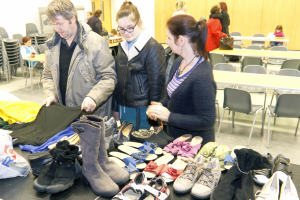
Susan Sadler, lead evangelist with Christians Against Poverty and leader of Life Church, Newton Aycliffe, tells how the community grew from 10 to 100 in just over a year.
I have to be totally honest, this is something none of us expected; but we know that God has given us something very special because nearly all of the people who come through our doors have not been church attenders before.
Amazingly, it's only about 18 months ago since a group of us from a small house church started to reach out into the community a little bit more. With very limited resources, we set up a charity called Lifeline Community Action in order to develop some work within a five mile radius of Newton Aycliffe in County Durham, where we're based.
Lifeline Community Action was the catalyst for a 'Helping Hands Project' for which people would be referred through various agencies and organisations. Some of the people we were coming into contact with wanted to know more about why we were doing these things and what this Christian faith was all about, so we started to meet together on Thursday evenings in someone's home to explore that in more depth.
 We are part of the Acts 435 initiative which helps people and churches to give money directly to those most in need. I noticed that, as I was going out and about delivering goods and care parcels, people kept talking more about the Thursday night gathering than the help they'd received! At that time, hardly anyone described what was happening on Thursdays as 'church' but it had definitely become an accepted gathering place.
Just over a year ago, our Bible study gatherings got too big for a living room. We realised that we'd have to find another venue because this is an area which suffers economically so we knew that the housing stock would be too small to accommodate the people wanting to come along.
In the end we decided to step out in faith and rent somewhere. I emailed three places and the room we found, in a local centre, could take 25 people. We thought that was fine but, a few weeks later, we had outgrown it with 32 people. Then the opportunity came up to go to Greenfield School where they had a room available in the week that had space for 50. Again, that sounded perfect but when we moved in, we took 49 people with us.
Soon after that we moved into the school hall because our membership now stands at about 100 and we'll generally have an average of 70 attending most weeks. I lead what is now known as Life Church and we have a couple of elders from the West Auckland Vineyard Church who come and help us.
Most of the people who come have never been part of a community like this or had any previous experience of church. Some, but not all, of them came to us through Christians Against Poverty (CAP). We had a CAP centre here for quite a few years so I've known many people in the area; it has been good to see some of them get involved in Life Church but I'd say that the majority of our regulars were not previously involved with CAP.
 When people want to know more of the Christian faith but have never previously been involved in church life, it can be difficult for CAP centres to know how to respond. Many churches do a great job of discipling people – and often in significant numbers – but not everyone feels at home in a more traditional church setting. That's when something different may come into being, something that is appropriate for people in their particular Christian journey.
Life Church attracts a wide range of people, including some who are quite challenging in their lifestyle and behaviour. It's great to reach gang leaders and children expelled from school, of course, but it brings its own problems and I have been criticised for that. I've been told, 'You encourage these people, Susan' and my critics are quite right, I do encourage these people and I will always encourage them!
I have worked for CAP for twelve years and have seen people become Christians, go to church for a few weeks and then give up on it because – for one reason or another – they struggle to thrive in that environment. The vast majority of churches are welcoming and caring but some people can still feel overwhelmed by it all; I'm so grateful to God that Life Church has become a place where many have settled down to explore their faith. Thankfully, we keep seeing the fruits of that; in summer 2013 we baptised ten people.
If you just look at the growth in numbers, you can miss the fact that this is massively challenging work to be involved in – you really do need the heart to do it. Our outreach into the wider area is because we are committed to God, to each other and to the community. That's the pecking order.
We are also very fortunate in that the local churches have been very supportive of us, including St Clare's Church of England parish church, Great Aycliffe, and West Auckland Vineyard Church.
 All churches want to disciple people in a way, and with resources, they can understand – and we're no different! Our attitude at Life Church is, 'you don't opt in, you opt out', so unless people definitely say that they don't want to be involved in something we assume that they will be. I say to everyone, 'we are all "in" unless you tell me otherwise'.
At CAP, our basic resources for discipleship are a Discovery Steps course and Discovery Breaks and I have been, and continue to be, involved in these resources as part of my work with Christians Against Poverty. The Lord very clearly gave me the vision for both of these and, basically, 'downloaded' the information to me some years ago!
Discovery Steps is an introduction to Christianity course which not only looks at such questions as 'What's life all about?' and 'Why should I read the Bible?' but also covers things like, 'What about my worries, my anger?'. Discovery Breaks came about when I asked CAP's UK chief executive Matt Barlow, 'Could we take some people away to help them find out more about themselves and about God?' That was ten years ago and we took 70 people away. There are now 14 Discovery Breaks up and down the country every year and probably about 1,000 people each year will benefit by being on one.
These breaks take place at different places up and down the country but a venue tends to be no more than two hours maximum from where they live. Generally they are full board. The programme is a holistic one; for at least one of the sessions they will hear a main gospel message and have a prayer time, but we also see it as a time of relaxation and fun, things like games and trips to theme parks and pampering sessions. Discovery Breaks can be life-changing but it's also important to do the regular things well at grass roots level when we're back on home territory.
What we make available at Life Church is very much like some aspects of what's on offer through the Discovery Breaks. If anyone new comes to the church for instance, we always offer to take them out for a meal. We've also had a 'getting to know you' event at the Rockliffe Hall and Wynyard Hall Country House Hotels in County Durham. Most of our people will never have had the chance to go to a luxury hotel but we want them to know how special they are and how precious they are individually.
 Every single one of church members will get weekly texts or phone calls from us. If they couldn't get to church for one reason or another we'll send them a message to say we've missed them. We also have Spot Prizes where people can nominate others for a gift every week; if it's anybody's birthday we'll sing to them and if there happens to be a few birthdays we'll sing happy birthday to each one of them personally. We want to make the point that we are all, individually, important to God and to each other. This year, many of us are going to France together for a week's camping holiday. We are also taking about 70 people to the Jonas Centre in Leyburn, Wensleydale, for a retreat in August and recently we took the ladies of Life Church to a Christian conference.
It's no surprise that Life Church celebrates whenever someone turns to faith but some might question, 'Is this a real salvation because it's in a different sort of church?' The answer's 'Yes it is. To have people turn to Christ in any setting is a wonderful thing and we thank God for it.'
We don't have a church building of course so our costs, for the rooms that we hire, amount to £30 a week. Life Church doesn't have any paid staff yet; we take an offering and standing orders – and every penny that comes in goes back into the community.
Our format is flexible. We don't have a worship band so we sing along to worship songs on YouTube and always get people involved in whatever's happening; we don't want them to feel like spectators while someone else, usually me, leads everything from the front. It's much more like a sharing group. We also have a youth group and a children's group.
I am the main church leader at the moment. I'm not ordained and my job with CAP is a national one so, if I go on tour, I try to make sure it's from Saturday to Wednesday so I can be back in time for church on Thursday. Thankfully I have support at Life Church from a core team and then we also have four trustees for the Lifeline Community Action charity. I do have a few people who help me, a former teacher who has now retired and the elders from West Auckland Vineyard Church. We do leadership training at Life Church and we are praying that people will come through from the community but I also know there are a lot of people who have a pastor's heart but couldn't lead Life Church with its challenges.
I think of it as having a lot of little fish in a holding pen. Some, in time, may decide to leave that pen and go and join another church, and that's fine, but there are an awful lot of people who won't. We continue to pray that our church community will help people on their journey towards Jesus and that they will be drawn into closer relationship with Him.
Fresh Expressions: the continuing journey
Graham Cray looks back on the growth of the fresh expressions movement – and forward to the continuing journey.
As I hand over the leadership of Fresh Expressions to Phil Potter, I have the privilege of looking back – not just over the five years I have spent with the team but at the twelve years since a working party first gathered round a table to write a report for the Church of England.
The journey from that Mission-shaped Church working party to Fresh Expressions 2014 is extraordinary. Who could have imagined that we'd be looking at 2,000 fresh expressions of church in both the Methodist Church and the Church of England, new denominational and mission agency partners in the UK, and friends and colleagues in many different part of the world?
Also extraordinary is the range and depth of local missional imagination it has been our privilege to observe, the wonderful stories we have been able to record and report, and the quantity and quality of new pioneering leadership which God has called into being.
However creative and inspirational this movement has been – and it has been very creative and inspirational – it is all down to grace. God in his mercy has not allowed his church to be paralysed into fatalism by decades of decline. He has forged one of the keys to the future, fresh expressions of church, in a most unlikely place! We have much to be thankful for. That gratitude, and continuing trusting dependence on God, is essential for the future.
Nationally and internationally, we have caught a wave of the Spirit. We have been allowed to share in a charism – a multifaceted gift of the Spirit. Our praxis emphasises following the missionary Spirit, and practising discernment in context. In just the same way, the future of the movement cannot be achieved by merely repeating what has been learned and done so far. Expertise must not supplant prayerful discernment and trusting obedience; the God of surprises still leads the Church. Stay open to the future which God has prepared, but which he reveals only step by step.
One lesson from this team's ten-year ministry is the importance of perseverance. We began in 2004 but the key point of lift-off in the founding denominations was 2010. The team for phase one ploughed and sowed; phase two watered and harvested; perhaps now we are called to secure an annual harvest for years to come? There is no quick fix; persevering with God-given vision in each partner organisation is the only effective pathway to the future.
From my perspective there are two equally important tasks ahead:
- supporting, equipping and networking of practitioners and pioneers;
- making space for them in the life of each partner denomination and organisation.
I am convinced that this is not just a matter of leaders making space for the new amid existing structures and practices, but that the mixed economy requires new practices of leadership at the senior level. A missional church requires missional leadership.
Finally I believe there is an outcome to bear in mind beyond the life of the Fresh Expressions team (however long that may be) and beyond the 'shelf life' of the fresh expressions terminology. The long-term task is to see the values which underlie this work embedded within the churches, so that they are assumed as normal.
At Phil Potter's licensing, Archbishop Justin expressed his confidence "that Fresh Expressions will continue to lead the re-imagination of the ministry of the church in this country". Incarnational mission, discerning and following the missionary Spirit, the planting of new communities of disciples by contextual mission: these are simply how we are to be the Church in Western society. They are to be the mainstream.
We work towards the point where the default setting for church instinctively includes these values and practices. We look for the time when church self-evidently means missional church and mixed economy ministry. May God continue to bless us all on that journey.
+Graham Cray
New Song Network – Apr14
A ‘New Song’ for a new church (Stephen Lindridge)
Stephen Lindridge sings a 'New Song' for a new church.
The Psalms inspire us as God's people to 'sing a new song' to our Lord, for the marvellous things he has done (Psalm 98.1). So it's very apt that the newest church to be recognised in the Methodist Church of Great Britain is forged on exactly this principle; to sing new songs to our Lord!
But New Song Network, based in Warrington, involves a great deal more than singing. It has created community and brought loving service, gospel proclamation and transformational discipleship to people previously unconnected in any way with church.
To me, this strikes three chords for the wider church's learning and encouragement – bearing in mind that a chord is a number of notes played at the same time.
New Song is not a 'one-trick pony'.
It is a network of relationships, doing a multiplicity of things that are seeking to live with meaning and purpose in the broader community in which they are based. So, learning how usefully to collaborate our resources, actions and activities over an area may lead to increasing our understanding of what it is to be the church.
In a general climate of decline (for the institutional churches), new life is happening.
Yes, in some places it's in tiny pockets but in other places the growth is substantial. This is a hugely significant message that swims against the tide of pessimism about the church in the UK. The rich and profound message of God's love in Jesus Christ is indeed still relevant in our culture, time and place and – when actively practiced in words and deeds that make sense to those around us – it changes lives.
Sadly, I have sometimes found this negative tide within the walls of our denominations. It is hard to understand how such good news can sometimes be received so badly, and with such opposition, from within the church.
Into these challenges we recall Jesus' words in John 15.18; the regular accounts of opposition to the early church in Acts of the Apostles; and modern-day stories of Christian persecution around the world – persecution which goes far beyond angry words. We should give thanks to God for such faithful witness and pray that we, too, will show God's grace to those who seem to hate us.
New Song re-imagines the old to bring new life.
'Something old something new, something borrowed, something blue' is a phrase that usually symbolizes the joining of two worlds into one. New Song Network for me demonstrates the long-espoused values of the Methodist Church so similar to those of Wesley's day, namely participation of every person, singing our faith with the tunes of the day, helping those in need and forming rich fellowship through small groups. This ethos has found new life in a contemporary form at New Song Network and the result is seen in lives transformed by the gospel of Christ.
I believe the voyage of discovery for many of us involves exploring what God is doing in our own neighbourhoods as our familiar, much-loved, values find new ground and new contexts in fresh expressions of church. Thank God for New Song Network as the newest church in Methodism, but the big question is, where will the next one be?!