
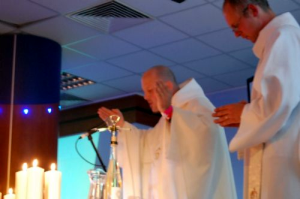
Blesséd aims to impact the lives of younger people who do not relate to some traditional forms of church, but with a more 'ancient:future' perspective than some other fresh expressions. Simon Rundell, Parish Priest for the church of Saint Thomas the Apostle, in Elson of the Diocese of Portsmouth, works hard to nourish, support and facilitate Blesséd with a personal passion for gutsy mission. Simon is most definitely a visionary! In fact, a number of other sacramental initiatives have taken inspiration from Simon's work with Blesséd in and around South East England.
When you have nothing, the sacrament is everything.
 Blesséd is an unfunded, somewhat unloved and quite ramshackle loose collection of individuals seeking to draw deeply on the incarnational mysteries and views of the sacramental life and through that proclaim ancient truths in modern ways.
It has been a dream to realise Blesséd as a truly alternative, ecclesial community, to foster and support a non-parochial gathering which is centred upon the Eucharist. This has been a long, hard and quite frustrating process, as the necessary work which underpins this can get lost beneath the pressures of other things: of parochial commitments and responsibilities and lack of money and time. Frankly, I am not sure it is working well at present and not convinced that what we want is necessarily what God actually wants.
One of the most important things about alternative worship (and the spiritual communities associated with it which seek to 'reach out for God') is the recognition that we might, and indeed have the permission to, fail.
Blesséd makes in its own way, a significant yet small contribution to the sum total of 'creative worship' as a form of mission. It expresses a different perspective than some of the more protestant-influenced fresh expressions and irritates some in its insistence that the sacramental life touches everyone whether they know it, like it or dislike it. As with other fresh expressions, we are placed on the edge or outside of the Church BUT engaged with the local unchurched or dechurched culture.
 Yet the outside is just where Church is called to be. This may not be a comfortable place, but it is from this vantage point that we can proclaim a transformative, newly-relational insight into society, following a God who calls us to engage with the wider community.
Being a fresh expression is inherently about struggle, about failing, as well as moments of success. In Blesséd numbers remain small, those who share in worship and support each other online are few and far between and weak and tired. And yet, that is what we are called to do – to support each other in our frailty, to gather in our brokenness to share in something tangible and yet powerfully inexpressible.
And I wouldn't have it any other way. Our very weakness, poverty and vulnerability are the source of our reliance on God.
So where does Blesséd go? If it isn't a formal, licensed, constituted or commissioned community, what then will it look like? It will, I sense, continue to be a roving resource and irritant: an inspiration to some and a folly to others; a burner of carpets and good ideas and a shot in the arm for those seeking to find a new place to encounter God in the Eucharist.
There is no agenda, just an openness to God. Pray for us, and help us to discern God's will. Until then, the altar is open and we, the people, gather to seek Christ present amongst us. Come.
 A docklands regeneration project in Glasgow is now home to hundreds of people – and The Glasgow Harbour initiative known as authentic (?). Church of Scotland minister Alex Smeed, one of the authentic (?) leaders, explains how churches in the area set it up in response to a call for new ways of 'doing' church.
 The audit firstly focused on qualitative data which included us intentionally spending time in the area itself to try and ascertain who the residents were, what kind of culture they came from, what hours they kept and where they worked.
 Some of our team moved into a flat in the harbour to have a place on site where people could be invited for a meal and generally practice hospitality. We continue to explore ways in which they can gather people together, including the launch of our authentic (?) curry house as a 'pop-up restaurant' and the development of a greater internet presence in order to promote online community.
 As authentic (?) we're also looking at things like having a regular running community. We would also love to offer free, organic, fairly traded beautiful coffees to people as they leave for work in the morning. All these sorts of ideas are things that we are pursuing, we believe in a God who blesses and so we want to pursue that, we want to embody that in everything we do.
 We are doing all of this hand in hand with other Christians in this area so that we can be as effective as possible, living out the unity of that body. Part of our vision is to see people reconnected with God, seeing that relationship restored and so we're going to be intentional about the way that we invite people to experience God, to live a life that is transformed by a relationship with him. It's about having the integrity to talk about that, to invite people into a place where they can explore in a contextually relevant way what it means to follow Jesus in this area.