
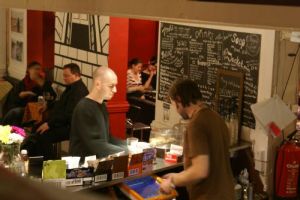
Ben Edson shares the story of always-incomplete community building with Sanctus 1 in Manchester.
I recently gave a presentation to some Australian visitors about Sanctus1. When it came to the time for questions one of them asked: 'How do you manage so much change?' I hadn’t realised that we had been through so much change, but now as I look back on seven years of Sanctus1 I realise that change is part of our narrative.
We have moved from a Cathedral to a parish church and now moved again to an arts café. We have seen the community grow from four to fifty; then from fifty to twenty and currently from twenty back to fifty. We have experimented with mid-week groups, small groups, groups on Sundays and no groups. We have been involved in running club nights, in mind body spirit fayres, in art exhibitions and a night café. Change is part of our story.
And perhaps, it is this sense of change that sustains us. Sanctus1 has been established for longer than many fresh expressions of church and it seems that as soon as the change stops we being to go stale. Fluidity is kinetic and change involves movement. If a fresh expression is to remain fresh it must keep moving, keep changing, keep evolving.

Each new person that comes to Sanctus1 changes the community; their unique presence brings a new dynamic, a new set of experiences and new areas of wisdom. This 'openness to the wisdom of the new' means that the old is permanently being refreshed.
As I have continued to reflect on the question posed by our Antipodean visitors I have realised that Sanctus1 is always provisional and will always be journeying towards being church. This is particularly emphasised by our geographic location in the City centre of Manchester, and the demographic of this people group, but it is also an ecclesiological stance that says we will never fully arrive. It seems when we think that we have arrived we discover that we are further away than we thought and that we have simply taken one step on our journey.
This context of provisionality raises many questions regarding future vision and planning. How can you have a plan for the future if the present is always provisional? Provisionality can be an empowering place to be, it means that present certainty does not define future dreams, but that future dreams define an uncertain present. An uncertain present creates space for creative thinking and action as we realise that the dreams for the future are, in fact, the dreams of today.

However, within this positive stance to provisionality how do we ensure that the story of Sanctus1 is carried into the future? One way that we think this has been achieved has been through the defining of our values.
The values need to remain provisional so that each person who comes to Sanctus1 feels that they can influence them so that they reflect the current community. Further evidence of our desire to carry the story of Sanctus1 forward is our desire to be structurally recognised through a Bishop's Mission Order, (BMO). A BMO has provisionality built into it – initially a BMO is for five years with the maximum time being ten years – structured provisionality. A certain short-term future and a positive stance to provisionality means that the present becomes an opportunity for missional engagement and connectivity with Christ.
Within this culture of provisionality the story-tellers and the story-carriers become very important as people who carry the narrative of Sanctus1 with them so that when the future is planned it remains consistent with the story of the past. It is often the case that the leader of a community becomes the central story-teller, however a less dependent and mores sustainable way is for the community to become a story-telling community.

When a community shares and lives the story they then they will go on to write the story, to start a new sentence and dream the next chapter. This has happened within Sanctus1 by the leadership being shared between a team of up to five people, with that team being a mix of clergy and laity; male and female. This team aims to be fluid enabling people to commit to it for an appropriate time-period rather than indefinitely. The story-tellers of Sanctus1 are then not only the leadership team but everyone involved in living the story of the community and serving the city centre of Manchester. To carry the story means to carry the centrality of word and sacrament, the affirmative yet critical approach to contemporary culture and mission as being central to our existence. There is of course a provisionality to this all, knowing that we are still journeying, still incomplete, still trying, still becoming church…
 Richard Moy, ordained pioneer minister explains how church is forming amongst those who have never been involved before, through Wolverhampton Pioneer Ministries.
 A small team of three gathered to pray every week in a local church and then gradually others joined in. After a year they began to gather in a café location in the centre of town and now a pool of about 50 people meets regularly for Sunday evening worship. On any one occasion 30 or so will gather together. Church 18-30 has been born.
 Early on Richard decided that one size would not fit all. Based on differing learning styles, this fresh expression of church offers deliberately varied learning and worship opportunities. There's a gathering for 'reflectors' which has a real sense of the 'spiritual'. Another event is aimed at 'theorists' and encourages those who attend to think why they believe what they believe. A third gathering has a contemporary worship style and a fourth is based on food and sharing communion together.
 And Richard believes what he is doing really is church. They operate as church – with regular worship, gathering around word and sacrament. People have been baptised as a result of joining Church 18-30 and mission is very much at the heart of things. If you see a couple of people sitting on a sofa in the middle of Wolverhampton, it is likely to be members of the church sharing their faith or offering to pray for passers by. And in a network church, 'some bits of the church will only last for a season and some bits will last forever', says Richard and that's OK.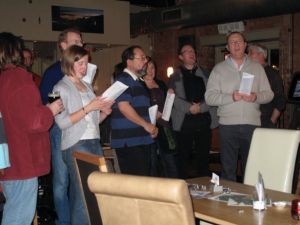
 It all happened very quickly. I started in post at the end of May 2009, discussions took place over the summer to sort out the BMO, and it was signed in December at a Beer&Carols event. We certainly reaped the benefits of the hard work that other BMOs had done before us in Exeter and Thanet.
 In the middle of the BMO area is The Quay, a canal side pub which was itself part of a regeneration project a few years ago. It is now the base for Presence's midweek meetings, and some of those at Presence have become regulars at the pub’s open mic session on Thursday nights.
 The regeneration of great swathes of the city means that new communities have become cut off from parish churches because the landscape has shifted, but by starting a fresh expression alongside those churches, we can redefine a pastoral boundary. It has just worked brilliantly in that it's possible to run a straight mixed economy which lets the existing parishes do what they do while we look at how we use these places in new and creative ways.
 This is a minimum 10 year project, and part of the challenge is that the landscape will continue to change dramatically during that time. Large brownfield sites in our area are set aside for new developments but are yet to be built on, so we need to be flexible in our approach and planning.
 We also very much hope to be involved at The Quay on St Patrick's Day. There are lots of possibilities but we might look at having a religious 'bit' followed by Open Communion using Naan bread – reflecting the type of area we're in. We want to reclaim these celebrations for God, and show that we're a church of festival and fun.
 B1 continues to be a community that seeks to reach out to the unchurched and dechurched within the city centre of Birmingham. Significant developments over the last few years have included the Breathe project and a 'recasting' of our vision and values.