
 Paul Bradbury asks what the true language of incarnational mission is.
This is what the kingdom of God is like. A man scatters seed on the ground. Night and day, whether he sleeps or gets up, the seed sprouts and grows, though he does not know how.
Mark 4.26-27
Three years into a pioneer post in Poole, Dorset, I get asked a lot: 'How's it going?' I hate this question. I haven't really worked out how to answer it. We've made progress, built some good relationships, seen people start to explore faith. But the questions behind the question seem to be: 'How big are you now?'; 'Have you seen much growth?'; 'Are people becoming Christians?' The answer should be in the form of a number. A big one would be nice. But somehow, even though I could, I don't want to answer that question in that kind of way.
It's not that I'm not interested in people becoming Christians – I am, passionately. It's just that the kind of culture and approach that those sort of questions and assumptions are associated with does not do justice to the mission I am engaged in. These questions, this hunger for results, numbers, growth, etc, seems to belie an impatience, a belief that God, who we rightly believe to be capable of extraordinary things, is somehow in a hurry.
Our culture is saturated with hurry and urgency, with growth and with graphs that head ever upwards and to the right. At times we import this culture, its assumptions and techniques into our mission, and in the most part it is in danger of killing us.
I am trying then to explore and give voice to a different language to describe mission and its progress. The roots of that language are in the gospels and in the parables of the kingdom. They are in the trajectory of the gospel story which climaxes in an event that is about as far from growth language as you can imagine. The cross was an utter failure to those disciples who witnessed it. A hopeful, fruitful ministry had come to an end. Three years of building momentum, with a growing following, seemed to be about to climax with a major PR launch in the nation's capital. But it didn't work out that way. It was shattering.
'How's it going, Jesus?' After three years, not very well perhaps. But Jesus was working to a different beat. The disciples were in a hurry too. The completion of the project was surely round the corner when Jesus came triumphantly into Jerusalem. Yet Jesus had laid down enough clues to suggest that that was not the scenario they should have expected. The parables speak a different language, one of organic, slow, patient transformation. A process that starts with the death of a seed. The burying of a small insignificant grain of matter. The humble, vulnerable downward movement into darkness and hiddenness of something that holds great hope.
Kingdom mission, mission in the wake of Jesus, is organic. Not mechanistic. It beats to a different drum. It speaks a different language. It will not fit the sort of charts we dream in our minds. It will not bend to our logic and our demands. It is paradoxical and out of our control. Our call is to partner with it, not manage it for our own schemes. And it requires a spirituality and life that is downwardly mobile, able to walk humbly in step with it.
I've been invited to explore this theme in a series of pieces on the Share blog. What does an organic approach to mission and ministry look like? What does it require of us? How can we be faithful to the pace and rhythm of God's Spirit and his kingdom? We need to tell an authentic story of incarnational mission in a language that is true.
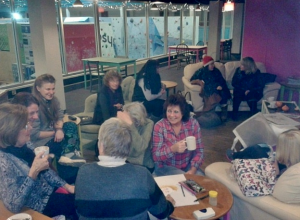
 With the closure of our Poole town centre café premises, No34, we were looking for a new home for our Space for Life gathering. As part our vision is to enable mission in every context, this was very important to us.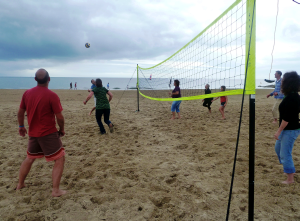
 At one point I was doing all the marketing for the café as well as trying to lead a fresh expression of church. I have certainly diversified in my work but I just try to follow what I feel God’s Spirit is asking me to do – and do it. Now we are trying to get the right resources to make that work sustainable because there were points in the café's opening few months where I needed those resources a lot quicker. I was getting overwhelmed by it all.
 Taking on the cafe had an interesting impact on Reconnect with four to five people joining us – one way or another – as a result of having the shop. I had shied away from premises right from the start because we didn't want to describe ourselves as, 'the church that meets in a specific place'. Our focus was on the unconventional but now, for three Sundays out of four, Reconnect meets in the café! But things are happening as a result of that. One lady, not from a church background, started coming to Reconnect because she had been in the café during the week, saw our notices and asked about it.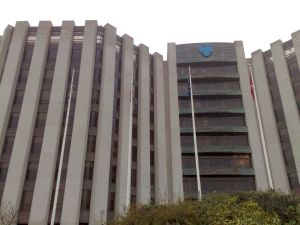
 work:space started in Barclays Bank headquarters in Poole and it is open to people of any faith and none. Using resources from the Christian tradition, it offers people an opportunity to reflect and explore their spirituality within a work context.
 The college hosts teams from lifeboat stations across the country for training and development. Within the building is a beautiful room with amazing views across Holes Bay – a great setting to host work:space. The group will be meeting monthly at first but we hope in time to be able to make it a weekly get-together. It has been really well received by the people within the organization and I'm quite excited about the possibility of it also developing within the council offices here.
 On 21st March, the Bishop, Dr Graham Kings, came and commissioned us as a community at a café in the town. We had about 70 people there and started off with some children's activities before the bishop led the commissioning and we signed the rule of life – something we had been developing in our meetings since Christmas by looking at Acts and the gospels to find out what it means to be a community of disciples. The rule was signed by all the community and the commissioning was essentially a commitment by us all to seek to live the life expressed in the rule.
 We organise felt making sessions as part of our outreach activity, and we made felt 'stones' on the commissioning day to be included in a prayer cairn. People came up and prayed for Reconnect as they put down one of the stones. The bishop also seemed to enjoy the day, even having his face painted (after the ceremony!)
 We see Reconnect as a shop window to say Church is not just about Sunday mornings, it's about many other things. Our aim for Sundays is to meet in such a way that our energy can be put into making friends with non-Christians in the area and serve the community. One of the most effective ways so far has been to clean the local beach a couple of times! It was an easy thing for us to go and do. The first time we did it we had various people ask us what were we doing, and the second time we had four local residents come and join us to help.
 We have a monthly pattern of meeting one Sunday in a local school, the second Sunday in our homes, third Sunday 'out and about' serving the community and fourth Sunday worshipping at other local churches. We dub this 'Festival' Sunday when Reconnect regulars go to a church somewhere else. We can't provide the experience of a bigger church, worshipping in a larger fellowship, so we say go and enjoy that experience and feed back into Reconnect. We also meet as adults on a Tuesday evening to worship, pray and explore our mission and community values together.