
Nicholas Vesey, vicar of St Luke's with St Augustine's, Norwich, tells of the steps being taken by Norwich Christian Meditation Centre to explore the Christian message from a contemplative perspective.
We come out of an Anglican Church, St Luke's with St Augustine's, and membership of our website at www.norwichmeditation.co.uk now stands at over 1,400. These members participate with us in a number of ways by:
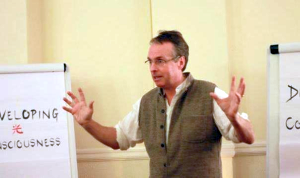
 Attending the introductory 'Developing Consciousness Course'.
The eight week course is an introduction to Christianity from a contemplative perspective and includes a review of the nature of consciousness, the part that our minds play in that, and how we each develop our own understanding of the nature of spirituality. In 2012 we are running three courses throughout the year and I have now written a book of the material we use; Developing Consciousness – A Roadmap of the Journey to Enlightenment.
Coming along to one of our conferences.
We hold three or four conferences every year. In 2011 we hosted Robert Beckford, Dave Tomlinson, Jesuit Priest Robert Kennedy and the Merton scholar James Finley. About 100 attend each event.
Being a part of our Soul Brothers' Men's Group.
About 40 men participate in this. Three small groups meet monthly and, every two months, there is a big meeting on a specific topic. This year we have covered: Men and Sex, Men and Money, Men and Power. We are linked into Richard Rohr's Rites of Passage initiative.
Joining our informal communion for non-churchgoers.
More recently we have decided to create this event specifically for people who have a more contemplative perspective. The informal communion for non-churchgoers happens once a month at the moment, however we hope to go weekly next year.
About 30 people range around one huge long table and we begin with everyone drumming for about five minutes before going into silence. This is followed by the Collect for purity and the Lord's Prayer. From there the pattern changes monthly. There is a theme – such as fertility, resurrection or connection – and what happens depends on that theme; we might have a guided meditation, some chanting, or a reflection. There is always a Scripture reading, a short homily, and a chance for anyone to respond.
We then move into a communion based upon the story of the Christ through scripture that culminates in everyone moving to the table and offering each other the bread and the wine across six stations. We end with a meditation as three flaming torches are lit.
Finally, as a response to the communion, we enable people to talk about their own projects and enrol others in their ideas over coffee. So far the events are well attended, and we are looking forward to a community developing that could form a new type of church.
 St Augustine's Church pioneered the
  Once in contact with the Centre, individuals can connect with the Christian community through our many expressions of worship, spiritual practice and community life: Ambient Wonder (alternative worship community), weekly Christian Meditation group, learning events, Sunday morning services, small groups meeting in people's homes and local community projects.
 The problem is that churches today are finding it difficult to find a niche within contemporary society. What we see as part of the solution is that many such churches fit naturally into some part of the contemplative tradition and there is a hunger in contemporary society for 'spirituality' or the cultivation of a sensitive and rewarding relationship with eternal truth and love. These churches could institute local Christian Meditation Centres to teach the contemplative tradition, and so appeal to those in search of spirituality. In support of that vision, a book is about to be published which includes all the contents of the Developing Consciousness course.