
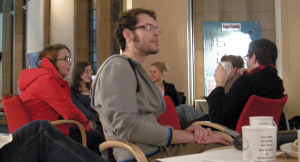
Matt Ward, Anglican chaplain at the Universities' Chaplaincy in Leeds, also oversees Emmanuel Café Church there. He explores why the Café Church is inspiring young adults to consider their vocation.
Last summer I attended the ordination service of a former member of Emmanuel Café Church and I am looking forward to going to another this year. Two previous Café Churchgoers are also currently in training and at least two more are actively exploring vocation to ordained ministry.
We're a small community which has been worshipping together for nine years, based in the chaplaincy at Leeds University and meeting every Sunday during term time at Claire Chapel, Emmanuel Centre. In many ways we're fragile, losing a significant number of our community each year as they graduate and move on. How have we managed to end up regularly seeing young people going forward for ordination? It wasn't something that we set out to achieve but it has certainly become part of our story.
I think that it is quite simple. It's all about encouraging people.
 Looking back, there are probably four things that we have done which are important in encouraging people to think about vocation – and although I started by talking about ordinations it's important to think of vocation in the widest possible sense. It starts with recognising that we all have a vocation to be disciples, to be growing in our faith and working out how to live that – whatever the career path.
So what are the four things we have been doing? Basically, we have encouraged people:
to be involved
If you come to cafechurch you are part of our community, and if you're part of our community we want you to be involved. Some people have come for the first time and the next week have been taking an active part in leading the session. Others take a bit longer to feel that confident but are drawn into discussions and reflections. What's key is that people are gaining experience and discovering what leadership might be like. We also benefit from learning from each other and regularly experiencing different styles of leadership.
by listening to them
In many ways the joy of being a small community is that you can get to know people really well, but the key to that is giving time to people and listening to them. It is about discovering who people are, what excites them, what worries them, what their hopes and aspirations might be. Above all, it's about taking people seriously. When you do that, you begin to know when something is a real possibility or simply a wild dream.
by challenging them
 As you get to know people, as you pray for them and see them become part of the community, you sometimes get a sense that you need to ask a sharp question. It's important to be bold with that. That question at times has been, 'Have you thought about ordination?' And sometimes you have to ask the question more than once and, as you ask it, equip people to listen for the answer from God via others around them.
by creating an atmosphere that allows vocation to be seen as normal
If you have never met anyone who has sailed round the world, the thought of doing so is almost too much to comprehend, but – if you've spent time with people who sailed round the world – it suddenly becomes less extraordinary. I think that the same is true around Café Church. If you never meet anyone like you who has thought about being ordained then it seems like a strange thing to consider, but when it's just one of a whole range of things that is mentioned when we're talking about vocation then it's not so weird.
We talk about vocation in a very ordinary, matter of fact way. We talk about it in a wide range of contexts and with a sense that it might have a wide range of out-workings for people. As we've done that over the past few years we have been privileged to see people respond to God and move on in their lives following him.

 There's quite a mix of people who have previously been part of a church and others who have never had any links with church at all. Most of those without any church background come through conversations I have around the university, not necessarily when I'm working on Café Church.
 Other people may not see it that way because, as everywhere, resources and money is tight and I am often asked about numbers and finance and so on. That's the really difficult thing for me; namely how we actually make sense of 'measuring' things. We are in a culture that measures everything so it's no surprise that we are questioned about things like, 'How much giving do you generate?'
 As part of encouraging them in discipleship, everyone shares in the leading of Café Church. By the end of a year everyone will have taken a lead at some point, it's a very deliberate thing. They are all capable of doing it and sometimes people really surprise you by what they bring. It's important that we are aware of each other's needs and those of the community around us but it is also good to remember that we are part of the wider Anglican Church. There is a reason why we have a lectionary, and some of that is really valuable for us.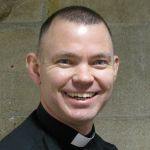
 A fresh expression of church that is 'fuelled by coffee'… Matt Ward, a chaplain at the University of Leeds, takes us behind the scenes at Emmanuel Café Church.
 Café Church operates in 10-week bursts during term-time. Obviously, as we operate in a university environment, we always miss the major festivals. That's a bit of a challenge for a church community… but there are still ways to celebrate 'together', even when we're not in the same place at the same time.
 Every year has seen quite a sense of growth in the life of the church, and in the lives of those who have come and found faith or confidence in their faith. My hope for the future is that Café Church continues to be shaped in a way that serves the needs of the students who come in and reaches out to students who don't. If it looks the same in 12 months as it does now, it won't be doing that.