
Heather Cracknell is developing community, and a fresh expression of church, at Round House Park near Norwich. She gives an update on the work so far.
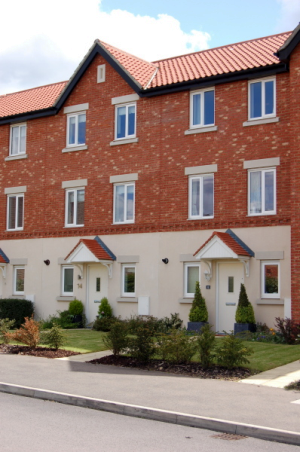
Launched in 2007, the Round House Park housing development – with planning for 1,065 homes – sits on the outskirts of Norwich at Cringleford.
In 2011, the Diocese of Norwich commissioned newly-trained Pioneer Curate Heather Cracknell to live and work in Round House Park. Heather was the first Pioneer Minister trained by the Diocese of Norwich and her remit was to go beyond the existing Christian community and create new communities: fresh expressions of church.
Heather explains,
We wanted to work out what fresh expressions of church might look like in a new housing area, because it’s clear that these new housing developments often don't relate that well to the established community or village that they are adjacent to.
Most of the people moving onto the new housing are younger, they don't have connections with the church to start with, they are not geographically moving into the parish in the same way as you would be if you were moving into a village… so that is why I was placed here.
 Being so close to the A11, the Norwich Research Park, and the Norwich and Norfolk University Hospital, Round House Park has attracted a lot of professional people, young families and a diverse ethnic mix.
There is now a new Church of England school in the centre of the development as well as a recently opened community centre, but when Heather arrived there were no community spaces. Prominent in her dog collar, Heather is open and approachable but in the early days she found it difficult to get to know people simply because they were hard to find. People spent a lot of time in their cars driving off the estate for work, school and social activities.
Heather remembers,
I have a dog and I used to walk her around to try and meet people. But that is quite hard so I just started to chat to anyone I met, inviting them to my house for curry nights on a Friday and Saturday night.
At those curry evenings Heather would encourage her guests to consider other activities that they would like to do together. From these ideas she launched as many groups as she could, including a book club, culture club, a new parents’ group and one off events including wine tasting, a bake-off and summer picnics. Heather also established, and runs, a website called Cringleford Hub which acts as a local social networking site helping people meet one another and start new groups.
She says,
Because I'm motivated by wanting to share the Good News and for the church to connect with people, the question that popped into my head really early on was: 'what does it mean to live well in Cringleford?' Part of living well is living in community, being creative together and eating together. Everything I am seeking to do is about living well and how do we go a bit deeper in life.
 Heather is keen to nurture creativity within the community. Last Christmas the Culture Club undertook a yarn bombing project, creating pompom garlands and draping them around public places to say Happy Christmas. In October, Heather put together a community art day producing attractive communal art pieces that now adorn the school walls.
It was just brilliant,
she says,
That is one of the most satisfying things I have done… literally bringing old and young, families and singles, everyone came together, we did something creative and we created all this art work from spare materials.
Heather's time is also spent within St Peter's, Cringleford, but her calling as a Pioneer Minister is to the unchurched – the growing populace who have never entered a church.
She explains her role to the congregation at St Peter's by saying,
We can be as warm and welcoming as we like but if those people come into our service they are going to have absolutely no idea what's going on. We may as well be speaking Swahili! The environment is so alien to them. So we can't sit here waiting for them.
The church's role should be to provide a place where people feel welcomed, accepted, loved and included. So this is the church serving its community by creating places for people to meet one another, and feel included and safe, and welcomed and have a part to play.
There is a hunger for connectedness with your neighbours, people do want community spirit, they don't necessarily know how to go about that, and particularly because there hasn't been any physical building in which to do that, so they have got on board really quickly when there is a catalyst. I think what the church has been and what I've been is a catalyst, a bit like the yeast – all of the ingredients were there, it just needed the catalyst to bring it to life.
 And as relationships have developed, conversations about faith and spirituality are naturally happening. Heather has run a 'Puzzling Questions' course and the Church of England's Pilgrim Course as people expressed intrigued in the Christian faith and wanted to start to explore it. In March, a fortnightly worship event was launched in the local school, which includes a meal together.
Heather says,
I've been here two-and-a-half years and we've just now got to the point where there is a core group of people who are wanting to do church – they don't really know what that looks like and they don't really know what that will be, and they've got young children. We are meeting on a Sunday afternoon, an informal environment with lots of different activities and ways to respond to God.
The Diocese of Norwich has given Heather five years to work on the Round House Park development. Her aim is to open a social enterprise community café, generating profits in order to fund sustainable community activities and events. Her main frustration has been that it has taken longer than she thought to set it up; but retains a passion to serve the community and get others involved.
She adds,
I really feel that God is at work here and all I have to try and do is join in, and join in in a way that is loving my community, loving the people that I meet and also giving people a way that they can join in too.
(This article, written by Jenny Seal, was first published on the Network Norfolk website)
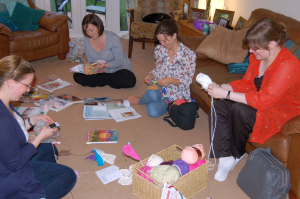
 I have been here for just over 20 months and, in that time, my priority has simply been to get to know as many people as possible. I started by having regular curry nights at my house and, from that, people would suggest different things we might do. This led to 'Stitch and Yarn' which involves people coming together for crochet, knitting or some sort of stitch craft; a cup of tea and a lot of chat. We've also had quizzes, running sessions, picnics and even a 'bake-off' around the kitchens of Roundhouse Park. We are trying to offer as diverse a range of activities as we can but we are still in quite an exploratory phase.
 The café would not only provide a physical focus for activities but, from the very start, be a spiritual hub. For us it's very important that Christian contemplative prayer and prayer stations of some sort would be 'built into' the rhythm of all activities there to give people the chance to explore Christian spirituality in a very familiar setting. It would be part and parcel of what's available and should beg the questions, 'What does it mean to live well? What would that mean to a community of people exploring faith together, meeting in a café space or school?'
 As a giving, supporting, encouraging new community of faith is formed at Roundhouse; that will be 'proper church' too.