
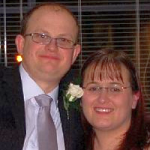
 Jackie Davies explains what fresh expressions of church means to her.
I've been going to church for as long as I can remember (I'm 35), and I now work as Children and Families Worker with Altrincham Methodist Circuit, so church has been, and is, a large part of my life. However, I've never really felt that traditional church services met my need to question things and look beyond what other people told me.
I first went to Café Sundae – held at Timperley Methodist Church – to support the Café's volunteer leader, Will Sudworth. I knew it was aimed at teenagers and assumed it would be painfully 'cool' and prepared myself for a long night. I couldn't have been more surprised at how much I enjoyed it. I loved the informal set up, and any church service where you can eat sweets and drink milkshakes gets my vote.
So after a good start it just got better. Film clips and vox pops kept me interested and engaged in a way I will admit that a sermon often doesn't. I enjoyed the table games because I got to talk to people at church about real issues rather than just saying hello and goodbye. However, the table debates were my favourite part of the evening – at last the chance to talk in church, to play an active rather than a passive role. I was so grateful for the chance to discuss issues that interested me in the context of my faith – I could have kissed the Café Sundae team for that! The mix of people at Café Sundae also resulted in me getting an insight into the views of a variety of ages and backgrounds.
Having enjoyed Café Sundae so much I was really excited when Will told me about Diversity Space. Although I was loving Café Sundae and pretending to be 14 again, I was also looking forward to talking about issues with over 18s.
Diversity Space has the same relaxed and informal feel as Café Sundae, but meeting in a local licensed coffee shop means we can have a glass of wine with our discussion too! Diversity Space offers a wonderful opportunity for us to talk about emotive and controversial issues in a safe environment where each of us has the chance to give our opinions without being judged.
I can also talk about my faith if I want to, but I don't feel pressured to have a particular opinion. It's also a space to bring friends without them feeling uncomfortable. In fact, I took my husband Matthew and two friends to the last one – I should get some sort of award!

 Malcolm Herbert asks what life looks like after mixed economy.
 Ned Lunn wants to help new leaders take centre stage.
 Lorna Koskela sees hope in the midst of the storm.
 John Bowen discusses lasting networks of encouragement in Canada.
 Kate Bradsen shares a story of restoration in Tucson, Arizona.
 Jackie Bellfield asks what the relationship between membership and discipleship is.
 Michael Volland states that new times call for new ways of being church.
 Tony Cant warns not to lose sight of the wood for the trees.
 Now, while the bark is where the growth is, it can't exist without the wood of the tree that has formed the trunk throughout the whole life of the tree. The bark and the wood need each other to become a living tree. We, as a fresh expression of church, need the structure of the traditional church/CofE to support us while we grow some new wood at the edge of the tree. But if we are cut off from the tree, the tree might stand for a while longer but the life will be gone – you can see where the metaphor goes.
 Will Sudworth reflects on how the mighty fall – and why some churches never give in.