
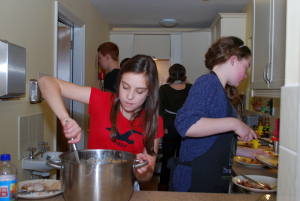
Katharine Crowsley tells how a 'mixing bowl of prayer' has helped to develop Cook@Chapel.
Over the past four years Cook@Chapel has grown and evolved as a fresh expression of church. The group of young people meets once a week to cook together, pray together and share a meal. By sharing food, hospitality and worship these young people can develop and deepen their faith – and build a small missional community.
Our prayer life of Cook@Chapel has developed very quickly from a grace said at the start of the shared meal to a time of prayer that takes place every week and forms a central focus to our meeting. The young people like to use a kitchen mixing bowl that we place written prayers into; we then pass the bowl around, stirring the prayers and reading them out in turn.
 Prayers are for all sorts of issues, from international concerns to the local, for family, friends and each other. This is called the 'Mixing Bowl of Prayer' and we realised the young people wanted to use this way of praying more frequently when the mixing bowl was brought out for prayers week after week. It has formed a prayer liturgy for the community which works and gives a good example of how the prayer life of the group has evolved naturally.
Over the past 18 months, the numbers of people attending has steadily increased as the turnover rate has decreased. This means that the group of young people attending has gradually stabilised. Before this period, people would join the group for a few months, or maybe a year, and then move on – whereas now they stay. As a result, the community has become more cohesive as faith has grown and worship has developed.
This change has been a positive one which, in turn, has raised many questions, including, 'how do we cope with the increase in numbers?' and 'how do we effectively disciple those who are new to the Christian faith, especially if Cook@Chapel is their only contact with church?'
 Recruiting new volunteers to help when we meet on Friday nights is something that works with the increasing numbers in the short term but the longer-term aim is to encourage young leaders from within Cook@Chapel itself. This will ultimately be more sustainable for Cook@Chapel's future and means that the young people will be involved in leading and guiding the development of Cook@Chapel.
Cook@Chapel is made up of some people with quite a deep Christian faith and others relatively new to faith. Providing opportunities for discipleship needs to occur in both an informal and formal way. Future developments will include the more structured option of deepening and developing faith through a taught course, whilst informal discipling will continue through the conversations that occur whilst preparing food or sitting around the table. Most importantly however is the discipleship that happens while journeying alongside people, developing our faith as we go.
Cook@Chapel was recently been involved in fundraising for an education project in Ghana and we cooked a safari supper to raise some money. The young people prepared a traditional meal of spicy chicken, rice and peas and the whole event was very successful – especially as it gave those at Cook@Chapel a chance to showcase their cookery skills to a wider 'audience'.
 As Cook@Chapel moves towards the start of its fifth year, other plans include a possible allotment where we can grow our own vegetables to cook for our fellowship meal. This is very much in the planning stage at present but would allow us to become more sustainable and to think more about where our food comes from. Love and care for God's creation has been an important part of Cook@Chapel's philosophy right from the start, so the allotment development would encourage stewardship of the earth's resources and the opportunity to work together as a community.
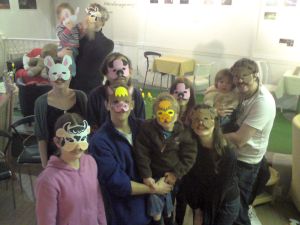
 We still seem to have a core of eight to 10 people at Sanctus1 and there is a lot of come and go but that is the nature of the generation we serve. As part of the changing pattern since the community first got off the ground, we now offer Sanctus on Sundays because the young professionals who first came to us now have children of their own. They were telling us, 'Wednesday night used to work for us as a meeting time but it doesn't any more.' So we decided to launch on a Sunday morning and meet at Nexus for a 10.45am start followed by lunch at 12. What goes around comes around! Basically what we do is a repeat of the Wednesday material but we also have a crate of toys and a little bit of interaction with the kids. The ongoing challenge will be to offer something for those children as they move on from the baby and toddler stage.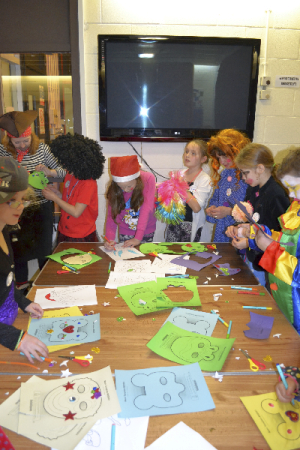
 Grafted manages and supports this much needed work and is also looking to the future with the development of a new drop-in at Newcastleton. This would be for people living with a variety of needs, including loneliness, depression and addictions. As the vision grows, we are working hard to develop relationships with churches in the surrounding Borders area to provide hope for those without hope.
 One of the elements is the No 8 Club which we run as a local authority youth venue, in agreement with the local council authority. Many of the No 8 young people also attend Refresh Community Church, a fresh expression of church which uses the same venue fortnightly on Tuesday evenings and meets in homes at small groups every other week.
 Those who come to Refresh wouldn't normally go to the parish church; we are not trying to change that at all. Instead we want them to come in and recognise that we are the church.
 It's a balancing act because the traditional churches we are involved with are quite happy that we are available for them but I am trying to resist any Idea that we want to take everything over on their behalf. I still keep in mind that my aim is to build community in Newcastleton and step up to Grafted2.