
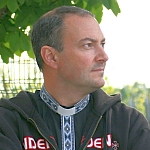
 Pete Hillman is asking for the skills for us to be entrepreneurs.
We are living through a period of great social upheaval where the church is being asked to engage with the government's Big Society initiative as one of the parts of the community best placed to bring this vision to fruition. We will leave aside the rights and wrongs of this strategy for now. Instead I want to reflect on what training and development should be provided by institutions preparing people for public ministry – and especially ministry in the context of fresh expressions.
The Legacy XS Youth Centre and Skatepark, including the Legacy XS youth congregation, opened its doors to the public in Benfleet six years ago. It is developed and run by a very small team of volunteers and a core group of paid staff. To this extent I think Legacy could be seen as being a prime example of what the Prime Minister would like to see in action throughout every community in the UK. Our youth work provision in the community has grown to outstrip that of the County Youth Service in our borough and is able to deliver this at a fraction of the cost. As such, Legacy is studied as an example of social entrepreneurship in the local specialist Business and Enterprise College.
I have no doubt that the vital role of service provision to the community is one that has always been central to the church's mission to the world. It might perhaps be argued that its loss, through the increasing march of the welfare state, has left the church without a sense of purpose and led to our maintenance models of church life.
But if my assessment of the situation is correct and the church is being called into a much more social entrepreneurial role in this generation, one of the most urgent questions centres on what skills are needed for stepping into this role in the community? We are all aware that finance is an ongoing challenge in any new initiative and so I would argue that – as well as the core skills of pastoral care, Ministry of Word and Sacraments and whichever other things we would wish to see included – we must add to the list some skills essential for the creation of income and the successful operation of a well-run organisation.
For example, I am certain that theological college or course syllabuses, and indeed Continuing Ministerial Development programmes, should provide training on writing a business plan and professional presentation skills – not merely 'How to use PowerPoint', but how to ensure well-produced printed documents and the means of best presenting key financial information to lay people or decision makers. There must be workshops on how to complete funding applications, something which would seem to be applicable to those running fresh or traditional expressions of church. Modules covering the creation and management of budgets, providing models and software tools would also be very useful.
Then, of course, there are the more specialist yet generally applicable things such as how to set up a charity and Health and Safety at Work, including risk assessments, safe systems of work and first aid provision. The wider church is seen to be doing reasonably well now in tackling such issues as child protection, but in many of the other areas I have mentioned, our knowledge is woefully inadequate. Anyone who is going to engage in entrepreneurial activity, and I firmly believe that all churches taking the area of mission seriously should be, will need at least an understanding of some of these issues – even if it's just where they can go to obtain advice and support.
I am sure that anyone trying to put together a training programme will ask where the space is to be found in the curriculum for such things, and this is a valid question. However, I have to say that without space being found for their inclusion I am unsure that we will be able to maintain the existing contexts in which we minister – let alone create new initiatives. There seems little doubt that if we are going to see genuinely creative initiatives breaking out across the church in the context of the communities we serve, then pioneers with an entrepreneurial flare, equipped with the technical skills to develop these projects, are going to be essential. As the church, we need to be celebrating the success of these projects as well as making practical provision for the equipping of such individuals – be they lay or ordained.
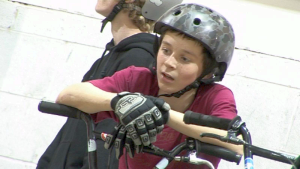

 And skateboarding sometimes forms part of the worship.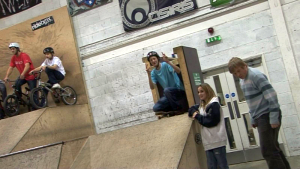
 Church of England Legacy XS youth centre in Benfleet, Essex, grew out of a small youth group meeting in a vicarage in 2001.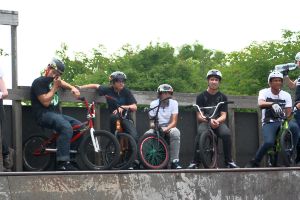
 This story illustrates the pinciples of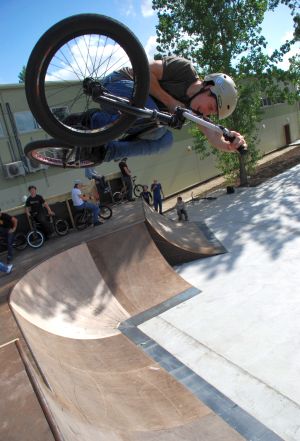
 Legacy XS offers, among other things, indoor and outdoor skate parks, a recording studio, arts suite… and a youth congregation. Leader Pete Hillman gives the lowdown on its work in Essex.
 We decided to reduce the hours we were open to the public and instead of running our midweek sessions on a commercial basis we instead now operate them as cell groups organised by our team of youth workers. That has been running quite successfully on Tuesday evenings for young people from Year 4/5 up to Year 7.
 The Legacy XS youth congregation itself has been much quieter and has shrunk down to a maximum of 20 people. How many of them are moving on in faith? Not many that we know of to be honest. It's better to tell the truth and say it is really, really hard to develop the youth congregation. The fact is that the measure of success and failure in God's economy is quite different. That may make it sound as if we are trying to cover ourselves but that's what we believe. All we say is that it's our job to put Jesus at the centre of what we do, for some young people that will be enough for now because maybe the time isn't yet right for them.
 You really have to be an entrepreneur if you are going to be doing radical stuff; that can be seen in things like taking risks and being a bit creative about the way you describe what's happening and what you can offer. It's about being as wise as serpents and a bit shrewd about things.